Resin bound aggregate is a surfacing system in which every stone is fully coated in a clear resin, then trowelled out on site as a single seamless layer. The coated stones lock together with voids between them, so the finished surface is permeable and water drains straight through.
What is resin bound aggregate, and how does the system work?
Resin bound aggregate is a surfacing system built from two things: graded stone and a clear resin binder. Every particle of stone is mixed until it is fully coated in resin, and the coated mix is then trowelled out on site over a prepared base.
Because each stone is coated all round, the stones bond to one another at their contact points and leave the spaces between them open. The result is a single seamless layer with a stone face and a connected void structure running through it.
We supply and install Addagrip's Addaset system. The aggregate choice drives the appearance - colour, particle size, whether the surface reads warm or grey - and the resin stays clear, so what you see is stone rather than pigment.
How is resin bound paving installed?
It is a wet trade with a short working window. Stone and resin are forced-action mixed in measured batches, poured out, spread, then hand-trowelled to level before the resin begins to go off.
The base matters more than the surface. Resin bound aggregate is laid over sound asphalt or concrete, and any settlement, cracking or fall problem in that base will report through to the finish. Falls, drainage outlets and edge restraints are designed before the first batch is mixed.
Edges are the detail people underestimate. The layer needs a restraint - a kerb, a metal edging, a channel - because an unrestrained edge is where a resin bound surface tends to start failing.
The finish comes off the trowel, so continuity across a large area depends on crew discipline and batch consistency. Our applicators are on our own payroll rather than subcontracted, which is how a promenade reads as one surface rather than as a series of days' work.
Why is resin bound surfacing permeable?
Permeability comes from geometry, not from an additive. Because the stones are coated and bonded only where they touch, the voids between them stay open and connected from the surface down through the layer.
Water passes through those voids instead of running across the top, which is why resin bound paving is specified where surface water has to be managed rather than channelled. The build-up beneath it has to be permeable too, or the water simply meets a sealed layer lower down.
In the Gulf that matters for irrigation and wash-down water around planting and on landscaped promenades as much as for rainfall. The detailing is covered in resin bound permeable drainage.
Where is resin bound aggregate used?
Pedestrian and light-traffic surfaces: promenades, park paths, plazas, courtyards, hotel grounds, driveways, tree pits, and the transitions between planting and paving.
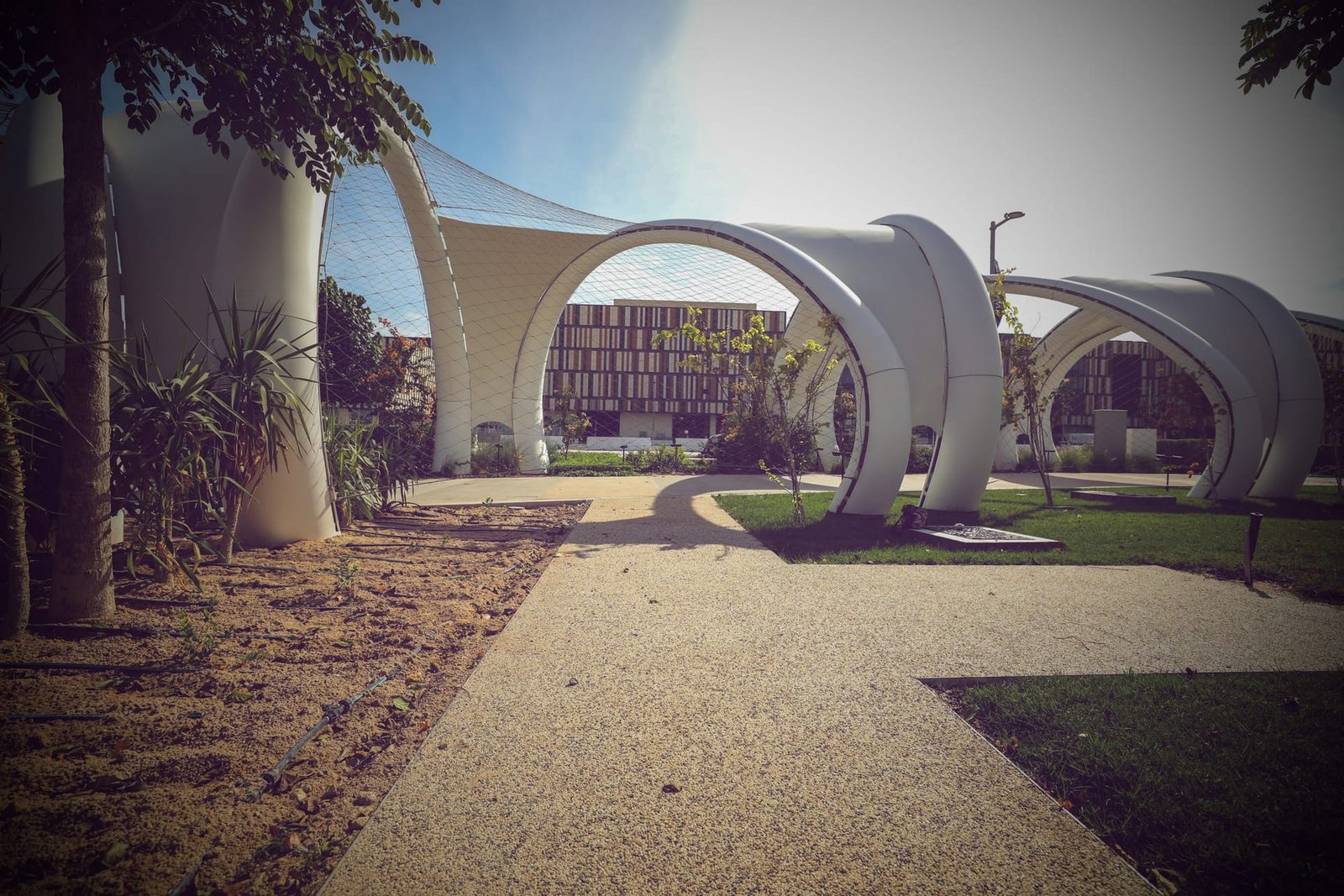
We installed Addaset resin bound aggregate as the promenade paving at Lusail Boulevard in Qatar. A promenade is a fair test of the system: long continuous runs, no joints to interrupt the walk, and planting and drainage details cutting through it.
It suits tree pits and root zones because water and air reach the soil through the surface, and it suits routes where a seamless surface is easier to walk on and to clean than unit paving. More completed work is on the projects page.
How does resin bound surfacing behave in Gulf heat and sunlight?
Resin systems outdoors are sensitive to two things: ultraviolet light and thermal movement. UV-stable resins are the reason a surface holds its colour rather than yellowing, and that is decided in the resin specification rather than in the aggregate.
Thermal movement is handled by the base and the joints within it. A resin bound layer follows its substrate, so movement joints in the concrete or asphalt below have to be carried up through the surface rather than covered over.
Aggregate colour also does real work in a hot climate, since lighter stone reflects more than dark stone. It is worth viewing samples outdoors in daylight rather than choosing from a chart. Long-term behaviour is covered in resin bound durability in the UAE.
Resin bound or resin bonded: what is the difference?
They sound alike and they are not the same. Resin bound aggregate mixes the stone through the resin and trowels the whole mix out, giving a smooth permeable layer. Resin bonded surfacing spreads resin onto the base and scatters loose stone onto it, giving a rougher, non-permeable surface with stone that can shed over time.
Neither substitutes for the other. If the brief calls for permeability and a smooth continuous walking surface, it is resin bound. If it calls for a coarse, high-grip finish on a slope, that is a different conversation. Resin bound vs resin bonded sets the two out side by side.
Specifying resin bound aggregate on a UAE project
The questions worth settling early are the base, the falls, the edges, the aggregate and the resin. Get those right and the surface is straightforward. Get the base wrong and no amount of care at the trowel stage will rescue it.
Send us the landscape drawings, the areas and the programme, and we will come back on build-up, aggregate options and sequencing. Use the enquiry form, or message us on WhatsApp at +971 50 136 0506.
Earth Layers supplies and installs Addaset resin bound aggregate from Dubai Industrial City, with our own crews working across the UAE and the wider Gulf. Wellness, in Every Surface.