
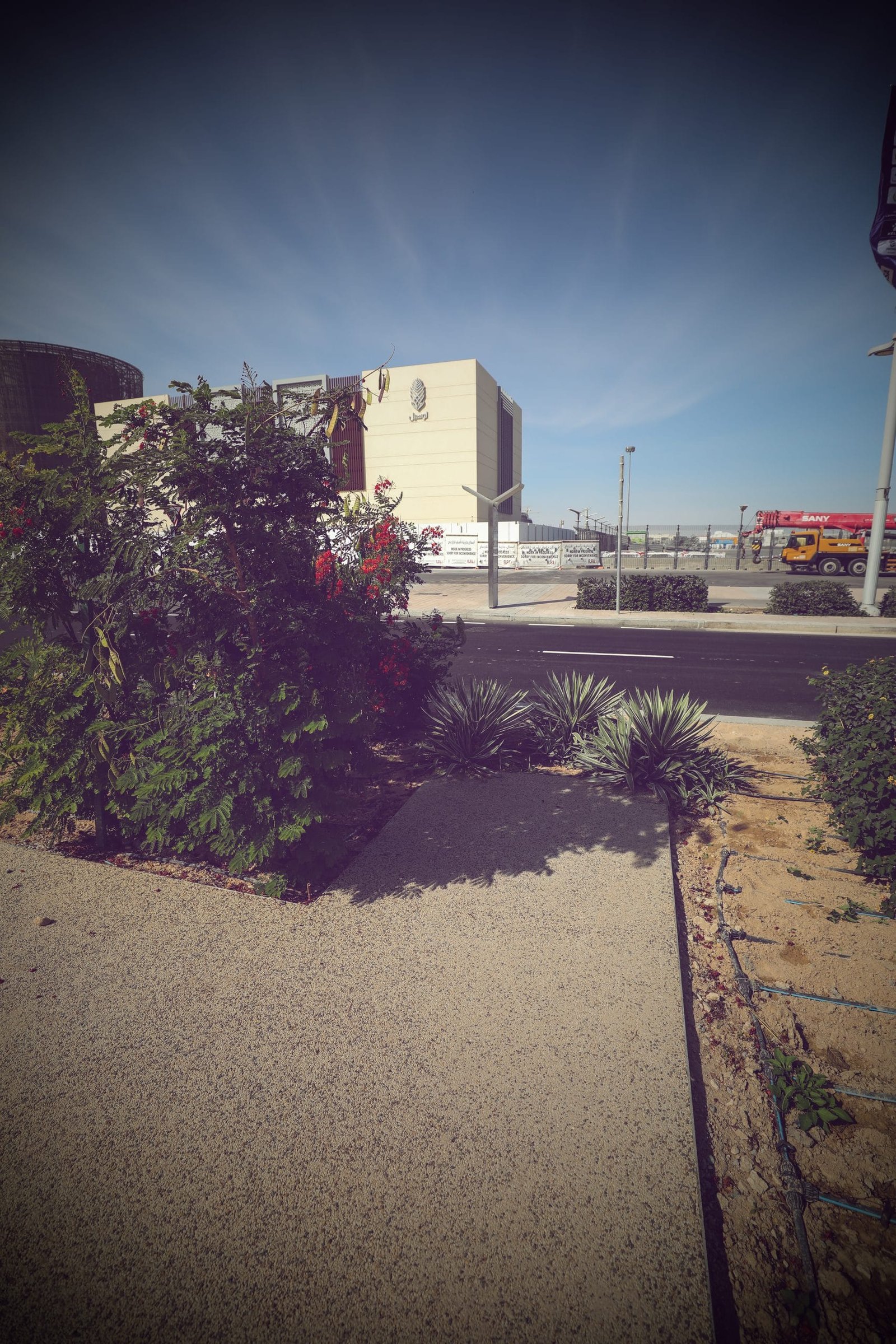
Yes. Resin bound aggregate is permeable: the stones are coated and locked together but not filled solid, so voids run through the full depth and water drains straight through into the base beneath. Permeability is only useful if the sub-base and subgrade can accept or route that water.
Is resin bound aggregate permeable?
Yes. A resin bound surface is porous by construction. The stone is coated with resin and compacted, but the mix is never filled solid, so a network of interconnected voids runs from the surface down to the base.
That is the structural difference from resin bonded gravel, where a continuous adhesive layer seals the base and water can only run off it. If the two are still blurred in your mind, our guide to resin bound vs resin bonded sets them side by side.
The caveat is important: permeability belongs to the whole build-up, not to the top layer alone. A permeable surface laid over a sealed base is a shallow bath. Water has to have somewhere to go once it is through.
How does water pass through the matrix?
Grading does most of the work. The aggregate is dried and screened to a narrow size band, so when the stones pack together the gaps between them stay open instead of being filled by fines.
The resin coats each particle and glues them at their contact points. It does not flood the voids. Rain landing on the surface finds those openings within a few millimetres and drops through the depth of the layer under gravity.
Real infiltration depends on aggregate size, layer depth, how accurately the mix was gauged and how clean the surface is kept. Treat any published rate as a laboratory starting point, then design the layers beneath to match the intent rather than the brochure.
What does the sub-base have to do?
A permeable sub-base has two jobs: carry the load and either pass or hold the water. Open-graded crushed stone, porous concrete and porous asphalt are used for this. A dense, closed base is not.
Below that, the subgrade decides the strategy. Where the ground accepts water at a workable rate, the system can infiltrate directly. Where it does not, because groundwater is shallow, the ground is salt-affected or the subgrade softens when wet, the designer will normally tank the build-up and take a controlled outfall to the drainage network.
This is a civil engineering decision rather than a surfacing one, and it is far cheaper to settle before the surface is specified. We would rather see the drainage strategy at drawing stage than be asked to make a permeable finish behave like a sealed one once the base is already in the ground.
Where does permeable paving fit in a surface water strategy?
Permeable paving is one of the standard tools in sustainable drainage, SUDS paving in shorthand, because it deals with rainfall where it lands instead of collecting it and moving it somewhere else at speed.
Three things follow. Peak flows into the network are reduced and delayed. The surface itself needs fewer gullies, channels and crossfalls. And silt and hydrocarbons are partly held in the layers rather than washed straight to an outfall.
For landscape design, the practical gain is level. A permeable surface can run flat from edge to edge without the falls a sealed surface needs, which matters in courtyards, plazas, entrance forecourts and accessible routes where a continuous plane reads better than a slope to a channel.
Does a permeable surface still need drainage design?
Yes. Permeable does not mean self-draining in all conditions, and treating it that way is how projects get into trouble.
Storms can arrive faster than any surface infiltrates. Thresholds, door lines and level changes still need detailing. Water that enters the build-up needs a route out, whether that is infiltration into the subgrade or a pipe. Behaviour during the storm that exceeds the design should be deliberate rather than discovered on the day.
Edge restraint matters as much as the middle. Metal or masonry edging holds the surface and controls where water leaves the build-up. Junctions with kerbs, gullies, tree pits and lawn all need drawing rather than improvising on site.
Why permeable paving matters in the UAE
Rain here is infrequent and then arrives in short, heavy bursts. That is precisely the pattern that overwhelms a sealed surface: everything falls at once, runs off at once, and ponds wherever the falls were slightly imperfect.
A permeable build-up takes part of that event out of the runoff and buys the network time. It also avoids the standing water that makes a handsome flat courtyard unusable for two days afterwards.
There is a second, quieter benefit in Gulf landscapes. Irrigation and washdown water reaches the ground instead of running to a gully, which suits tree pits, planting beds and the paving strips between them. At Lusail Boulevard the Addaset surface runs directly up to planting along the promenade.
Will it clog with sand and silt?
It will slow down if it is neglected. Blown sand, leaf litter and construction fines settle into the surface texture and gradually blind the voids. This is the normal maintenance mechanism for every permeable surface, not a defect peculiar to resin.
The counter is routine and undramatic: regular sweeping or vacuum sweeping, keeping soil and mulch from washing across the paving, and periodic washing with a wide fan pattern at moderate pressure held well back from the surface.
Where a surface has been left for years, a specialist clean will usually recover a good part of the infiltration. Our notes on durability and maintenance in the UAE go through the cleaning routine in more detail.
Specifying permeable resin bound paving with Earth Layers
Earth Layers supplies and installs Addagrip Addaset resin-bound aggregate across the UAE, with our own artisans on payroll rather than subcontracted crews, and we are the exclusive Middle East distributor for the materials we install. If the material is new to you, start with what resin bound aggregate is.
The useful conversation happens early. Base build-up, infiltration or attenuation, edge details, thresholds and aggregate choice all interact, and they are much cheaper to resolve on paper than on site. Aggregate blends can be seen and handled alongside our other materials.
Send drawings, levels and your drainage intent through enquire, or message the UAE team on WhatsApp +971 50 136 0506, and we will come back with a build-up we can stand behind.