Earth Layers builds in-situ rammed earth in Sharjah. At Kalba Beach we rammed stabilised earth walls for Shurooq, the Sharjah Investment and Development Authority, metres from the Gulf of Oman — graded soil moistened to a precise water content, compacted in lifts between engineered formwork, and accepted against a 28-day compressive strength of at least 8 MPa.
A rammed earth wall on the Sharjah shoreline
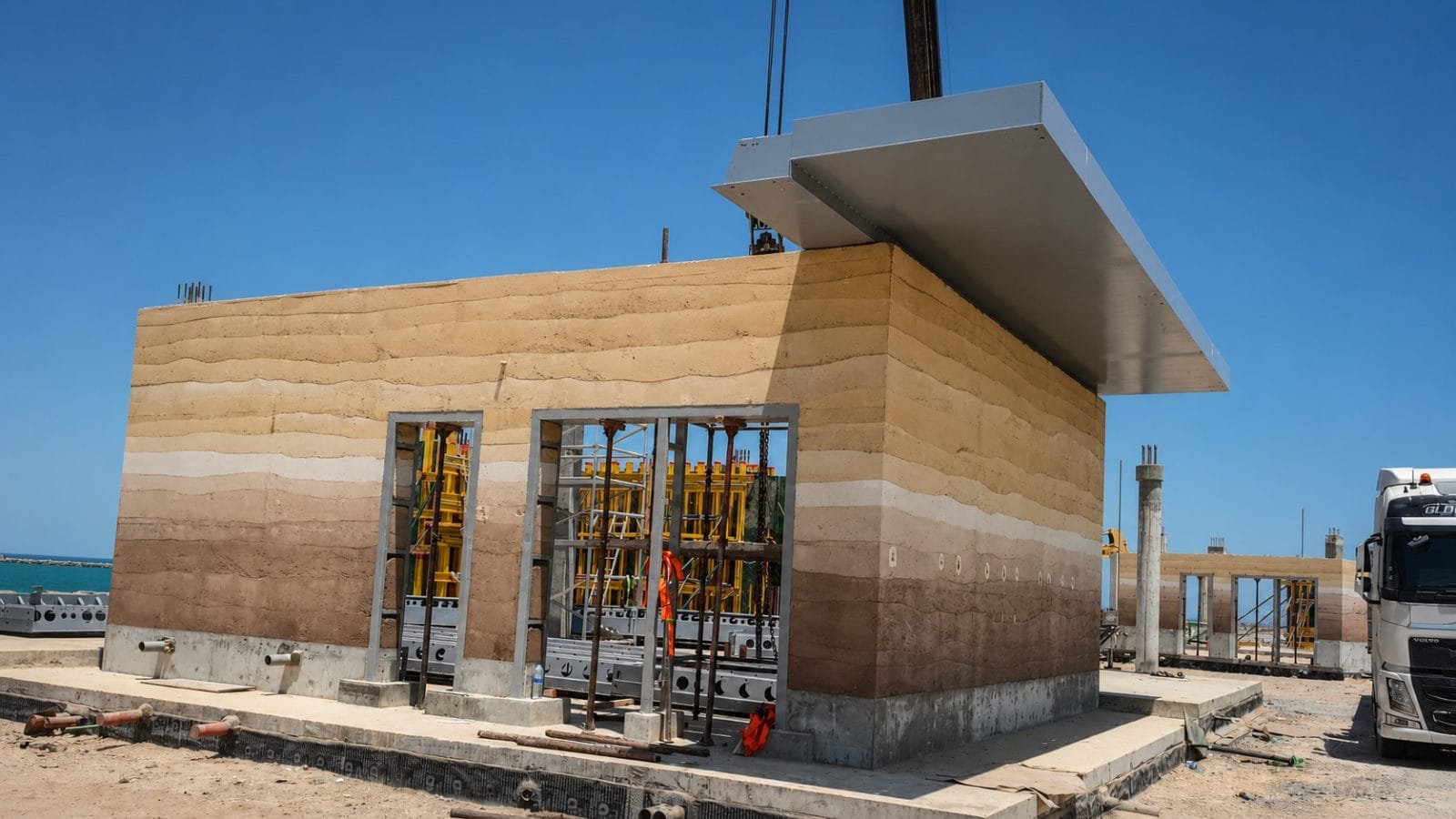
Most enquiries about rammed earth in Sharjah begin the same way: can a wall made of compacted earth stand this close to the sea. At Kalba Beach it does. We built in-situ stabilised rammed earth there for Shurooq, the Sharjah Investment and Development Authority, on a public-realm beachfront site metres from the Gulf of Oman, and the roof slab was craned onto the completed walls once they carried their own load.
Sharjah is unusual among the emirates in holding land on both coasts — the Arabian Gulf on one side of the peninsula and the Gulf of Oman on the other. Kalba sits on the eastern shore, backed by the Hajar mountains, and the site conditions there are not the conditions of an inland plot. That difference is the whole of this article.
What went up is in-situ rammed earth: graded soil moistened to a precise water content and compacted in horizontal lifts inside engineered formwork until the wall reaches strength. Nothing is applied over it. When the forms come off, the banding you see is a record of how the wall was made, one tamped lift at a time.
Stabilised or unstabilised, and why it changes the acceptance route
Rammed earth divides into two families, and the choice governs how the wall is tested rather than how it looks. Kalba Beach was built in the stabilised form.
Stabilised work is accepted on a 28-day unconfined compressive strength of at least 8 MPa — a hold point signed by the consultant, not a figure taken on trust. Unstabilised work follows NZS 4298, New Zealand's earth building standard, which asks for at least 1.3 MPa compressive strength and linear shrinkage under three per cent. Either way the structural engineer designs against a tested number, which is what separates engineered rammed earth from a decorative imitation of it.
The two also differ in geometry. An in-situ stabilised wall needs 17 cm of ramming clearance each side of an embedded column, so a 300 mm column puts the wall at 640 mm minimum; unstabilised needs 20 cm each side, giving at least 700 mm. Those numbers belong in the coordination model early, because they are not negotiable once the structure is set.
The mock-up governs the wall
The build follows four fixed stages, and skipping any of them is where rammed earth packages come unstuck. Trial sampling blocks fix the mix. A 2 x 2 m site mock-up with eleven bands is built and signed off before permanent works. Engineered shuttering is fabricated to the wall geometry. Then the crews ram, layer by layer, with acceptance testing running alongside rather than afterwards.
The mock-up does two jobs at once. It is the visual contract — colour, texture and band set-out are approved on that panel and nowhere else — and it is the engineer's test material. Aesthetic and structural sign-off happen on the same wall, weeks before anyone is standing in front of the real one.
Colour is decided lift by lift, by adjusting the mix between layers. A wall can hold one even tone or grade through bands of cream, taupe and terracotta, but the decision is made before ramming starts. There is no correcting a rammed earth wall afterwards with a coating; the surface is finished the moment it is built.
Detailing an earth wall within sight of the sea
Heat is not what threatens an earth wall. Persistent moisture is, and it arrives at two places: the head and the base. Protection at the top that keeps water off the wall, and separation at the bottom that stops ground moisture rising into it, are the two details that decide how the wall ages.
Coastal air on either side of the peninsula carries more moisture than the air over the interior, so on a shoreline site that detailing discipline matters more, not less. It does not make the method unsuitable — earth walls have stood in humid climates for centuries — but it does mean the copings, upstands and damp separation deserve the same attention as the mix design, and should be drawn rather than assumed.
One boundary is fixed regardless of location. Rammed earth is a wall system only. It suits monolithic walls inside and out, and it is never used for floors or in wet areas, because a wall that cannot be corrected after the event has no business in a shower.
The strata look without the structural wall
Not every project in Sharjah that wants the banding can carry a 640 mm wall, and not every interior needs one. For those cases we install Rammed Earth Finish by Clayworks, a 7-10 mm clay plaster that recreates the strata aesthetic on interior walls and ceilings. Earth Layers is Clayworks' sole authorised distributor and approved applicator across the Middle East.
Like every clay plaster, it belongs on interior walls and ceilings and never on floors or in direct-water zones. It is a breathable mineral surface with nothing to off-gas, and clay walls help hold a room between 40 and 60 per cent relative humidity. If you are weighing the wall against the plaster, we set the two side by side in rammed earth versus rammed earth plaster.
Working in Sharjah
The first question worth asking any rammed earth contractor in Sharjah is who actually rams the walls. At Earth Layers the artisans on the formwork are on our own payroll rather than subcontracted, and they are the same crews who built the UAE Pavilion at Expo 2023 Doha — a complete pavilion in in-situ rammed earth, awarded Gold for Best Self-Built Pavilion — and the guest buildings, mosque, minaret and boundary walls at Al Kaaban Resort.
We operate from Dubai Industrial City and supply and install across the Emirates, including Sharjah and its east coast. Procure the package as one supply-and-install appointment: one party that designs the mix, builds the forms, rams the lifts and stands behind the acceptance testing, so responsibility for the finished face does not split three ways. For budget guidance at concept stage, see what rammed earth costs in the UAE.
If you are considering rammed earth for a project in Sharjah, send us your finishes schedule or message us on WhatsApp at +971 50 136 0506. We will tell you honestly whether the wall, the plaster, or a mix of both is the right answer.