
Formwork sets the baseline for rammed earth price in Dubai
Ask what rammed earth costs in the UAE and the honest answer starts with formwork, not soil. In-situ rammed earth is rammed in lifts between forms, and that formwork behaves more like temporary engineering than joinery. It has to hold its line under sustained ramming pressure, lift after lift, without bowing or losing its edge.
Geometry decides how hard the formwork works. Long, straight runs let the same forms cycle along the wall, spreading their cost across many metres. Curves, tight corners, openings and stepped profiles each demand bespoke form pieces that may only be used once — which is why two walls of identical area can sit at very different points on a rammed earth budget.
Lifts and labour: paying for craft, not material
The mix itself is the humble part of the equation. What moves the rammed earth price in Dubai is the labour wrapped around it. Every lift is placed, compacted and checked before the next goes in, and the tamped lifts you read as strata in the finished wall are a literal record of that time.
At Earth Layers the artisans who ram the walls are on our own payroll rather than subcontracted, so crew productivity is something we plan, not something we hope for. Site access, working height and Gulf summer temperatures all feed into how many lifts a crew completes in a day — and therefore into your programme and your cost.
Height matters as much as length. Taller walls mean more lifts, more formwork cycles and slower work near the top, so a long low boundary wall and a short tall feature wall can carry similar areas but very different labour content.
Wall thickness and the structural brief
Thickness is a multiplier. A thicker wall takes more material, more lifts, heavier formwork and longer ramming, so every additional centimetre is felt across the whole package. The structural brief drives it: a load-bearing wall is a different proposition from a feature wall or a boundary wall, and each lands differently on the budget.
This is where early engineering conversations pay off. Settling what the wall must carry before the formwork is designed keeps thickness honest, and avoids paying structural money for a wall doing purely architectural work. Our structural guide to rammed earth walks through how those decisions are made.
Mock-ups and engineering acceptance
UAE consultants rightly want evidence before they sign off an earth wall. On our projects, acceptance testing works to 8 MPa, referencing New Zealand's earth building standards (NZS), and mock-ups let the design team approve colour, strata and texture before full production begins.
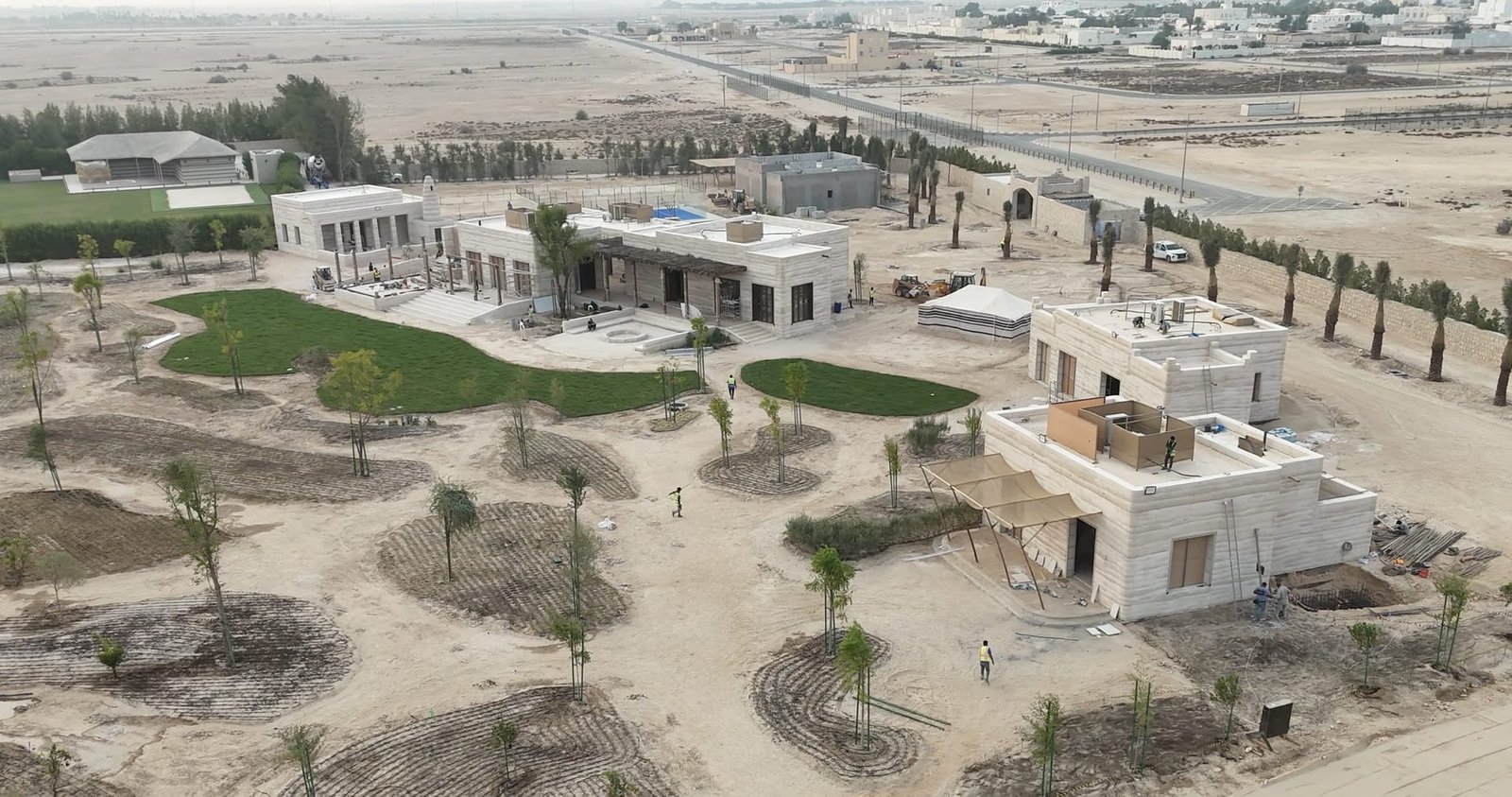
Mock-ups and testing are genuine line items, but they de-risk the job at exactly the point where changes are still easy. It is the same discipline behind the UAE Pavilion at Expo 2023 Doha — a complete pavilion in in-situ rammed earth built by our own crews — and the guest buildings, mosque and boundary walls at Al Kaaban Resort, all rammed in lifts on site.
When the rammed earth budget is tight: the plaster route
Not every project needs a structural wall to get the look. Rammed Earth Finish by Clayworks is a 7-10 mm clay plaster that recreates the strata banding on interior walls, applied by the same in-house artisans. Because it removes the formwork, the lifts and the structural engineering, it sits at an entirely different point on the budget.
As Clayworks' sole authorised distributor and approved applicator across the Middle East, we supply and install it ourselves. If you are weighing the two routes, our comparison of rammed earth versus rammed earth plaster sets out where each one makes sense.
What to send us for an accurate number
The fastest route to a real figure is a short list of documents rather than a long conversation. Elevations and plans showing wall lengths, heights and thicknesses let us work out formwork runs and lift counts, which is where most of the cost sits.
Tell us the exposure: internal, external, or a boundary wall taking full sun and occasional driven rain. Exposure drives the mix, the stabilisation decision and the detailing at head and base, and those change the number more than the square metre count does.
Programme matters as much as geometry. Rammed earth is formwork-led, so a wall that can be built in long uninterrupted runs prices differently from the same area broken into short panels around openings. Tell us when the structure is available and when the crew would need to be on site.
Finally, say whether a mock-up is required before approval, and whether you need acceptance testing documented — ours is to 8 MPa referencing New Zealand's earth building standards (NZS). Both are sensible on a significant wall, and both are easier to price in at the start than to add later. If the answer turns out to be an interior finish rather than a structural wall, we will say so — the comparison in rammed earth vs rammed earth plaster explains when that is the honest recommendation.
Send us your BOQ for engineered pricing in 48 hours
Because so much of the cost sits in formwork, geometry and engineering, generic figures mislead more than they help. A drawing set or bill of quantities lets us price the actual walls — their lengths, heights, thicknesses, corners and finish — rather than an average that fits no one.
Send your finishes schedule or BOQ and we will return engineered pricing within 48 hours, or message us on WhatsApp at +971 50 136 0506 to talk the scope through first.