
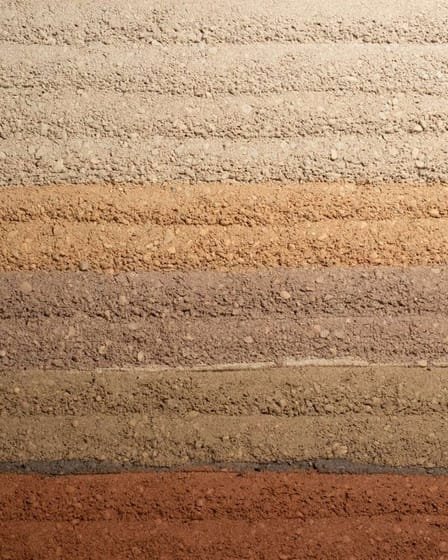
One look, two very different builds
Stand in front of a banded earth wall and it is not obvious whether you are looking at half a metre of compacted structure or ten millimetres of rammed earth plaster. The strata read the same. What sits behind them could not be more different, and the choice between in-situ rammed earth and the plastered version shapes cost, programme and structure from day one.
Earth Layers supplies and installs both across the UAE, with the artisans on our own payroll rather than subcontracted. That puts us in a useful position to say plainly when each route makes sense — and when a project genuinely needs the wall, not the finish.
The structural wall: rammed in lifts on site
In-situ rammed earth is a structural element. Earth is placed between formwork and compacted in layers, lift by lift, until the wall reaches full height; when the forms are struck, the tamped lifts read as strata. On our projects, acceptance testing runs to 8 MPa, referencing New Zealand's earth building standards (NZS).
This is how our own crews built the UAE Pavilion at Expo 2023 Doha — a complete pavilion in in-situ rammed earth, awarded the Gold Award for Best Self-Built Pavilion — and the guest buildings, mosque, minaret and boundary walls at Al Kaaban Resort in Qatar. The reward is mass: the wall is the architecture, not a lining applied to it.
Rammed earth plaster: the Clayworks Rammed Earth Finish
Rammed Earth Finish is a clay plaster from Clayworks, applied by hand at 7-10 mm to give the strata look on interior walls. It goes over conventional backgrounds such as blockwork and drywall, so the structure underneath stays exactly as your engineer designed it.
Because it is a genuine clay plaster rather than a paint effect, the banding has real depth and texture, and it brings the practical qualities of clay with it: surfaces that help hold a room between 40 and 60 per cent relative humidity, with nothing to off-gas. Earth Layers is Clayworks' sole authorised distributor and approved applicator across the Middle East — there is more on the full range in our Clayworks in the UAE guide.
Rammed earth wall vs plaster: cost and programme logic
A structural wall carries structural costs: formwork, mix design, compaction, engineering sign-off and acceptance testing, plus the programme time to ram each lift and strike the forms. It has to be planned in from the structural drawings onwards, which is why it suits ground-up builds rather than fit-outs. We set out the numbers in more detail in our rammed earth cost guide.
The plaster follows a normal finishing programme instead. It arrives after the walls are built, adds 7-10 mm to the build-up rather than hundreds of millimetres, and needs no formwork, plant or structural coordination. For a fit-out, a refurbishment or an upper floor where a massive wall was never an option, that is usually the deciding factor.
The interior-only rule for clay
One boundary matters more than any other: clay plaster is for interior walls and ceilings only — never floors, and never zones with direct water. The Rammed Earth Finish follows the same rule. Where showers, hammams and other wet areas need a natural surface, tadelakt and lime plasters from our materials range take over.
Structural rammed earth sits on the other side of that line: the facades and boundary walls at Al Kaaban were rammed in lifts on site, outdoors. So the test is simple. If the strata you want are external, underfoot or load-bearing, you are in wall territory; if they are on an interior wall of a lobby, restaurant, villa or hotel corridor, the plaster gets you there for a fraction of the build.
Which one should you specify?
Choose in-situ rammed earth when the wall itself is the point: a pavilion, a resort, a boundary wall, a ground-up project where mass and permanence justify the programme. Choose the Clayworks Rammed Earth Finish when you want the strata indoors, on a normal structure and a normal timeline. Both are natural routes that contribute to WELL, LEED and Mostadam scorecards, and you can compare them side by side across our projects.
If you are weighing a rammed earth wall vs plaster on a live project, send us your finishes schedule through our enquiry page or message us on WhatsApp at +971 50 136 0506. We will come back with an honest read on which route fits your budget, programme and design intent.