
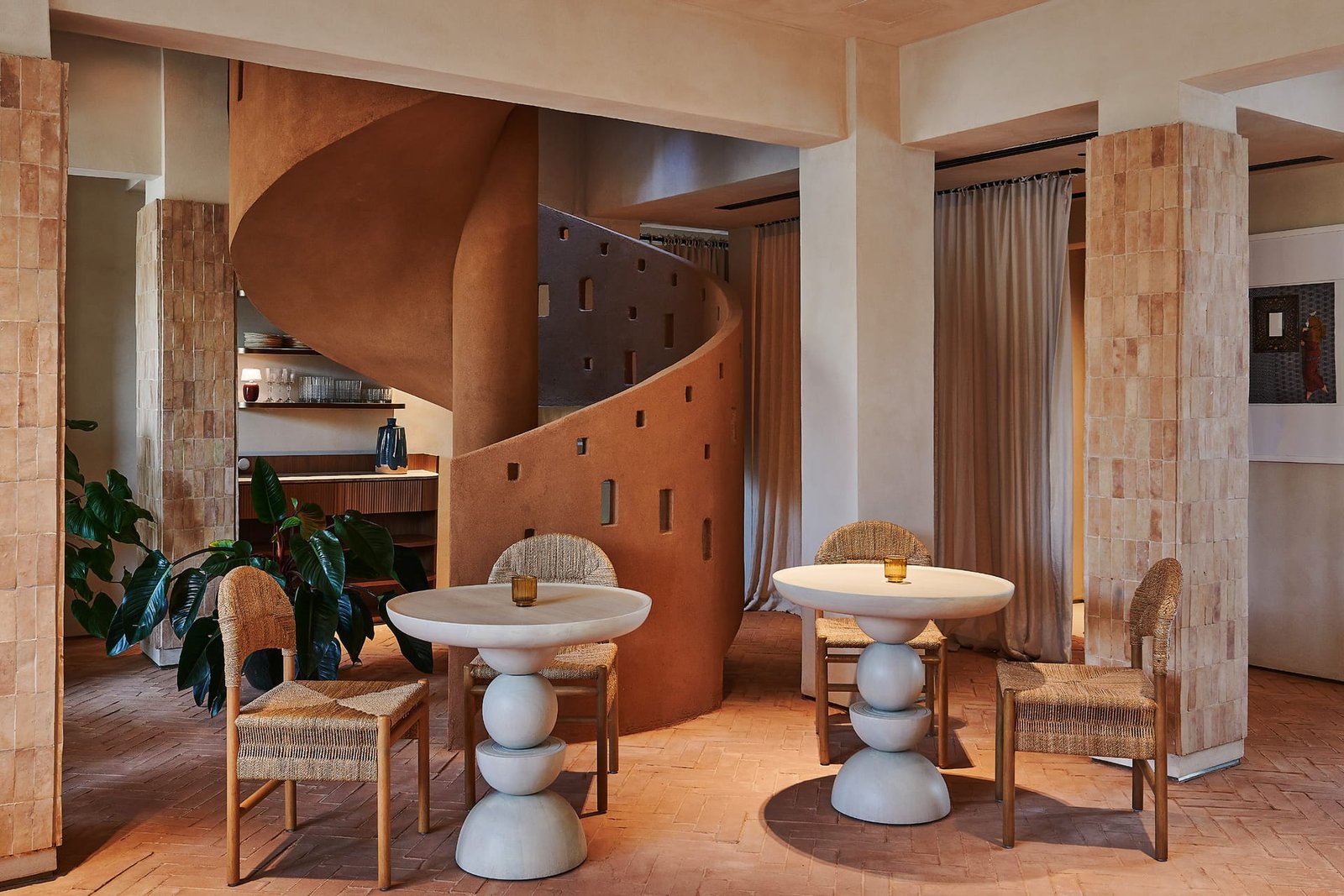
Clay plaster is a mineral wall finish made from clay, graded sand and natural pigment, applied by hand over a prepared substrate. It is a finish, not a structural layer. It goes on interior walls and ceilings, never floors or direct-water zones, and has nothing to off-gas.
What is clay plaster made of?
Clay plaster is a mineral finish made from clay, graded sands and natural mineral pigment, often with a small proportion of fine plant fibre. There is no cement in it and no plastic film over it.
The clay is the binder. Unlike gypsum or cement it does not set through a chemical reaction: it dries, and the plate-like clay particles lock the sand together as the water leaves. That is why clay plaster can be re-wetted and reworked, and why repairs blend rather than sit as patches.
Colour comes from the earth and the pigment rather than from a coat of paint. The colour runs through the material, so a scuff exposes more of the same tone instead of a different one underneath.
How is clay plaster different from paint or gypsum?
Paint is a film applied to a surface. Clay plaster is the surface, applied by hand at a real thickness, so it carries texture, depth and a soft directional sheen that a roller cannot reproduce.
Against a gypsum skim the difference is behaviour as much as appearance. Clay is hygroscopic, taking up water vapour when the air is humid and releasing it as the air dries, and that property is what makes it useful indoors rather than merely attractive.
It is also monolithic. Corners, curves, reveals and ceilings can carry the same finish without a joint, which suits the seamless interiors being specified across Dubai and Abu Dhabi. We compare the two directly in clay plaster versus paint.
What clay plaster finishes are available?
The Clayworks range we install runs from almost flat to openly textured. Smooth is the quiet one, a fine even surface that reads as colour and light. Demi Rustic carries a light aggregate movement, and Rustic is more open and tactile again.
Tonal introduces variation of colour across a wall rather than of texture, which suits large uninterrupted planes that would otherwise look inert. Clay on Brick is applied over brickwork so the substrate still reads through the finish.
Two specials sit at the ends of the range. Clay tadelakt gives a burnished, closed surface, and Rammed Earth Finish at 7-10 mm builds the horizontal strata of a compacted earth wall onto an ordinary substrate, covered in rammed earth interior feature walls.
All of them read differently in person from how they read on a screen. The wider range sits on materials, and sample boards travel to your office or to site.
Where can clay plaster be used, and where it cannot?
Clay plaster goes on interior walls and ceilings. That is the whole list. It does not go on floors, and it does not go in direct-water zones such as the inside of a shower enclosure or the splash area around a basin.
This is not a hedge. Clay is water-soluble by nature, and that is the same property that makes it repairable and reworkable. Wet areas belong to lime plaster and tadelakt, which harden by absorbing carbon dioxide from the air and resist mould through their own chemistry.
A well-planned scheme uses both: clay through bedrooms, living spaces and ceilings, lime or tadelakt through the bathrooms, so the palette runs continuously without asking a material to do a job it was not made for. See lime plaster and tadelakt in the UAE.
Exterior clay is a separate, dedicated system rather than the interior product used outdoors. We installed it on the curved facades of the Canvas Events Pavilion in Dubai.
What does clay plaster need underneath it?
A sound, dry, flat and correctly primed substrate. Plasterboard, blockwork, cement render and concrete can all take clay plaster, but each needs its own preparation and key coat, and movement joints in the background have to be respected rather than plastered over.
Most clay plaster failures anyone can point to are substrate failures. If the background moves, is damp, or was never primed for a mineral finish, the plaster reports the problem faithfully. Preparation is covered in clay plaster substrates.
Because the finish is thin, flatness is set by the background. A wall that is out of plane will still be out of plane afterwards, since clay plaster is a finish rather than a levelling layer.
Why do designers specify clay plaster?
Three reasons come up repeatedly. The first is air: clay helps hold a room between roughly 40 and 60% relative humidity, a band that matters in a country running air conditioning most of the year, and there is nothing in the material to off-gas.
The second is light. A hand-applied mineral surface scatters light rather than bouncing it, so walls read soft and deep and change through the day. The same wall photographed at nine in the morning and five in the afternoon rarely looks like the same colour.
The third is the scorecard. Natural finishes contribute to WELL, LEED and Mostadam assessments, which increasingly matters on UAE and Saudi projects. They contribute to a score; no finish is itself certified, and a specifier who claims otherwise is overselling.
There is a quieter fourth reason: it can be repaired. A damaged area is re-wetted and reworked by the same trade, rather than repainted wall to wall.
How does clay plaster perform in a Dubai villa?
Well, provided it is kept in its zone. Interior walls and ceilings in a conditioned villa are close to ideal for the material: stable temperature, no driving rain, and dry air that clay quietly buffers.
It is dry-dusted or brushed rather than washed, and marks that would need repainting on an emulsion wall can usually be worked out locally. At Villa 515 in Dubai we installed a custom yellow Demi Rustic through a restaurant interior with design NON.
Colour choice is the part worth slowing down for. Gulf daylight is strong and warm, and a tone that looks restrained on a swatch can read very differently across a full wall facing a west window.
Specifying clay plaster in the UAE
Earth Layers supplies and installs. We are Clayworks' sole authorised distributor and approved applicator across the Middle East, and the artisans who apply the plaster are on our own payroll rather than subcontracted, which is what makes a consistent finish across a large area achievable.
The useful first step is a sample panel in the real light of the real room, agreed before the finishes schedule is locked. It settles colour, texture and expectations in one visit.
Send drawings, substrate details and the finishes schedule through the enquire page, or message the UAE office on WhatsApp at +971 50 136 0506. Wellness, in Every Surface.