
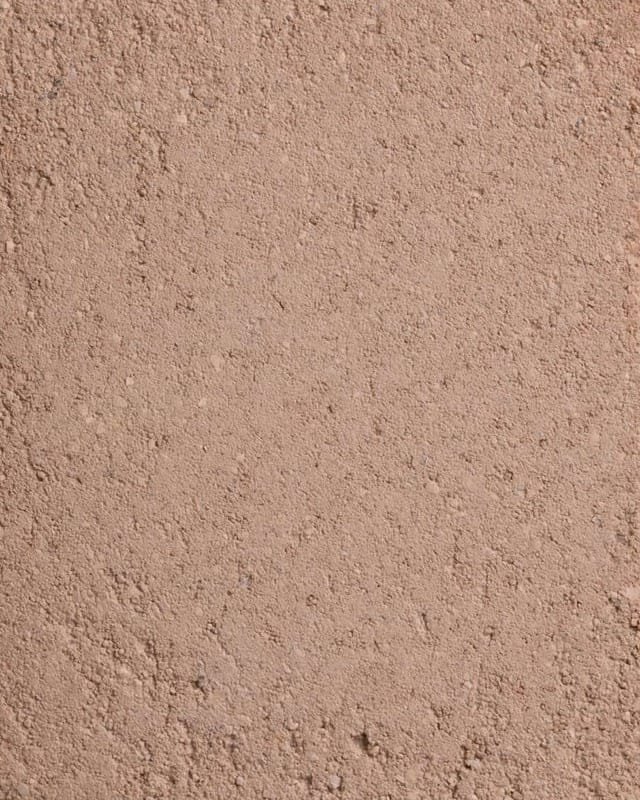
Clay plaster is applied to sound, stable interior substrates: plasterboard, gypsum plaster, cement render, blockwork, concrete and previously painted walls, once each is prepared and primed for suction. It suits walls and ceilings only, never floors and never direct-water zones such as showers or basin splashbacks.
What can clay plaster be applied to?
Clay plaster is a decorative finish, not a structural build-up. It follows the flatness, movement and suction of whatever sits behind it, which is why the substrate decides most of the outcome long before a trowel touches the wall.
The usual backgrounds are plasterboard, gypsum plaster and skim, sand-cement render, fair-faced concrete, blockwork and AAC, cement-particle board, and existing painted walls. All of them can work. None of them work untouched.
The common requirement is easy to state and easy to skip: sound, dry, stable, clean, and flat to the tolerance you want to see. A clay plaster finish only a few millimetres thick will not straighten a wall, it will report it. Heavier textures such as the Rammed Earth Finish are built at 7 to 10 mm and carry a little more, but the principle holds.
Clay plaster on plasterboard: what has to happen first
Boards must be fixed properly before anyone discusses colour. Correct fixing centres, screw heads set just below the paper face, no drumming panels, no unsupported edges. A board that flexes under hand pressure will crack whatever is put on it.
Joints should be taped and filled, and in most cases we prefer a full skim across the boards rather than filled joints alone. Two materials across one wall means two different suctions, and that difference can read as tonal banding under raking light, most visibly on pale and Smooth finishes.
Where plasterboard meets a different material, such as a concrete column or a soffit, treat it as a junction rather than a flat run. Mesh reinforcement across the change of substrate is the minimum; a shadow gap or a stop bead is the more honest detail.
Can you apply clay plaster over gypsum, render and painted walls?
Clay plaster over gypsum is routine, with two conditions. The gypsum must be dry through its full thickness rather than dry to the touch, and it must not be polished to a closed, glassy face. Over-burnished gypsum offers little key, so it is abraded and primed.
Sand-cement render and concrete are equally workable once cured and dimensionally stable. Release agents, curing compounds and laitance have to come off concrete first. High-suction backgrounds such as blockwork and AAC need suction control rather than a stronger trowel arm.
Painted walls are the variable one. Sound, well-adhered matt emulsion is usually a reasonable base once primed. Gloss, eggshell and oil-bound coatings are abraded to a key. Anything chalky, flaking or distemper-like is removed, because the finish can only be as well attached as the coating beneath it. There is more on this in our note on clay plaster durability and cracking.
Primers, suction and why the key coat matters
There are only two ways a background fails a thin clay finish. Too much suction pulls the water out before the plaster can be worked and closed, giving drag marks, dusting and a patchy face. Too little suction, or a sealed surface with no key, gives poor adhesion.
A primer carrying fine aggregate answers both: it evens out suction and leaves a mechanical key. Tinting the primer towards the finish colour stops a dark or patchy background reading through pale clays.
This is preparation, not decoration, and it is the step that makes a wall behave the same from one end to the other. We prime and apply with our own artisans rather than subcontracted crews, using Clayworks clay plasters, for which we are the sole authorised distributor and approved applicator across the Middle East.
Where cracks in a clay plaster application actually start
Clay plaster is not a crack-bridging membrane and should not be asked to behave like one. Most cracking traces back to movement behind it: an unsupported board joint, a junction between dissimilar materials, shrinkage in a green sand-cement coat, or a partition that was never braced.
The remedies are all preparation remedies. Reinforce the joint, isolate the junction, let the background finish moving, or express the change with a bead or a shadow gap. Adding more plaster over a moving background simply moves the crack.
One genuine advantage of an unfired clay finish is that it stays reworkable. A damaged area can be re-wetted and blended back into the surrounding surface, which painted gypsum cannot do without repainting the whole wall.
Site conditions in the UAE that decide the finish
Dust is the first one. On live sites in Dubai and Abu Dhabi, cutting and grinding nearby will settle on a primed wall and sit between the primer and the plaster. Walls are cleaned down immediately before application, and adjacent works are screened or stopped.
Air movement is the second. Clay plaster dries by evaporation, so a chilled-air outlet or a drying fan aimed at a fresh wall will skin it unevenly and can leave a visible shadow of the airflow. We set the room to a steady condition and keep the air gentle until the wall is through.
Sequencing is the third. Clay plaster goes on after wet trades and MEP first fix, after joinery has been templated, and it needs protecting until the other trades are finished. Once cured, the surface is hygroscopic and helps hold a room between 40 and 60 per cent relative humidity, which is worth having in a conditioned Gulf interior, as we explain in clay plaster and humidity.
Where clay plaster should not be applied
Clay plaster is for interior walls and ceilings. Not floors, under any specification. Not direct-water zones either: inside shower enclosures, around basins or behind a tap, water arriving repeatedly on an unfired clay surface will erode it.
Bathrooms and kitchens are not off limits as rooms. A bathroom wall away from the splash zone is a reasonable place for clay, and the boundary is water contact rather than the label on the door. We mark that boundary on drawings before we quote, and set it out in clay plaster in bathrooms and kitchens.
For wet areas we specify lime and tadelakt instead, which handle water by their own chemistry, as covered in what tadelakt is. Exterior clay is a separate dedicated system rather than an interior plaster used outdoors, as at the Canvas Events Pavilion in Dubai.
Get the substrate signed off before anyone plasters
The quickest way to protect a clay plaster budget is to agree the substrate scope in writing: who makes good, who skims, who primes, and what flatness the finish will be judged against. We survey before we commit to a programme, and we say plainly when a wall is not ready.
We supply and install, with the artisans who do the work on our own payroll rather than subcontracted, from our base at Dubai Industrial City. The person who tells you the background needs work is on the same team that has to live with it.
Send drawings, a finishes schedule, or simply photographs of the walls as they stand. Enquire here or message us on WhatsApp +971 50 136 0506, and we will come back with a substrate preparation note and a sample panel proposal. Wellness, in Every Surface.