
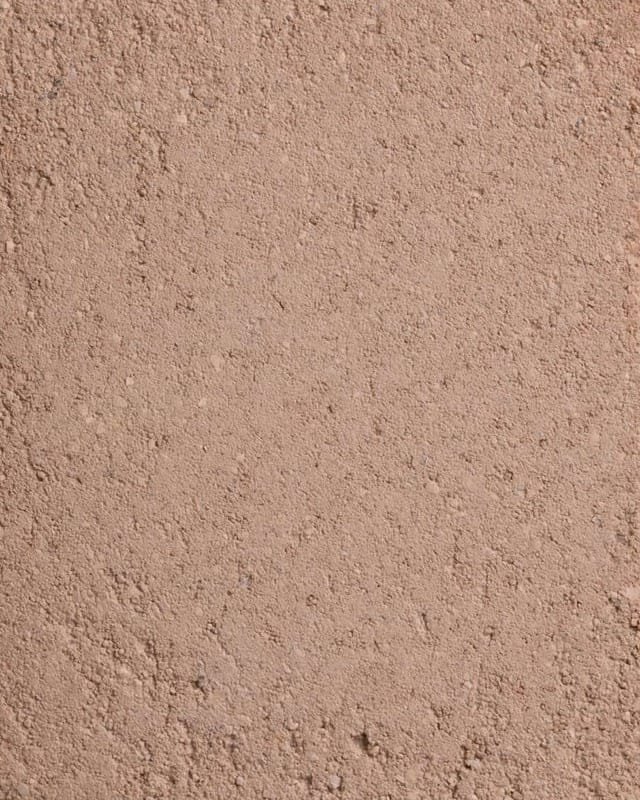
Clean clay plaster dry: a soft brush or dry sponge lifts most marks, and light abrasion with a fine pad removes scuffs. Never use wet cloths, detergents or scrubbing. Dents and chips are patched with the same clay, feathered out and re-textured to blend.
Why clay plaster is cleaned dry, not wet
Clay plaster is a mineral finish. The clay itself is the binder, there is no polymer film sealing the surface, and the colour is pigment through the body rather than a coat on top. Anything wet you put on the wall goes into the plaster instead of sitting on it.
That single property sets the whole maintenance method: work dry, work gently, and work outward from the mark rather than scrubbing at it. Most marks that would need a damp cloth on painted gypsum come off clay plaster with a soft brush and a little patience.
It also means damage is genuinely repairable. Because clay can be re-wetted and re-worked, a dent can be filled and merged into the existing surface, which a paint film cannot do without leaving a patch that flashes in raking light.
How do you clean clay plaster?
Start with dust. A soft, dry natural-bristle brush, or a vacuum with a clean brush head held just off the surface, lifts settled dust from a textured finish. In Dubai and Abu Dhabi interiors this is the routine most walls ever need, because fine dust is the main thing that dulls a clay surface.
For scuffs and fingerprints, a dry cleaning sponge, the kind used to lift soot, takes marks off without any moisture. Work in short strokes and turn the sponge to a clean face as it loads up.
For a mark that survives that, very light abrasion works: a fine sanding sponge or a fine white pad, used with almost no pressure across an area wider than the mark itself. Feather the edges so there is no hard boundary, then brush the dust away.
Test in a low-light corner or on a spare sample board first, and stop early. Clay plaster forgives a second pass; it does not forgive a hole rubbed through to the base coat.
What should you never use on clay plaster?
Water, detergents, all-purpose sprays, solvents, wet wipes and steam. Water re-opens the clay and dries back as a tide mark darker than the wall around it, and detergent leaves a surfactant residue that attracts dust and shows as a shadow within weeks.
The same logic explains where the finish belongs. Clay plaster is for interior walls and ceilings only, never floors and never direct-water zones such as showers or the splash area around a basin. Those are lime and tadelakt territory, and the boundaries are set out in our guide to clay plaster in bathrooms and kitchens.
If a leak or a condensing pipe has wet a clay wall, the finish is not the first problem. Fix the source, let the wall dry fully, then assess the plaster.
How to patch clay plaster dents and chips
Keep a sealed tub of the original material from the installation. Colour in clay plaster comes from the clay and the mineral pigment in the mix, so a matched batch is worth more than any touch-up technique.
Brush out loose material and crumbling edges. Mist the area lightly with clean water so the existing plaster and the new material knit together rather than the patch sitting in as a plug. Press the clay in with a small trowel or filling knife, slightly proud, and let it firm up.
For deeper damage, build in two thin passes rather than one thick one. A thick patch shrinks as it dries and telegraphs its own outline. Anchor holes and fixing damage are filled the same way, once the plug has been removed or cut back below the surface.
Finishing is where the repair is won or lost. Match the original tool motion, whether that was a sponge, a trowel or a brush, and carry it out past the patch into the surrounding plaster so the texture runs continuously through the repair.
Will a clay plaster repair be invisible?
Honestly, it depends on the finish. Textured finishes such as Demi Rustic and Rustic absorb a repair almost completely, because the eye reads variation as part of the surface. Smooth and Tonal finishes are less forgiving, particularly on a large plain wall lit from the side.
Rammed Earth Finish adds a further constraint. The strata have to line up through the patch, so those repairs are set out before any material is mixed.
Where a patch would always sit awkwardly, the better answer is to re-skim to a natural break, corner to corner or the full face of a wall. Clay bonds readily to sound clay, so a thin refresh coat is straightforward and does not build up the layer history that repeated repainting creates.
Clay plaster maintenance for hotel and facilities teams
Write the method into the housekeeping manual on day one. The instruction is short: dust dry, no sprays, no wet cloths, report chips rather than filling them with proprietary filler.
Damage clusters in predictable places. External corners, door reveals, the line where trolleys and luggage pass, and the first metre above skirting take almost all of it. Corner protection and a considered skirting detail solve most of that at design stage rather than at handover.
On projects such as the clay plaster restaurant interior at Villa 515 in Dubai, the finish is part of daily front-of-house life, so we hand over spare material, a written method and a sample board from the project batch. Ask for that package at handover; it is far easier than matching a wall two years later.
When to re-skim rather than patch
Patch localised damage. Re-skim when damage is widespread, when a wall has been wetted repeatedly, or when previous repairs by others have left a map of mismatched patches across one elevation.
Cracking is a different diagnosis again. Fine crazing in the finish coat is cosmetic, while a line that follows a board joint or reappears after repair is telling you something about the substrate or movement behind it, which we cover in clay plaster durability and cracks.
It also helps to know what you are working with. Our primer on what clay plaster is sets out the layers, thicknesses and finishes we install as Clayworks sole authorised distributor and approved applicator across the Middle East.
Get a repair method for your project
We supply and install, and the artisans who apply the plaster are on our own payroll rather than subcontracted. That matters for repairs, because the crew who can match a wall is the crew who made it.
Send photographs of the damage, the finish name if you have it, and where the wall sits in the building. We will tell you plainly whether it is a dry clean, a patch or a re-skim. Start at enquire, or message our UAE team on WhatsApp +971 50 136 0506.