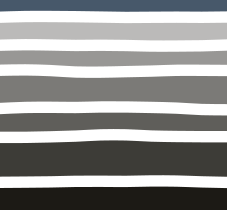
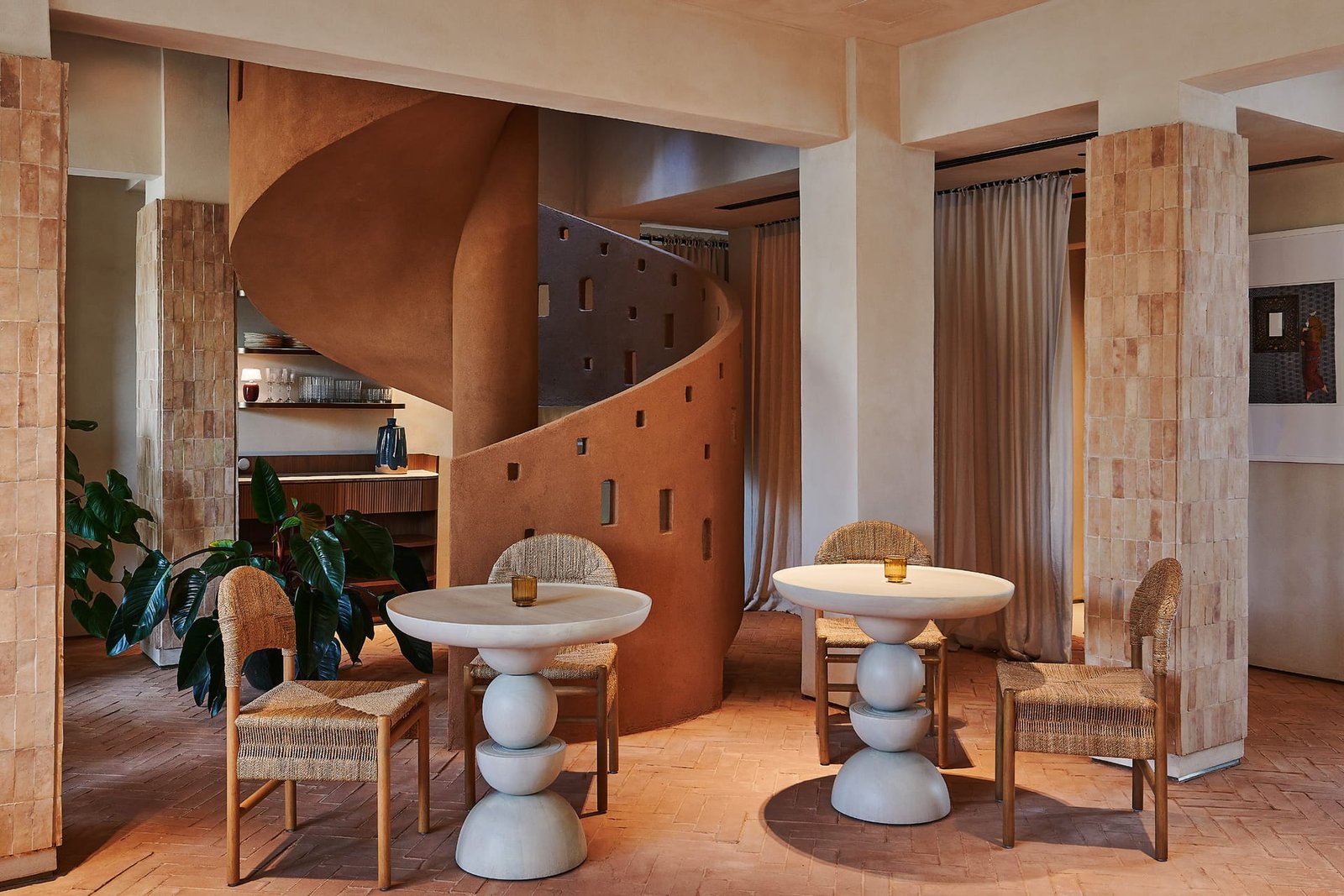
Paint is a thin film of colour over gypsum; clay plaster is a mineral layer several millimetres thick with the colour through the body. That gives depth and texture paint cannot imitate, nothing to off-gas, and a surface that buffers humidity, at a higher installed cost and with skilled application.
What is the real difference between clay plaster and paint?
Paint is a coating: pigment and binder in a film a fraction of a millimetre thick, rolled over filler, skim and a board or render. Clay plaster is a finish material in its own right, applied in layers a few millimetres thick, with clay as the binder and the colour running through the body.
So the comparison is not quite like for like. One is a colour layer applied to something else, the other is the surface. That is why clay plaster vs paint is usually settled on how a wall behaves under light and over ten years, rather than on the colour card.
Gypsum sits in the middle of the argument, and it is normally the background rather than the competitor: board, skim, then either paint or plaster on top.
Depth of colour: why clay reads differently under light
A paint film reflects light from a single plane. Clay plaster scatters it, because the aggregate, the trowel pressure and the hand of the applicator leave micro-relief. The same wall reads warmer near a window, deeper in a corner, and shifts as the sun moves.
That is also the honest downside. Clay plaster is not uniform. Two walls in the same colour will never match the way two rolled walls match, and a project that needs flat, repeatable, identical surfaces should be painted.
Finishes run from Smooth through Demi Rustic, Rustic and Tonal to Clay on Brick, plus a Rammed Earth Finish at 7 to 10 mm that brings the strata look of rammed earth onto interior walls.
| Aspect | Clay plaster | Paint on gypsum |
|---|---|---|
| Colour | Pigment through the whole body | Thin film over skim |
| Texture | Hand-applied, varies across the wall | Uniform, rolled or sprayed |
| Off-gassing | Mineral, nothing to off-gas | Depends on the paint specified |
| Humidity | Hygroscopic, buffers short-term swings | Film slows vapour exchange |
| Repairs | Patched and re-textured in clay | Touch-ups often flash |
| Renewal | Thin re-skim in the same material | Repaint cycle, layers build up |
Clay plaster vs gypsum: what each layer is actually doing
Gypsum skim is a levelling background. It is quick, it is cheap in programme terms, and it always needs something over it, whether that is paint or clay.
Clay plaster can be applied over correctly prepared gypsum board and skim, cement render, blockwork and other backgrounds, each with its own primer and reinforcement requirements. That preparation is not optional, and it is where most finish failures begin, as we explain in clay plaster substrates.
The practical read is that you are rarely choosing gypsum instead of clay. You are choosing what goes on top of the gypsum, and whether the wall build-up ends in a film or in a body of material.
Air quality: what a natural wall finish honestly offers
Clay plaster is mineral. There is nothing in it to off-gas, no solvent curing out over the first weeks and no film to yellow. On a fit-out running to a tight handover with furniture arriving behind the trades, that absence is worth something.
Paint varies enormously, and low-VOC paints exist and are worth specifying where paint is the right answer. We also supply eco paints and clay washes for exactly that middle ground, listed with the rest of our materials.
On sustainability submissions, natural finishes contribute to WELL, LEED and Mostadam scorecards. They are not certified in themselves, and anyone describing a finish as certified under those schemes is describing something else.
Does clay plaster do anything paint cannot?
Clay is hygroscopic. It takes up water vapour when a room gets humid and releases it when the air dries, which helps hold an interior between 40 and 60% relative humidity. A film-forming paint slows that exchange down.
The effect is real but bounded. It works across the outer few millimetres and scales with how much plastered surface is exposed, which we set out in does clay plaster regulate humidity, including what changes in a heavily air-conditioned Gulf interior.
Thermally and acoustically, a few millimetres of plaster is a modest contribution, and we would not sell it as more than that.
Lifecycle: repainting versus re-skimming
Painted walls in a commercial interior sit on a repaint cycle. Each cycle adds a layer, masks the one before it and eventually has to be stripped back.
Clay plaster is maintained differently: dry cleaning, local patching in the same material, and a thin refresh coat when a room is renewed. Nothing accumulates, and it is the same material every time, as covered in how to clean and repair clay plaster.
Installed cost is higher than paint, because the material is thicker and the application is skilled artisan work rather than a labour rate. Over a building's life the gap narrows. We would not claim it always reverses.
When is paint still the right answer?
Wet zones, first of all. Clay plaster is an interior wall and ceiling finish, never floors, never showers, never the splash zone around a basin. Lime plaster and tadelakt cover those areas, and lime hardens by absorbing carbon dioxide from the air and resists mould by its own chemistry.
Then there are very short programmes, high-churn rental fit-outs where walls are repainted between tenants, and schemes where perfectly uniform colour is the design intent.
Elsewhere, in lobbies, villas, hospitality interiors, spas and long-tenancy offices, the case for a mineral finish is strong. The clay plaster we install is made by Clayworks, for whom we are the sole authorised distributor and approved applicator across the Middle East.
See it before you specify it
A colour on a screen tells you very little about a finish that changes with the light. We keep sample boards and can produce project-specific samples in the actual colour and texture. Samples travel to your office or to site, and a mock-up on your own wall settles the colour before any decision is made - ask for one.
Send drawings, areas and a target handover date through enquire, or message the UAE team on WhatsApp +971 50 136 0506. Wellness, in Every Surface.