Al Sa'fat is Dubai Municipality's green building system, and under Administrative Resolution No. 154 of 2020 Silver Sa'fa is mandatory for every building in the Emirate; Golden and Platinum Sa'fa are optional. Two of its requirements land on a finishes schedule: low-emitting materials, where paints and coatings must be accredited by Dubai Central Laboratory or another laboratory approved by Dubai Municipality, and regional materials, where clause 701.07 counts what was extracted and manufactured within 800 km of the project site — a radius that reaches soil won near a Dubai site and does not reach a plaster made in Cornwall or Spain.
Silver Sa'fa is not optional
Al Sa'fat is Dubai Municipality's green building system, and it is worth being precise about its status because it is often described as a voluntary rating. It is not. Administrative Resolution No. 154 of 2020, issued by the Director General of Dubai Municipality on 9 August 2020, sets out three grades and says of the first: satisfaction of its standards, conditions and requirements is mandatory for all buildings in the Emirate.
That grade is Silver Sa'fa. Golden Sa'fa and Platinum Sa'fa sit above it and are optional, awarded to projects that go further. So the question on a Dubai project is never whether the finishes schedule has to answer Al Sa'fat, only which grade it is answering.
Most of the system is about energy, water, ecology and waste, and a wall finish has nothing to say about any of it. Two requirements are different, and both belong to whoever writes the finishes schedule.
Low emitting materials: the certificate matters as much as the chemistry
The first is emissions. Al Sa'fat requires that for all buildings, including new applications in existing buildings, paints and coatings used in the building must not exceed the VOC limits specified by Dubai Municipality — and that they must be accredited or certified by Dubai Central Laboratory, or by another laboratory approved by Dubai Municipality. A parallel clause does the same for adhesives, adhesive bonding primers, sealants and sealant primers.
Note what that clause is actually asking for. Mineral finishes have a real advantage on the chemistry: clay plaster is a mineral and plant-based material with nothing to off-gas, and lime is the same. But low emissions on their own do not answer the clause. The requirement is accreditation from a named laboratory or one Dubai Municipality has approved, and that is a question to settle with the authority for the specific product on the specific project, not an assumption to carry into a submittal.
What we can hand over is the evidence we hold, described accurately. The Clayworks plasters carry Eurofins Indoor Air Comfort GOLD with full VOC emission test reports, issued by Eurofins Product Testing A/S. The Cemher systems carry VOC emission and content test reports from Applus Laboratories. These are emission and content test reports — powerful evidence for indoor-air credits, and we will never present one to you as an EPD or an HPD. The whole register, with issuing bodies and expiry dates, is on our credentials page.
Regional materials: where earth has an advantage the imports do not
The second requirement is provenance, and it is measured with a tape rather than a passport. Clause 701.07 of the 2nd Edition asks that, based on cost, a minimum share of a building's materials be extracted, harvested or recovered — and manufactured — within 800 km of the project site: at least 10 per cent for Silver Sa'fa, 20 for Golden and 30 for Platinum.
Three qualifications in that clause matter to a finishes package. Only materials permanently installed in the building count, which is exactly what a wall finish is. Mechanical, electrical and plumbing components, furniture and specialty items such as lifts are excluded from the calculation, so the denominator is smaller than a whole building's material cost. And where only part of a product is won and made locally, only that share by weight contributes. One wrinkle worth knowing: the same document's glossary defines Regional Materials as GCC-sourced, but the test a project is actually assessed against is the 800 km radius in the clause.
Held against that radius, most of our palette does not qualify, and we would rather say so than let a consultant discover it at review. Clayworks clay plasters are made in Cornwall, in the United Kingdom. Cemher's Microtadelakt and microcements are made in Spain. Fellert acoustic plaster is Swedish, Addagrip resin bound is British, AURO primers are German. None of those is within 800 km of a Dubai site, and every one of those origins is published in the specification table on its own page.
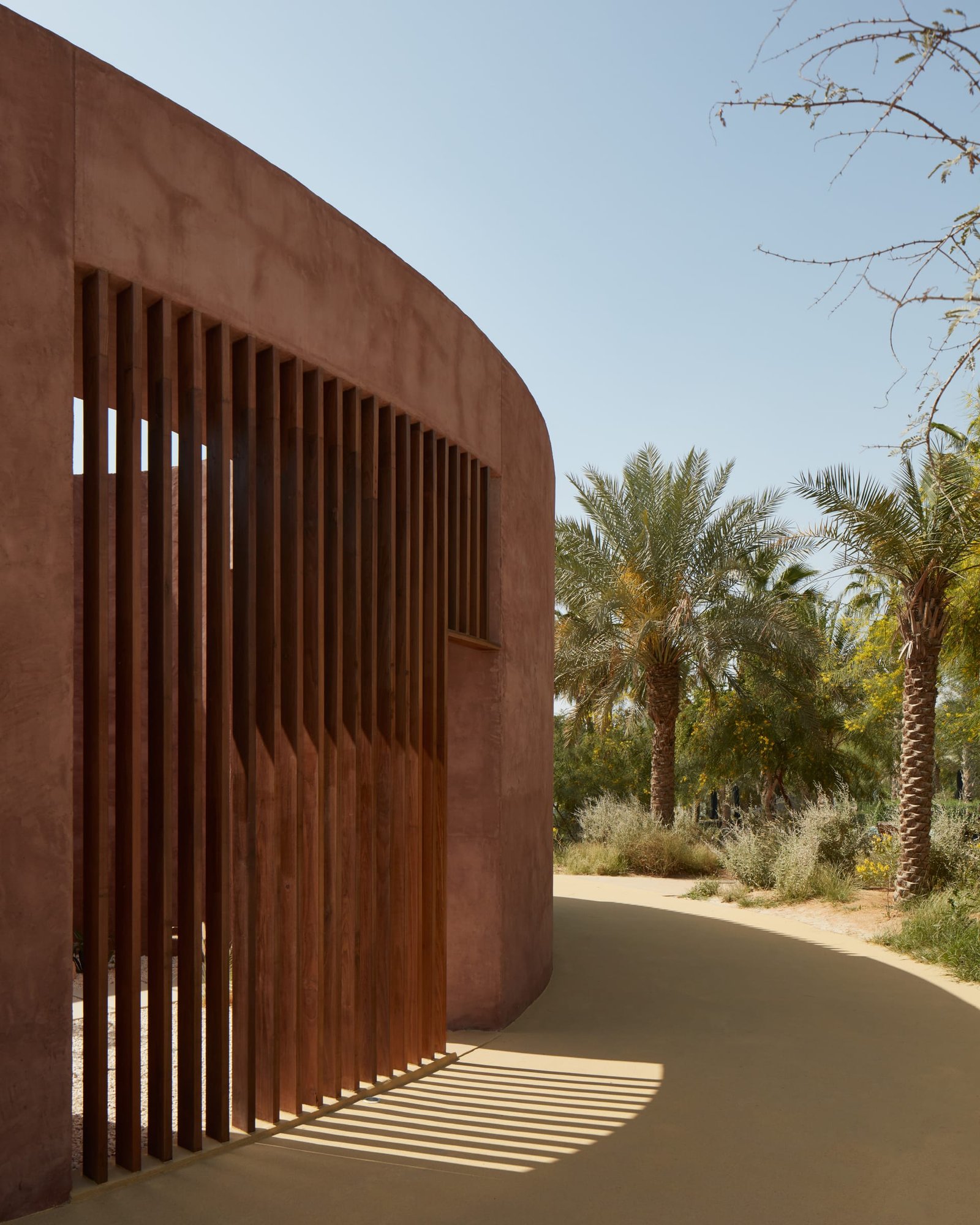
In-situ rammed earth is the exception, and it is a large one. An earth wall is built from graded soil, and soil is the single material on a finishes schedule that can be won and processed close to the site rather than shipped to it. Where the mix is extracted and prepared inside the 800 km radius, a rammed earth wall contributes to the 701.07 share by the same rule that excludes the imported plasters — and unlike them it is doing so by cost of permanently installed material, which on a wall of that mass is not a rounding error.
What that means at concept stage
The practical sequence is unglamorous. Decide early which surfaces are carrying compliance weight and which are simply finishes. Ask for each product's country of origin and its emission evidence in the same breath as its colour reference. And where the project is chasing Golden or Platinum rather than the mandatory Silver, look hard at whether a material that can be sourced regionally belongs in the scheme — because that decision is far cheaper at concept than at tender.
It also changes how an earth wall reads on a Dubai project. Rammed earth usually arrives on the drawings for how it looks and for its mass. Under Al Sa'fat it has a second argument that no imported finish can make, and that argument is worth putting in front of the sustainability consultant early rather than discovering it late.
The rest of our Dubai notes cover the method and the rooms: how in-situ rammed earth walls are built and clay plaster for Dubai homes and villas.
The same question in the other emirates
Dubai is not the whole picture, and the systems are not interchangeable. Abu Dhabi rates its buildings through Estidama and the Pearl Rating System, which since 2010 has required at least 1 Pearl on every new building and at least 2 on government-funded ones — we set out which documents support a Pearl submittal in clay plaster and Estidama Pearl, and Al Ain falls under the same regime as part of the Emirate of Abu Dhabi.
Our built earth wall in the Emirates is at Kalba Beach in Sharjah, for Shurooq, and the coastal detailing that came with it is in rammed earth in Sharjah.
Wherever the project sits, send us your finishes schedule and we will return the origins, the test reports and the specification clauses alongside the samples — or message us on WhatsApp at +971 50 136 0506.