
What in-situ rammed earth actually is
Enquiries about rammed earth in Dubai have moved well past the mood board. Architects, contractors and private clients across the UAE now ask for in-situ rammed earth by name: walls formed on site from compacted earth, with the layered record of the ramming process left visible as the finish.
The method is ancient, but the modern version is engineered. A controlled mix of earth and aggregate is placed between temporary formwork and compacted layer by layer until it is dense enough to stand on its own. There is no cladding, no render and no paint — what you see when the forms come off is the finished wall.
Formwork and lifts: how the walls go up
The sequence will feel familiar to anyone who has poured concrete. Formwork — rigid shutters braced to resist the force of ramming — is erected to the exact geometry of the wall, and the earth mix is placed inside it in successive layers.
Each layer is tamped until fully compacted before the next goes in. These compacted layers are the lifts, and they are the signature of the method: once the formwork is struck, the tamped lifts read as strata, running through the wall like sedimentary rock.
Colour is decided lift by lift. By adjusting the mix between layers, the crew can hold a single even tone or grade a wall through bands of cream, ochre and terracotta — a decision agreed with the architect before ramming starts, because it cannot be changed afterwards.
Why rammed earth suits the UAE
The Gulf is a natural home for earth construction. Rammed earth walls are massive, and that thermal mass slows the passage of heat through the envelope — a useful trait in a climate defined by solar gain rather than rain.
The region's low rainfall is equally kind to the material. The main risk to any earth wall is persistent moisture at its head and base; with sensible detailing — protection at the top, separation at the bottom — the UAE's dry climate is far more forgiving than many of the climates the method has already served in for centuries.
There is also the sustainability case. Rammed earth is made largely from raw mineral material, and natural finishes of this kind can contribute to WELL, LEED and Mostadam scorecards — an increasingly common requirement on Dubai developments.
Quality control: tested to 8 MPa
The UAE has no dedicated earth-building code, so we anchor our quality control in an established international framework: New Zealand's earth building standards (NZS). Our walls undergo acceptance testing to 8 MPa, which gives structural engineers a verified figure to design against rather than an act of faith.
Testing runs alongside the build, so the mix approved on paper is the mix proven in the wall. It is one of the clearest markers separating engineered in-situ rammed earth from decorative imitations of it.
The strata look without the structural wall
Not every project can carry a full-thickness earth wall, and not every interior needs one. For those cases we install Rammed Earth Finish by Clayworks, a 7–10 mm clay plaster that recreates the strata aesthetic on interior walls. Earth Layers is Clayworks' sole authorised distributor and approved applicator across the Middle East.
Like all clay plaster, it is a breathable mineral surface with nothing to off-gas, and clay walls help hold a room between 40 and 60 per cent relative humidity. If you are weighing one option against the other, we compare them directly in rammed earth versus rammed earth plaster.
Choosing a rammed earth contractor in Dubai
Rammed earth is unforgiving of inexperience, so the first question to ask any rammed earth contractor in Dubai is a simple one: who actually rams the walls? At Earth Layers, the artisans on the formwork are on our own payroll, not subcontracted — the same crews who built the UAE Pavilion at Expo 2023 Doha, a complete pavilion in in-situ rammed earth that took the Gold Award for Best Self-Built Pavilion.
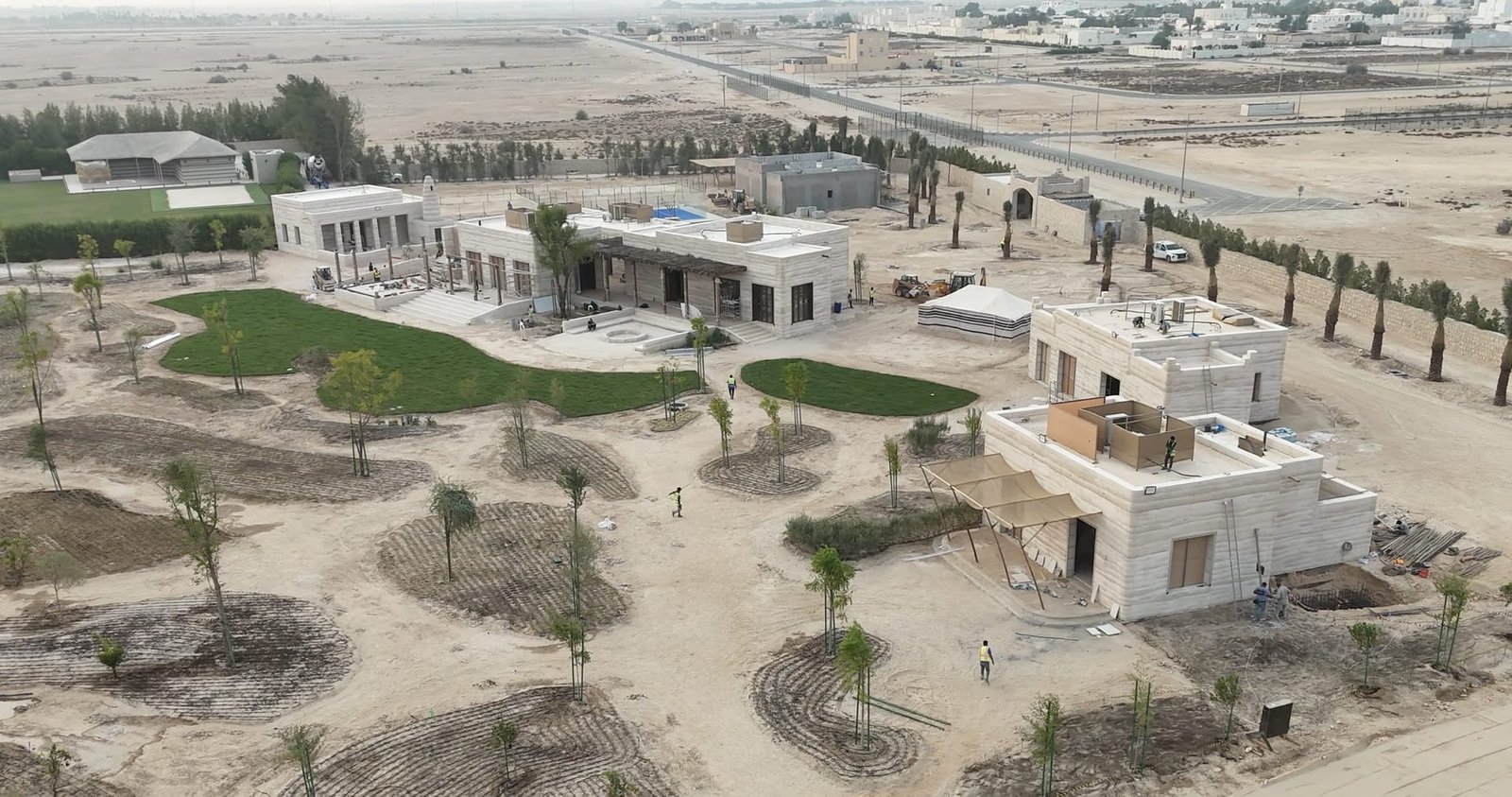
At Al Kaaban Resort in Qatar, those crews rammed guest buildings, a mosque and its minaret, and the boundary walls, all in lifts on site. We operate from Dubai Industrial City, with sister companies in Saudi Arabia and Qatar. For budget guidance, see what rammed earth costs in the UAE.
If you are considering rammed earth for a project in Dubai or anywhere in the UAE, send us your finishes schedule or message us on WhatsApp at +971 50 136 0506. We will tell you honestly whether the wall, the plaster or a mix of both is the right answer for your project.