Al Ain's historic buildings are mudbrick: earth moulded into bricks, dried, laid in mud mortar and finished with mud plaster. Modern in-situ rammed earth is a different technique in the same family — graded soil moistened to a precise water content and compacted in lifts inside engineered formwork, with no bricks and no joints, accepted against a 28-day compressive strength of at least 8 MPa.
The country's earth architecture is in Al Ain
Al Ain is where earth building in the UAE is most visible and best protected. The Cultural Sites of Al Ain — Hafit, Hili, Bidaa Bint Saud and the Oases Areas — were inscribed on the UNESCO World Heritage List in 2011, the first World Heritage property in the country. The oases within it preserve historic mudbrick structures built for defensive, residential and religious use, and Hili holds one of the earliest known examples of the aflaj irrigation system, the buried channels that still carry water to the date palms.
That matters for anyone specifying finishes there, and not only sentimentally. It means an earth wall in Al Ain is not an imported idea being tried out on a site that has never seen one. Earth is the local building material; what a modern wall brings is a different technique for placing it, not a different substance.
It also sets a standard. When the reference buildings a few kilometres away have stood for generations in the same climate, a modern earth wall is measured against them rather than against a rendering.
Mudbrick and rammed earth are not the same technique
The two are often spoken about as one thing, and they are not. Mudbrick — adobe — is earth moulded into individual bricks, dried, then laid in courses with a mud mortar and usually finished with a mud plaster. The wall is an assembly of small units, and the mortar joints are part of how it works and how it is repaired.
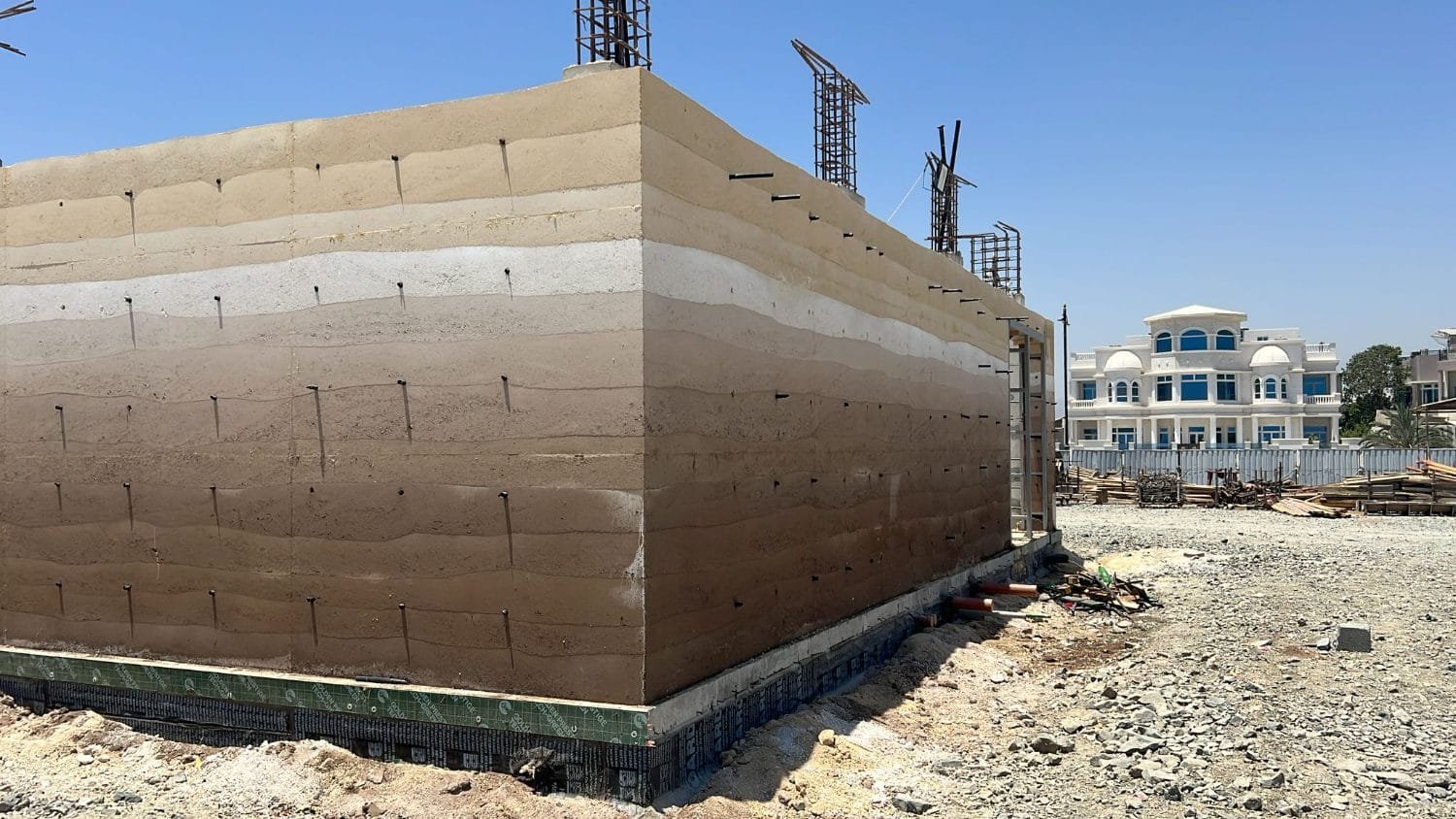
In-situ rammed earth has no units and no joints. Graded soil is moistened to a precise water content and compacted in horizontal lifts inside engineered formwork until the wall reaches strength, and it comes out monolithic. The horizontal banding you see on the finished face is not coursing — it is the record of each compacted lift.
Both draw on the same raw material and both rely on the same discipline at the head and base of the wall, where persistent moisture is the real risk rather than heat. What differs is how the earth is placed, how it is consolidated, and therefore how it is engineered and tested.
What an engineered earth wall asks for now
A contemporary rammed earth wall carries an acceptance route that a historic one never needed. The build runs through four fixed stages: trial sampling blocks to fix the mix, a 2 x 2 m site mock-up with eleven bands signed off before permanent works, engineered shuttering fabricated to the wall geometry, then ramming layer by layer with acceptance testing alongside.
Stabilised work is accepted on a 28-day unconfined compressive strength of at least 8 MPa, a hold point signed by the consultant. Unstabilised work follows NZS 4298, New Zealand's earth building standard, which asks for at least 1.3 MPa and linear shrinkage under three per cent. Our walls carry a ten-year warranty.
Thickness follows from the structure. An in-situ stabilised wall needs 17 cm of ramming clearance each side of an embedded column, so a 300 mm column gives a wall of at least 640 mm; unstabilised needs 20 cm each side, so at least 700 mm. Precast panels run 200-400 mm when backed with concrete or UHPC, or from 450 mm solid and un-backed. Those figures belong in the coordination model early — they are not adjustable once the frame is set.
The clay side: a plaster instead of a wall
Not every project wants half a metre of structural earth, and an interior fit-out rarely does. Rammed Earth Finish by Clayworks is a 7-10 mm clay plaster that carries the strata banding on interior walls and ceilings, and the same clay family extends to Tadelakt and to Clay on Brick, which reads closer to a plastered masonry wall. Earth Layers is Clayworks' sole authorised distributor and approved applicator across the Middle East.
Like every clay plaster, these belong on interior walls and ceilings — never on floors, never in showers or other direct-water zones. What they bring besides the surface is behaviour: clay takes up moisture when a room is damp and releases it as the air dries, helping hold an interior between 40 and 60 per cent relative humidity, with nothing in the material to off-gas.
If you are weighing the wall against the plaster, we set them side by side in rammed earth versus rammed earth plaster.
Most of this work arrives as a villa renovation
In Al Ain, natural finishes usually turn up inside a villa renovation rather than a new build, which changes the questions worth asking. The palette that tends to make sense is a plain one: clay plaster on interior walls and ceilings through the living spaces and bedrooms, a rammed earth or Rammed Earth Finish feature wall in the majlis or the entrance, Microtadelakt in the wet rooms as a sealed system, and microcement where a floor needs to run seamless from room to room.
On a renovation the substrate decides more than the finish does. Clay goes onto a sound, prepared surface, and absorbent mineral backgrounds need a primer so the coat pulls evenly rather than flashing where suction changes. Existing paint, gypsum and cement render each behave differently under a clay coat, and the honest answer on some walls is that the old surface comes off first. We set the backgrounds out in what clay plaster can be applied to.
The other renovation question is where a full earth wall is realistic. In an existing villa it usually is not — the thicknesses above are structural, and they are not something to introduce into a finished house. That is what Rammed Earth Finish is for, and it is why the wall-or-plaster decision is worth making before anything is priced.
Al Ain sits within the Emirate of Abu Dhabi
That is a practical point rather than a geographical footnote. Projects in Al Ain fall under Abu Dhabi's Estidama programme and its Pearl Rating System, which since 2010 has required every new building in the emirate to reach at least 1 Pearl and government-funded buildings at least 2.
So the finishes arrive with paperwork. We set out which documents support a Pearl submittal, what each one actually proves and which of ours has expired, in clay plaster and Estidama Pearl; the tender-stage side of an earth wall — samples, mock-ups, acceptance and procurement — is in specifying rammed earth in Abu Dhabi.
Working in Al Ain
We should be straight about where our walls stand. Our built rammed earth in the Emirates is at Kalba Beach in Sharjah, in-situ and stabilised, for Shurooq. Beyond the UAE our crews built the UAE Pavilion at Expo 2023 Doha — a complete pavilion in in-situ rammed earth, awarded Gold for Best Self-Built Pavilion — and the guest buildings, mosque, minaret and boundary walls at Al Kaaban Resort. In Al Ain we would begin where we always begin, with a mix trial and a mock-up on your site.
Earth Layers operates from Dubai Industrial City and supplies and installs across the Emirates. The artisans who ram the walls and trowel the plaster are on our own payroll rather than subcontracted, which is the only way one party can carry the mix design, the formwork, the testing and the finished face together.
If you are considering an earth wall or clay finishes for a project in Al Ain, send us your finishes schedule or message us on WhatsApp at +971 50 136 0506. For concept-stage budgets, start with what rammed earth costs in the UAE.