Microcement is a cement-polymer coating laid 1 to 3 mm thick over a substrate that already exists, so in Abu Dhabi it is mostly a fit-out material: floors, wet rooms, pool tanks and terraces. Three systems cover the range and they are not interchangeable, since only Micropool is rated for immersion. The evidence it brings to a Pearl submittal is EN test data and an A+ indoor air emissions classification, not an Environmental Product Declaration.
A floor coating arrives in Abu Dhabi through the fit-out
Abu Dhabi fixes a building's Pearl rating before construction begins, and the regime itself — the thresholds, the categories a finish can touch, and why a product contributes to a rating rather than carrying one — is set out in what Estidama Pearl asks of a finishes schedule. What matters here is narrower. Microcement rarely arrives on a new-build slab in this emirate. It arrives in a fit-out, into a shell somebody else finished, and the surface it will sit on was laid to a standard nobody in the room can now produce a record of. That is the condition the whole specification has to answer.
The argument a thin coating can make is an argument about subtraction. A sound ceramic floor that is primed and coated is a floor that never goes into a skip, and the replacement screed beneath it is never ordered, mixed or delivered. On a fit-out of any size that is a quantity somebody can weigh, and it is far more persuasive written as tonnes diverted than as an adjective. The condition attached is not decorative: the existing surface has to be sound. Where it is not, demolition comes back onto the programme and the saving leaves with it.
One boundary belongs at the front rather than in the small print. Microcement is closed with a sealer, so the surface does not exchange water vapour with the room the way an unsealed mineral plaster does, and anyone who chose it for breathability has been sold the wrong family; the three smooth finishes are separated in polished plaster, tadelakt and microcement. What it does instead is take traffic, water and cleaning chemistry, which is why the Abu Dhabi enquiries that reach us are floors, wet rooms, pool tanks and terraces rather than walls.
Three systems, and the differences that decide the submittal
Thickness is the governing fact rather than a detail. At 1 to 3 mm the finish takes the shape of whatever is beneath it: it does not level a floor, it adds no structural capacity, and it will not hold shut a crack that is still opening. The polymeric systems want a background of at least 25 N/mm² compressive strength and 1.5 N/mm² pull-off, and those are figures to test on the actual floor rather than to accept from a specification written for a different building. A pull-off tester costs less than one room of rework.
Three systems cover most of an Abu Dhabi schedule. Microdur Plus is a three-component microcement laid between 0.3 and 5.5 mm, compressive class C50, adhesion Class B 6.0 to UNI EN 13892-8:2003. Microrock is a two-component polymeric system at compressive class C80 and belongs where traffic is heaviest: parking, back-of-house routes, retail floors. Micropool is the immersion-rated member of the family. The differences that decide a submittal are rarely visual — fire class, immersion rating, and whether the system will sit over underfloor heating — so a schedule has to name the system per area rather than name microcement per project.
Reaction to fire is the difference most often lost when a colour decision is taken late. Microdur Plus classifies A1 and A1FL under UNE EN 13501-1:2019; Microrock and Micropool classify B. Where a fire clause names a surface class for a corridor or an escape route, the system laid there has to satisfy it, and swapping in another one for tonal consistency breaks that clause quietly. Underfloor heating divides the family the same way: Microdur Plus goes over hot-water and electric systems, Micropool over hot water only, and Microrock over neither.
What a microcement system can put in front of an assessor
On indoor air the evidence is emission testing, and it should be quoted at the size it will survive at. The systems we install classify A+ for emissions into indoor air, tested under UNI EN ISO 16000-6:2019 and to UNE EN 16516:2018. Submit the sealer's own data alongside that, because on a sealed floor the sealer is the layer actually in contact with the room's air, and it is the second question a consultant who has read a few of these will ask. A classification covering the base coat alone describes a surface nobody will ever stand on.
The document types themselves — what an Environmental Product Declaration covers, how a Health Product Declaration differs, why a VOC emission report answers a different question again, and how to read one that has lapsed — are separated in the Estidama documents guide. The line that matters for this material is short: the microcement systems we install hold a full EN test record per layer and the emissions classification above, and they do not hold an Environmental Product Declaration. Say that plainly. Borrowing a declaration from a different product in the same supplier's folder is the substitution an assessor is likeliest to catch.
The practical ask list for anyone offering to lay it is short enough to send in an email. A technical data sheet for every layer, primer and sealer included. The fire classification of the system specified for that area, not the best figure in the range. The substrate criteria the applicator will hold you to, written as numbers. The colour and batch reference tied to an approved panel. And who employs the people who will hold the trowel. Our register of certificates, with issuing bodies and dates, sits on the credentials page, and the clauses are on the specification page.
Coating over what the last fit-out left behind
Most Abu Dhabi microcement work is a recoat: ceramic tile in an apartment tower, a power-floated screed in an office, terrazzo in a lobby. The finish is the straightforward part. What decides the result is whether the background is sound, what it reads on a pull-off test, how much moisture remains in the slab, and where the movement joints run. Structural and movement joints have to be carried up through the coating and marked on a drawing before anyone opens a bag. Two millimetres of finish will not hold a joint shut, and covering one produces a crack that traces its line exactly. How a tiled background is surveyed, and why a joint grid can telegraph, is worked through in microcement in Dubai.
Two timing windows catch teams meeting these systems for the first time. The primer goes on undiluted at 6 to 8 m² per litre, and the first finish coat must follow it no sooner than 30 minutes and no later than 8 hours. The polyurethane sealer then waits until the finish reads below 5 per cent moisture on a meter, and its own recoat window runs from 4 hours to 3 days; the temperature and humidity it insists on are the subject of the terrace section below. On a live fit-out with other trades in the room, those intervals set the programme rather than fit into it.
Junctions are where a thin coating is tested, so they are resolved on paper rather than improvised on the day. Thresholds, drain flanges, skirting returns and the line where the coating meets joinery all need a detail before the first coat, because none of them can be invented in 2 mm. Slip resistance measures USRV 41, Class 2 to UNE EN 12633:2003, a figure to check against the project's wet-floor requirement rather than to assume covers it. In a kitchen it is worth knowing the surface is sensitive to vinegar and other organic acids, which is a housekeeping instruction rather than a defect.
Pools, wet decks and the line between a finish and a tanking system
A large share of the microcement enquiries reaching us from Abu Dhabi are water-adjacent: pool tanks, wet decks, spa floors, the terrace that runs to the water's edge. Micropool is the member of the family rated for immersion. It is tested under UNE EN 14891:2017 and recorded no penetration at 5 bar of direct pressure across three days, and separately through 28 days of immersion without pressure. Microdur Plus is expressly excluded from swimming pools and continuously immersed surfaces by its own data sheet. Putting it into a tank because the colour matched the deck is a failure with a paper trail already attached.
It has to be said in the same breath that none of this makes the coating a tanking layer. The waterproofing sits below and still has to be detailed at upstands, outlets and every movement joint; the coating takes wear, chemistry and appearance, and the membrane takes containment. On an Abu Dhabi site those two responsibilities frequently sit with two different subcontractors. Agree in writing who owns the interface, who tests it, and who is present when the coating goes over it, before either party mobilises. A tank that leaks is never diagnosed cheaply once there is a finish over the evidence.
The tank and the deck around it are usually two specifications, and pretending otherwise is where the colour argument starts. Micropool answers immersion; the deck beside it is answering foot traffic, sunlight and cleaning instead, so the system chosen there may not be the system in the water. Two systems from the same range can be pigmented to one reference and still read differently, because sheen and texture follow the trowel and the sealer as much as the pigment. If the two surfaces have to match, that is settled on adjacent panels at mock-up stage, not agreed from a colour name on a schedule.
The summer working window on an exposed terrace
Climate sets the programme on anything outdoors here, and it does so through the data sheets rather than through opinion. Microdur Plus is not applied below 10 °C or above 30 °C. The polymeric systems need a minimum of 12 °C. The sealer is the tightest of the three, wanting 12 to 25 °C with relative humidity under 80 per cent. Read those limits together against an exposed Abu Dhabi terrace between May and September: surface temperature rules out most of the working day, and coastal humidity closes the early morning from the other side.
The consequence is a shaded, enclosed or shifted working window, and it is far cheaper to price at tender than to discover with a crew standing on a hot deck. Temporary shading, a tented enclosure, cooling the surface, or simply moving external work into the cooler months are all legitimate answers; assuming the terrace will behave like the lobby is not. Where a programme genuinely cannot accommodate any of them, the thing to change is the sequence, not the sealer's limits. Nothing in a data sheet becomes negotiable because a handover date moved.
Outdoors the background also moves more than it does inside, because the same slab runs through a much wider daily temperature swing. That makes joint layout and soundness matter more on a terrace than in a bedroom, not less, and it makes an existing external tiled deck a harder background than an internal one rather than an easier one. We would rather visit a terrace, take readings and price the preparation honestly than quote from a photograph and meet the real deck on the first morning of the works.
Supply-only moves the risk; it does not remove it
The usual microcement failure in this market is procedural rather than chemical. Material is sold to a fit-out contractor, application is handed to a crew meeting the system for the first time, and the outcome is decided by people who have never opened its data sheet. When the sealer clouds, a joint telegraphs, or two rooms drift apart in colour, the supplier points at the applicator, the applicator points at the background, and the client is left holding a floor nobody will take back. Supply-only looks cheaper at tender precisely because the risk has been moved onto the party least able to price it.
Earth Layers is arranged the other way round: the company that sells the system is the company that lays it, so there is one warranty position and one party to call. That is possible because the applicators are employees rather than a crew assembled for the package — roughly 200 of them, working under the company's own sponsorship. The effect on a floor is small and constant. Whoever answers a question about a background at eight in the morning and whoever trowels it at ten are on the same payroll, and neither has a commercial reason to blame the other.
Approval matters more for this material than for almost anything else we install, because colour on a sealed cementitious floor is produced by trowel pressure, sanding grade and sealer sheen as much as by pigment. So a sample is made, and then a panel is laid on the job itself, on the background that will be coated, under the light the room actually has. What that panel shows is the reference the finished floor is checked against, and it should include the awkward parts — a threshold, a grout line, a drain — rather than a clean rectangle in the middle of a room. A photograph of a floor in another country settles nothing.
The Abu Dhabi work we can name, and the work we cannot
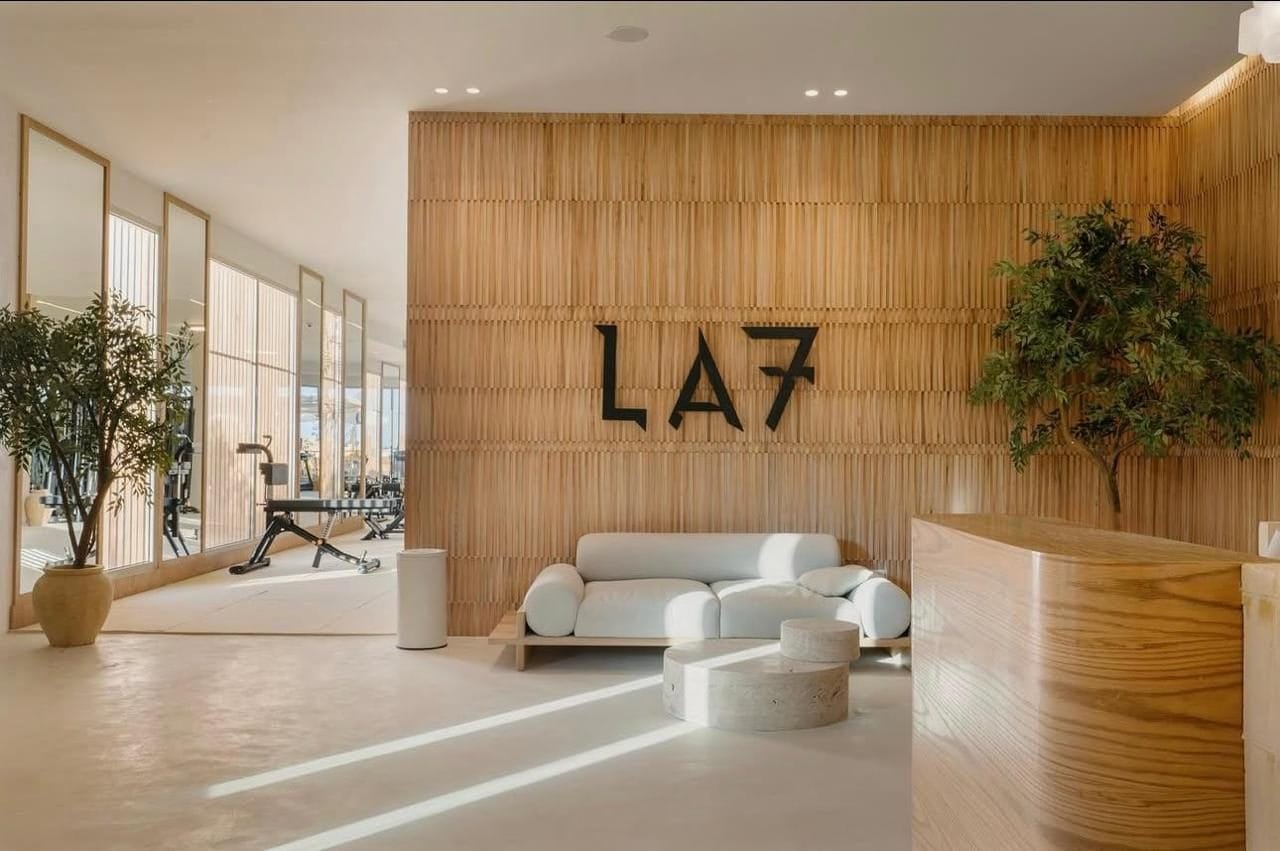
References should be exact, so here is the exact position. Earth Layers has supplied and installed inside the emirate, and none of that work appears here under a project name. The microcement installations we can name sit outside the UAE: the King Fahad Cultural Centre in Riyadh, and the LA7 Wellness Beach Club in Egypt, a coastal leisure building of exactly the type this material is asked to serve on the Gulf. Read both as evidence of what our own crews apply and how, not as a claim about buildings in this emirate. A consultant is entitled to know which is which before the submittal rather than after it.
The company works from Office F27, Saih Shuaib 2, Dubai Industrial City, across Dubai, Abu Dhabi, Sharjah and Al Ain. Abu Dhabi is served from that base rather than treated as an export market, which is why a visit to look at your existing floor before pricing is a normal step rather than a favour, and why samples and a site panel can be sequenced into a fit-out programme instead of arriving at the end of it. Coverage is set out in where we work in Abu Dhabi.
If you are specifying a floor, a wet room, a pool tank or a terrace in the emirate, send the finishes schedule with whatever you know about what is already down — the tile type, its age, the leaks, the drawings if they still exist — through our enquiry page. What comes back is a system named per area, the test data supporting each one, and a written note on what it does not cover. WhatsApp reaches us on +971 50 136 0506, and the wider palette sits on the materials page.