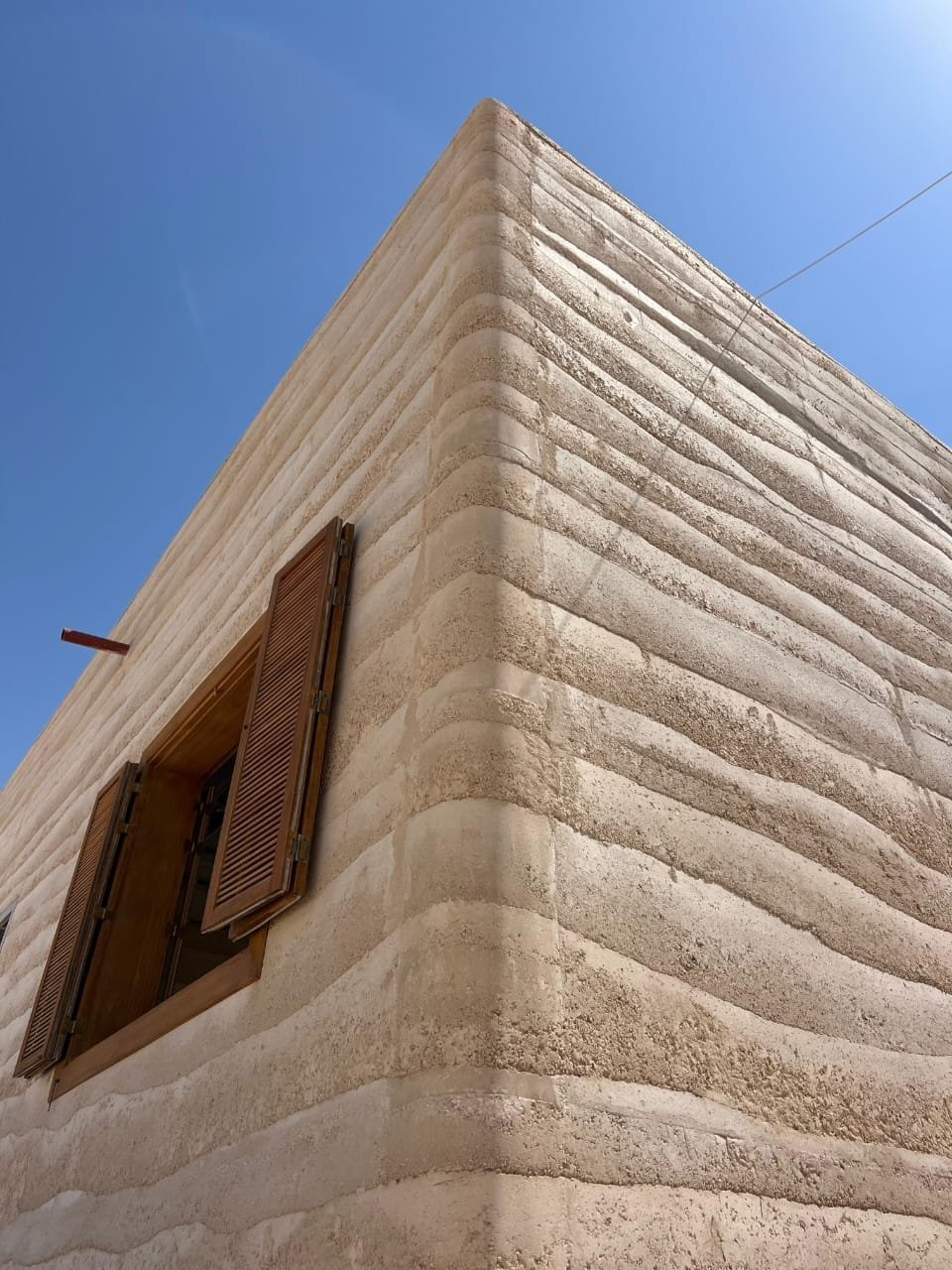
Stabilised rammed earth (SRE) has a small proportion of cement or lime blended into the soil mix before compaction; unstabilised rammed earth relies on clay alone to bind it. Most contemporary structural and external walls are stabilised, because stabilisation raises wet strength and resistance to rain, spray and abrasion.
What is stabilised rammed earth?
Rammed earth is soil — gravel, sand, silt and clay in balance — compacted in lifts between formwork on site. When the forms come off, those tamped lifts read as strata across the face of the wall. That is true of every in-situ rammed earth wall, stabilised or not.
Unstabilised rammed earth uses nothing but that soil and water. The clay fraction is the binder, and it holds the wall together through cohesion between fine particles.
Stabilised rammed earth, usually shortened to SRE, blends a modest proportion of cement or hydraulic lime into the same mix before it is placed. The difference is not cosmetic. It changes how the wall behaves when wet, how it has to be detailed, and how it is tested.
What does stabilisation actually do?
Clay binds by suction and electrostatic attraction between particles, and both weaken as the clay takes on water. That is the central limitation of an unstabilised wall: it is strong and stiff while dry, and progressively less so when saturated.
Cement hydrates and forms a rigid matrix through the fines. The wall then has wet strength. It keeps most of its capacity if it gets soaked, resists abrasion at the surface, and erodes far more slowly under driven rain and wind-blown sand.
Lime works differently. It hardens by absorbing carbon dioxide from the air, which is slower, and it tends to be chosen where a gentler, more vapour-open wall is wanted.
More binder is not automatically better. Past a certain point extra cement adds embodied carbon without a proportionate gain in strength, and can make the wall more brittle and more prone to shrinkage cracking. Mix design is soil-specific, and it is proven by trial panels and testing rather than by a rule of thumb.
| Aspect | Unstabilised | Stabilised (SRE) |
|---|---|---|
| Binder | Clay in the soil only | Clay plus cement or hydraulic lime |
| Wet strength | Softens when saturated | Holds most capacity when wet |
| External use | Needs deep shelter and careful detailing | Standard for exposed facades |
| Surface | Softer, erodes more readily | Harder, resists abrasion |
| End of life | Rewet and reuse as material | Crush and reuse as fill |
| Embodied carbon | Very low, soil and compaction only | Low, rises with cement content |
Why are most contemporary structural walls stabilised?
Three reasons, in roughly this order: exposure, verification and programme.
Contemporary architecture asks earth walls to do things vernacular building rarely did — carry roof loads at modest thickness, hold clean arrises, stand as an exposed external facade with little or no overhang, and sit close to landscaping and irrigation. Stabilisation buys the margin that makes that reasonable.
Then there is verification. Engineers and clients want a number they can check. A stabilised mix can be designed, sampled, cured and tested against a compressive strength target; our acceptance testing is to 8 MPa, referencing New Zealand's earth building standards (NZS), which is not a figure an unstabilised mix would normally reach.
Programme is the third. Modern sites do not wait for a wall to dry out over a season. A stabilised wall gains strength predictably, tolerates a period of exposure before the roof is on, and can be struck and loaded to a schedule.
Where unstabilised rammed earth still makes sense
Interior walls, sheltered courtyards and deeply protected elevations. If a wall is never going to be rained on or splashed, the main argument for cement disappears.
Unstabilised earth also stays reversible. Break it up, rewet it, and it becomes material again, which is a genuine end-of-life advantage rather than a marketing line. It keeps the clay chemistry intact as well, so the wall continues to buffer moisture — clay is hygroscopic by nature.
It carries the lower embodied carbon of the two, for obvious reasons. If that is the driver on your project, read rammed earth sustainability and carbon.
Does stabilisation change the way the wall looks?
Slightly. Cement tends to cool and grey the colour a little, and the harder surface holds sharper arrises and finer form detail. Unstabilised walls often read warmer, with softer edges and a more open grain.
Both give you the strata. The layering comes from compaction in lifts, not from the binder, and it can be emphasised by varying soil colour between lifts or by changing lift heights deliberately.
Where a project cannot carry a structural earth wall at all — a fit-out, a tower interior, a refurbishment — the strata can be achieved as a finish instead. Clayworks Rammed Earth Finish is a clay plaster applied at 7-10 mm that reads as strata on an interior wall. The differences are set out in rammed earth vs rammed earth plaster.
What stabilisation means on a Gulf site
Soil is a local material and no two sources behave the same. Every project starts with characterising what is available, blending to a workable grading, and building trial panels to fix colour, lift height and compaction before the first structural wall goes up.
That work matters more in the Gulf than in a temperate climate. Mixes lose water to evaporation quickly, and the window for compaction moisture content is narrow in summer, so placement rates, curing and protection all have to be planned around it.
We supply and install, with artisans on our own payroll rather than subcontracted crews, which is how compaction stays consistent from the first lift to the last. The complete in-situ rammed earth UAE Pavilion at Expo 2023 Doha was built that way, and it received the Gold Award for Best Self-Built Pavilion.
Choosing between them, and where to start
Reduce it to two questions: how exposed is the wall, and does it need to be verified by test. If it is external or loadbearing and has to satisfy a structural engineer, it will almost certainly be stabilised. If it is internal, sheltered, and valued for material honesty and reversibility, unstabilised belongs on the table.
Either way the decision belongs at concept rather than at tender. Wall thickness, opening sizes, roof overhangs and plinth details all follow from it — how thick should a rammed earth wall be covers the question most teams ask next.
If you are weighing stabilised against unstabilised rammed earth for a project in Dubai, Abu Dhabi or elsewhere in the Gulf, send us the drawings and the site constraints and we will tell you plainly what the wall needs. Enquire here, or message us on WhatsApp at +971 50 136 0506.