Rammed earth carries a low material burden because most of the wall is soil and aggregate that is never fired. Its carbon footprint is driven by three things: how far the material travels, how much cement is used to stabilise it, and how long the wall is expected to last.
Is rammed earth sustainable?
Broadly yes, with conditions worth stating. The material burden of a rammed earth wall is low because the bulk of it is soil and aggregate that has never been fired, and because the wall is structure and finish in one — no blockwork, no render, no skim, no paint, no tiles.
The conditions are the interesting part. A wall built from earth hauled across a country with a heavy cement addition is a different proposition from a locally blended, lightly stabilised one, and honest specification should say which it is.
So the useful question is not whether rammed earth is sustainable in the abstract. It is which decisions on your project make it so.
The raw material: soil, aggregate and no kiln
Fired brick, cement clinker, steel and glass all require high-temperature processing, and that heat is where most of their embodied carbon sits. Rammed earth skips it. The soil is dug, screened, blended, moistened and compacted — mechanical work rather than thermal.
The mix is also mostly inert mineral: gravel, sand, silt and clay in balance. There is no manufactured binder for the bulk of the wall, and in an unstabilised mix there is no manufactured binder at all.
That is the structural side of the picture. In-situ rammed earth is only part of most projects, and the finishes around it count too.
Transport is the number that moves
Earth is heavy and low in value per tonne, so haulage distance dominates its footprint faster than almost any other variable. A locally won or locally blended mix does more for the result than most other choices available on the wall.
In the UAE this cuts both ways. Aggregate and crushed rock are readily available regionally, which helps. But the right grading for rammed earth is a designed blend rather than whatever is nearest, so some components may still travel.
It is worth asking a supplier where each component of the mix comes from, and getting that in writing at tender rather than assuming it at concept.
How much does stabilisation add to the carbon?
Cement is the carbon in a stabilised rammed earth wall — almost all of it. The proportion is modest set against concrete, but it is the dominant line in the calculation, which makes mix design a carbon decision as much as a structural one.
The discipline is to use the least binder that meets the strength and durability the wall genuinely needs, established through trial panels and testing rather than by copying a recipe from another site. Our acceptance testing is to 8 MPa, referencing New Zealand's earth building standards (NZS).
Where a wall is internal or properly sheltered, an unstabilised mix removes that line entirely. Stabilised vs unstabilised rammed earth sets out when that is realistic and when it is not.
How much waste does rammed earth create, and what happens at end of life?
On site, very little. Offcuts are rare because the wall is cast in place, surplus mix goes into the next lift or the next panel, and there is almost no packaging because the material arrives loose.
At end of life, an unstabilised wall can be broken up, rewetted and used again as material. A stabilised wall behaves more like concrete: crushable and reusable as fill, but not returnable to soil. Neither outcome is a failure, and both are worth stating accurately on a sustainability submission rather than glossed.
The larger saving sits upstream. A monolithic earth wall replaces the block, the render, the skim, the paint and every future redecoration cycle that would have followed.
Durability is part of the sustainability case
A low-footprint material that has to be replaced twice is not a low-footprint material. Rammed earth's argument depends on the wall lasting, which in the Gulf means getting the plinth, the capping, the overhang and the irrigation detailing right at the start rather than fixing them later.
Detailed properly it is a long-life, low-intervention wall with no coating cycle and no repainting. Rammed earth durability and lifespan goes through what actually threatens an earth wall in this climate and how each risk is designed out.
How rammed earth contributes to WELL, LEED and Mostadam scorecards
Natural finishes contribute to WELL, LEED and Mostadam scorecards. They are not certified under them, and any supplier who says otherwise is overselling. Certification is awarded to a building, assessed as a whole, with documentation behind every claim.
Where rammed earth typically helps is in credit areas concerned with material sourcing and regional extraction, with reduced processing and material transparency, with indoor air quality and low-emitting materials, and with thermal comfort and energy performance through mass.
Interior finishes reach the same categories from another direction. Clay plaster has nothing to off-gas and helps hold a room between 40 and 60% relative humidity; lime plaster hardens by absorbing carbon dioxide from the air and resists mould by its own chemistry. Clayworks materials sit behind most of that work, and we are their sole authorised distributor and approved applicator across the Middle East.
What assessors want in the end is evidence: sourcing declarations, product data and installation records. That is a documentation exercise, and it runs more smoothly when the supplier and the installer are the same company.
Where to start on a UAE project
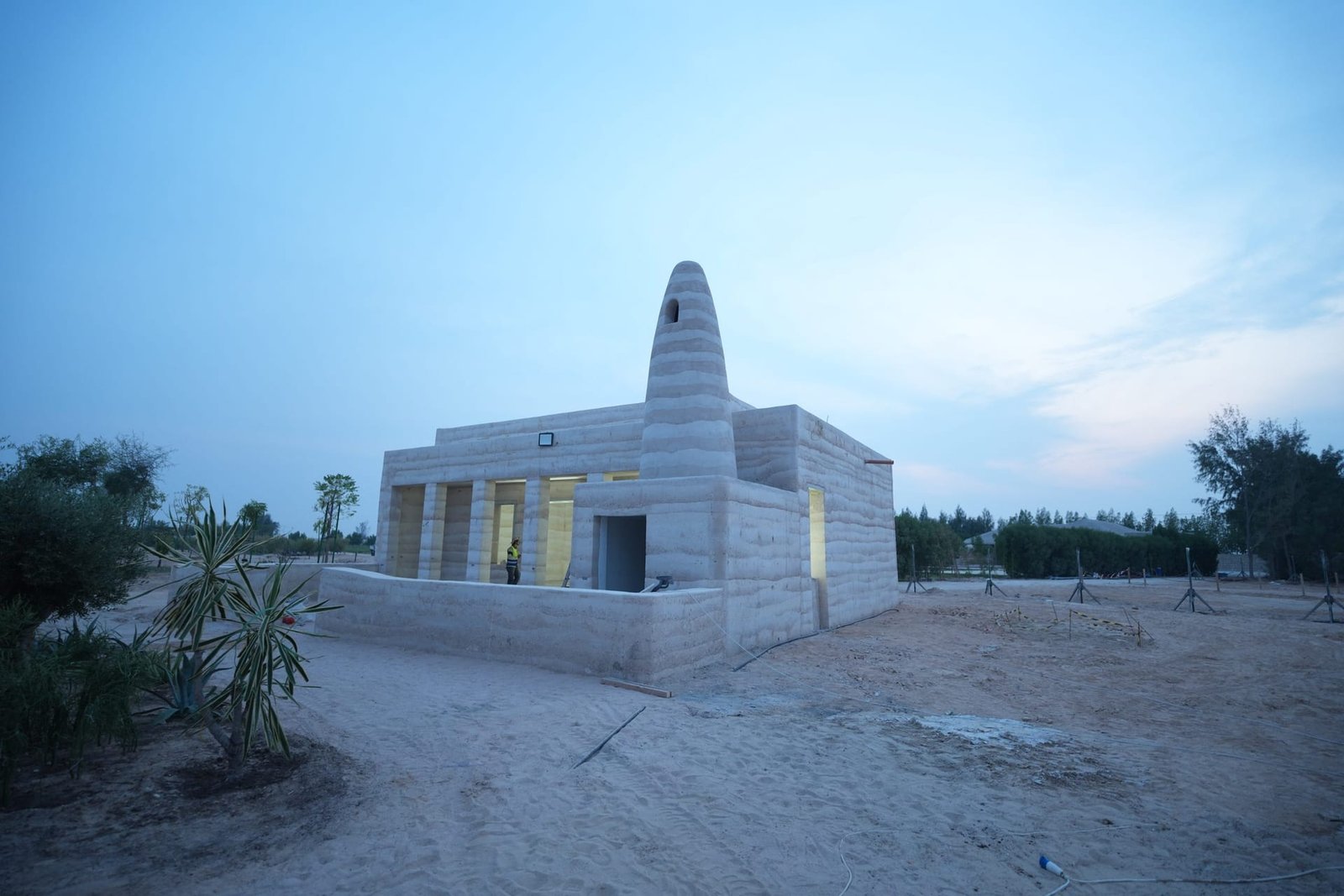
The complete in-situ rammed earth UAE Pavilion at Expo 2023 Doha is a full-scale demonstration of what the material does as a building rather than as a sample, built by crews on our own payroll rather than subcontracted.
We supply and install, and we are the exclusive Middle East distributor for the materials we install, so the sourcing chain behind a submission is short and traceable rather than assembled after the fact.
If you are targeting a WELL, LEED or Mostadam rating on a project in Dubai, Abu Dhabi or elsewhere in the Gulf and want to know what rammed earth and natural finishes can genuinely contribute, tell us the scheme and the stage you have reached. Enquire here, or message us on WhatsApp at +971 50 136 0506.