
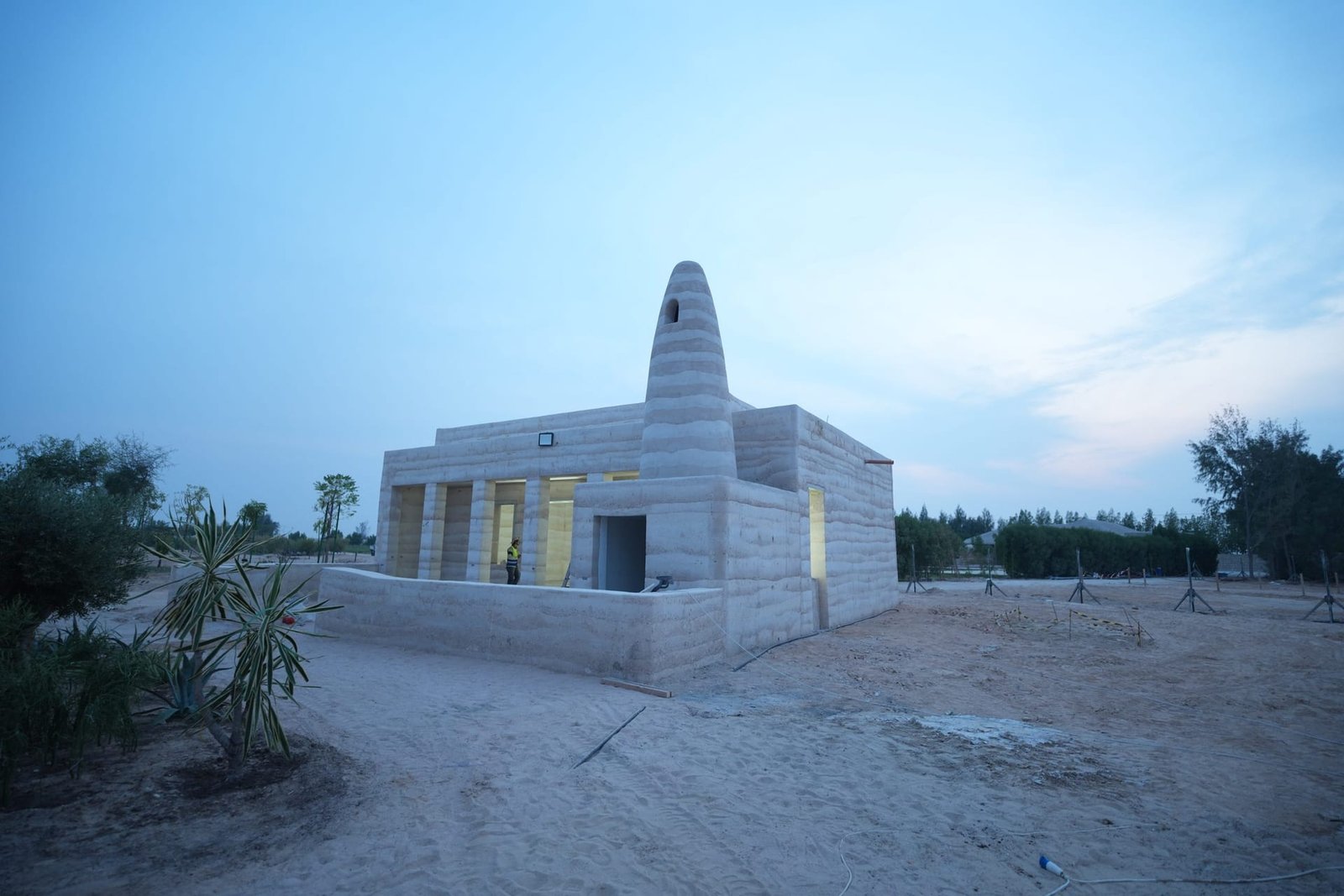
Rammed earth walls can last for centuries, and surviving examples across Europe, Africa and Asia prove it. Lifespan is decided less by the earth than by detailing: a dry base, a good roof or coping, controlled water at the top and bottom, and honest maintenance.
How long do rammed earth walls last?
Centuries, when they are detailed properly. Rammed earth structures still standing in Europe, North Africa and Asia are the plainest evidence there is, and they were built without any of the mix control, compaction equipment or testing available today.
There is a simple reason for this. Rammed earth is inert mineral material. It has nothing organic to rot, no coating to fail, no film to peel and no embedded steel to corrode and burst the surface. Most building materials fail at their weakest applied layer; rammed earth does not have one.
What it does have is a sensitivity to water. A well-detailed wall with a dry base and a good cap can comfortably outlast the building it belongs to. A badly detailed one can show visible erosion within a few seasons. The spread between those two outcomes is enormous, and it is entirely in the design. If you are new to the method, start with what rammed earth is.
What actually decides rammed earth durability?
Water, arriving in three ways. From above, as rain landing on the top of the wall and running down the face. From below, as moisture drawn up out of the ground by capillary action. And from within, as vapour that has no route out because something impermeable has been applied to the surface.
The old builders' maxim covers the first two: an earth wall needs a good hat and good boots. A coping or overhang at the top that throws water clear, and a dry plinth at the base with a capillary break and drainage away from the foot. Get those right and most of the durability question is answered.
The third factor is compaction quality, and it is the one you cannot inspect later. Under-compacted lifts are the weak seam where water finds a way in and where erosion starts. Consistent moisture content, consistent lift depth and consistent ramming are what produce a wall that ages evenly. That is a crew discipline before it is a specification.
Wall geometry, height and exposure also matter, and they belong with the engineer as much as the architect. Our structural guide to rammed earth covers that side of it.
How does rammed earth age?
It weathers rather than fails, and the distinction is worth holding on to. On exposed faces, a little of the fine material is lost over the years, the coarser aggregate reads slightly more strongly, and the strata become more legible. The wall softens; it does not break down.
There is no flaking, peeling, blistering or delamination, because there is no applied film to fail. Colour shifts gently over time as the surface weathers, in the same way stone does. Most clients find the wall looks better at ten years than at one.
Dust is the Gulf-specific reality. It settles on the small horizontal ledges left by the lifts, which is part of the character of the material but does gradually change the tone of a wall. It brushes or rinses off, and how often you bother is an aesthetic decision rather than a durability one.
The detailing that decides lifespan
Copings and overhangs come first. A metal or stone cap with a generous drip, or a roof overhang that genuinely throws water clear of the face, removes the single biggest source of erosion. Flush details that let water sheet down the wall are the most common cause of visible damage we are asked to repair.
The base is next. A plinth that lifts the earth clear of splash-back, a proper damp-proof detail, and ground that falls away from the wall rather than towards it. On sites with high groundwater or low-lying landscape, this needs coordinating with the civils rather than treated as a finishing detail.
Openings need reveals, sills with drips, and a strategy for where water goes when it hits a frame. Uncontrolled runoff from a window head down a rammed earth face will leave a permanent mark long before it causes structural harm.
Services and fixings should be planned and cast in during construction. Drilling into rammed earth afterwards is possible, but it is far better to set out the positions before the lifts go in. On the question of surface water resistance and treatments, see is rammed earth waterproof.
Does the Gulf climate shorten or extend the life?
In broad terms, conditions across the UAE and much of the Gulf favour the material. Low annual rainfall and long dry periods are exactly what an earth wall wants, and heat alone does nothing to it.
The threats here are specific rather than climatic. Short, intense downpours that overwhelm poorly formed copings. Irrigation, which is realistically the most common cause of damage we see: a misdirected sprinkler playing on the base of a boundary wall will do more harm in a year than a decade of weather. Coastal air carrying salt, and groundwater on low-lying sites.
Soluble salts deserve a word. They travel with moisture and crystallise where the surface dries, which can leave deposits and, over time, disrupt the face. The control for salt is the control for water: keep the wall dry at its base and shed water at its top, and the problem largely does not arise.
The buildings at Al Kaaban Resort in Qatar cover guest accommodation, a mosque and minaret and long runs of boundary wall, all in genuinely exposed Gulf conditions. That range is a fair test of how the detailing has to work in practice.
Strength, stabilisation and what testing tells you
Our acceptance testing is to 8 MPa, referencing New Zealand's earth building standards (NZS). Testing on the project mix is what matters, because rammed earth performance depends on the specific soil and the compaction actually achieved on site, not on any general figure.
Stabilisation with a small proportion of cement raises early water resistance and surface hardness. Unstabilised rammed earth relies more heavily on the mix, the compaction and the detailing. Both approaches produce durable walls; the choice depends on exposure, geometry and the surface character you want.
One caution: do not confuse strength with durability. A high-strength mix in a badly detailed wall will still get wet, and a wall that stays wet will still erode. Compressive strength tells you about structural capacity. Detailing tells you about lifespan.
Maintaining a rammed earth wall, and how to start
Maintenance is genuinely light. Brush or rinse the lift ledges when dust builds up. Keep drainage at the base clear. Check coping fixings and joints annually, and look at the foot of the wall after heavy rain to confirm water is going where it was meant to go.
Repairs are made with matching earth, and because the material is mineral throughout, a patch weathers into the wall rather than staying visible as a scar. There is no repaint cycle to budget for, which is a real difference over a twenty-year horizon. Our guide to rammed earth maintenance in the Gulf sets out a practical routine.
Earth Layers supplies and installs, with the artisans who build the walls on our own payroll. Lifespan is made on site — in the compaction, the copings and the base detail — which is why we would rather be in the conversation at design stage than asked to price a drawing that has already fixed the details.
Send us your elevations, exposure conditions and site levels through our enquiry page, or message us on WhatsApp at +971 50 136 0506. We will tell you plainly what the wall needs to still be standing well in fifty years.