
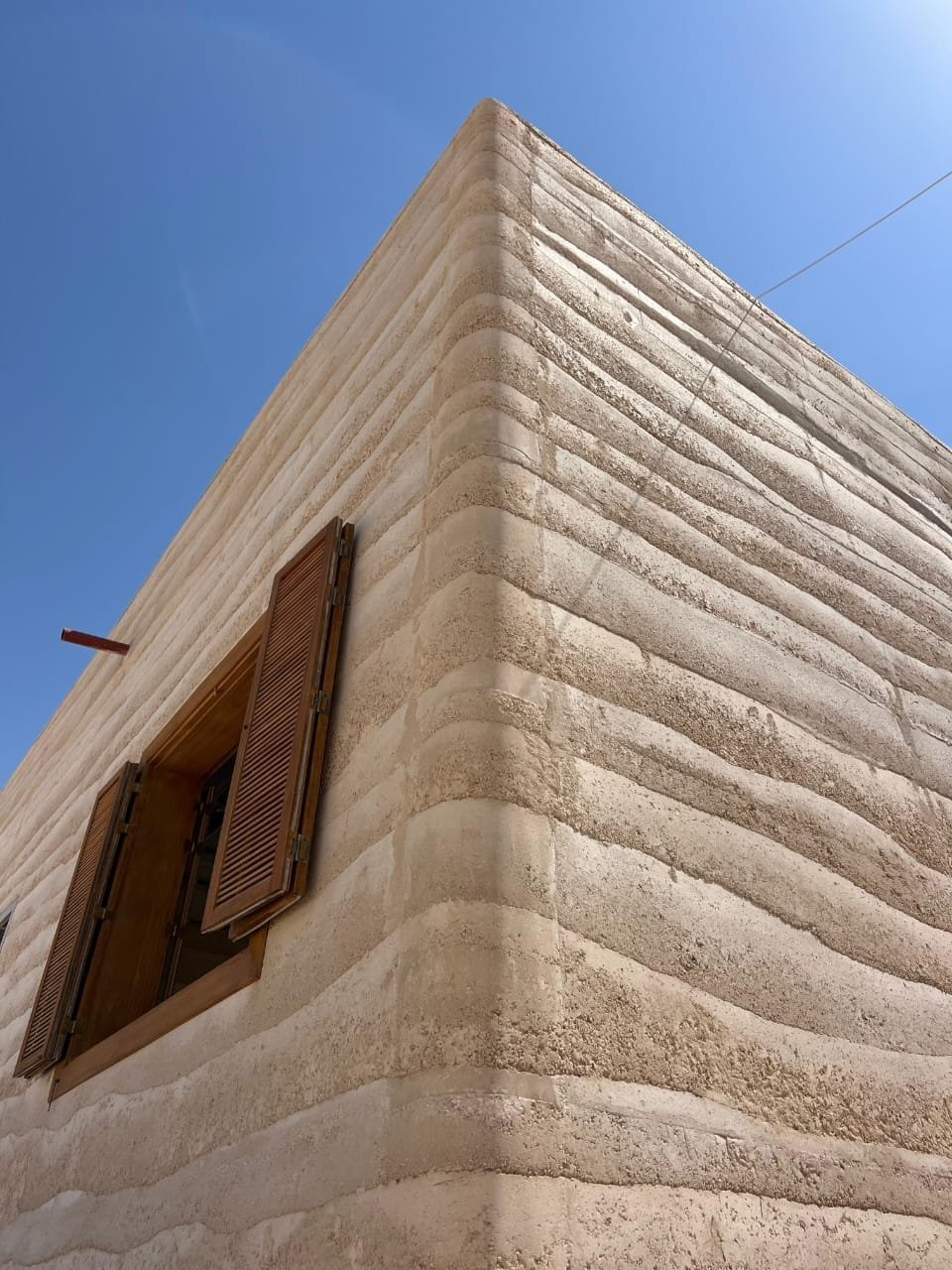
Rammed earth is not waterproof, and it does not need to be. A well-built, stabilised wall is water-resistant: it sheds rain, absorbs a little moisture at the surface and dries back out. Durability comes from detailing, a good hat, good boots and a compacted, capped top.
Is rammed earth waterproof?
No. Rammed earth is water-resistant, not waterproof, and the difference is worth being precise about. A waterproof material stops liquid water passing through it. A water-resistant wall slows water down, absorbs a small amount at the surface, and gives it back to the air when the rain stops.
That is how earth buildings have stood for centuries in climates far wetter than the Gulf. The failure people picture, a wall softening and slumping in a downpour, comes from bad detailing rather than from earth being inherently fragile.
Two things keep water out of an in-situ rammed earth wall: the density achieved by compacting the mix in thin lifts, and the way the wall is capped, drained and kept clear of standing water. Get both right and rain is a non-event. Get either wrong and you will see it inside a season.
What happens when rain hits a rammed earth wall
Rain on a compacted earth wall does two things at once. A small proportion is drawn into the outer few millimetres by capillary action; the rest runs off down the face. When the shower passes, the absorbed moisture migrates back to the surface and evaporates.
Rammed earth is vapour-open, so it dries in both directions instead of trapping moisture behind a film. That is the opposite of a painted cement render, where water that finds a way in behind the coating has nowhere to go and eventually pushes the coating off the wall.
The condition to design out is sustained wetting. A wall soaked repeatedly with no drying period, from a leaking downpipe, an irrigation head pointed at the base or a planter pressed against the face, will soften locally. A wall that wets and dries in cycles stays stable, which is the basis of rammed earth durability and lifespan.
Does rammed earth erode in heavy rain?
Unstabilised earth does erode under driving rain, but slowly and measurably rather than dramatically. Most contemporary external rammed earth is stabilised with a modest proportion of cement or lime, which binds the fine fraction and raises resistance to surface erosion considerably.
Density does the bulk of the work. Our acceptance testing is to 8 MPa, referencing New Zealand's earth building standards (NZS). Compressive strength is not a direct measure of water resistance, but a mix compacted well enough to reach that figure is a dense mix with few connected voids, and that is what keeps water at the surface. The choice of mix is set out in stabilised versus unstabilised rammed earth.
The strata that make the finish legible are density and colour variations through the wall, not open joints. A properly compacted lift interface is as dense as the lift above it, so there is no ledge for water to sit in. Where a wall does weather, it weathers evenly and slowly, and it reads as patina rather than damage.
How are rammed earth walls protected from water?
The old rule in earth building is a good hat and good boots. The hat is a cap, coping or generous overhang that keeps water out of the top of the wall, where the horizontal lift faces are most exposed. The boots are a plinth or upstand that lifts the base clear of splash-back, ponding and irrigation.
Between hat and boots sit ordinary details done properly: drips under projecting elements, falls that take water away from the wall rather than towards it, no flat ledges that hold puddles, no planting beds tight against the face, and a damp-proof course between the wall and whatever it stands on.
On very exposed elevations a breathable water-repellent can be applied to the surface. It reduces capillary uptake while still letting vapour out, and it is a maintenance item rather than a permanent seal. It also changes how the wall darkens when wet, so it is a decision to take at design stage rather than after handover. Maintenance in Gulf conditions sets out what re-treatment involves.
Rammed earth, humidity and ground salts in the UAE
Rain in the UAE is infrequent but concentrated, and walls in Dubai and Abu Dhabi spend far more of the year in high humidity than in rain. Ambient humidity alone does not harm a compacted earth wall. Earth is hygroscopic: it takes up and releases water vapour with the surrounding air, and that exchange happens at the surface without touching the structural core.
Ground-borne moisture is the more serious risk in the region. Where a wall sits on damp or saline ground, capillary rise can carry salts up into the base, where they crystallise and spall the surface. A damp-proof course, a raised plinth and drainage that moves water away from the foot of the wall close that path off.
Wind-driven sand and dust are the other Gulf factor. They abrade a surface slowly, and they mean any surface treatment has to be chosen on the understanding that the wall will be cleaned periodically rather than left untouched.
Can rammed earth be used in bathrooms and wet areas?
Rammed earth is fine as an interior wall in a bathroom that is not a direct-water zone: a dry wall in a large bathroom, or a feature wall behind a freestanding tub set away from the spray. Inside a shower enclosure, or immediately around a basin, it is the wrong material.
The same rule governs Clayworks Rammed Earth Finish, the 7-10 mm clay plaster that reproduces the strata look on interior walls. Clay plaster goes on walls and ceilings only: never floors, never direct-water zones. It is a good way to bring the language of an earth wall into a space where a structural wall is not practical, and the difference between the wall and the finish is worth understanding before either reaches a specification.
Wet areas belong to lime. Lime plaster and tadelakt are what we use in showers and around basins: tadelakt is burnished and soap-treated so that water beads and runs off, and lime hardens by absorbing carbon dioxide from the air and resists mould by its own chemistry.
Specifying rammed earth that handles water
Most water problems in earth walls are drawn rather than built. By the time a wall is standing, the cap, the plinth, the drainage falls and the landscaping around it are already fixed, so we prefer to be in the conversation while those are still on paper.
We supply and install, and the artisans who ram the walls are on our own payroll rather than subcontracted. At Al Kaaban Resort in Qatar our crews built guest buildings, a mosque and minaret and boundary walls in in-situ rammed earth; the UAE Pavilion at Expo 2023 Doha was a complete in-situ rammed earth pavilion built the same way.
Send drawings or a description of the site and its exposure through our enquiry page, or message us on WhatsApp +971 50 136 0506. We will tell you plainly whether rammed earth suits the position, and what the detailing around it has to do.