
What rammed earth durability really means
Rammed earth durability is sometimes discussed as though the material were fragile. It is not. An in-situ wall is rammed in lifts between formwork as a dense, monolithic mass, and on our projects walls are acceptance tested to 8 MPa referencing New Zealand's earth building standards. That is a structural material, not a decorative veneer.
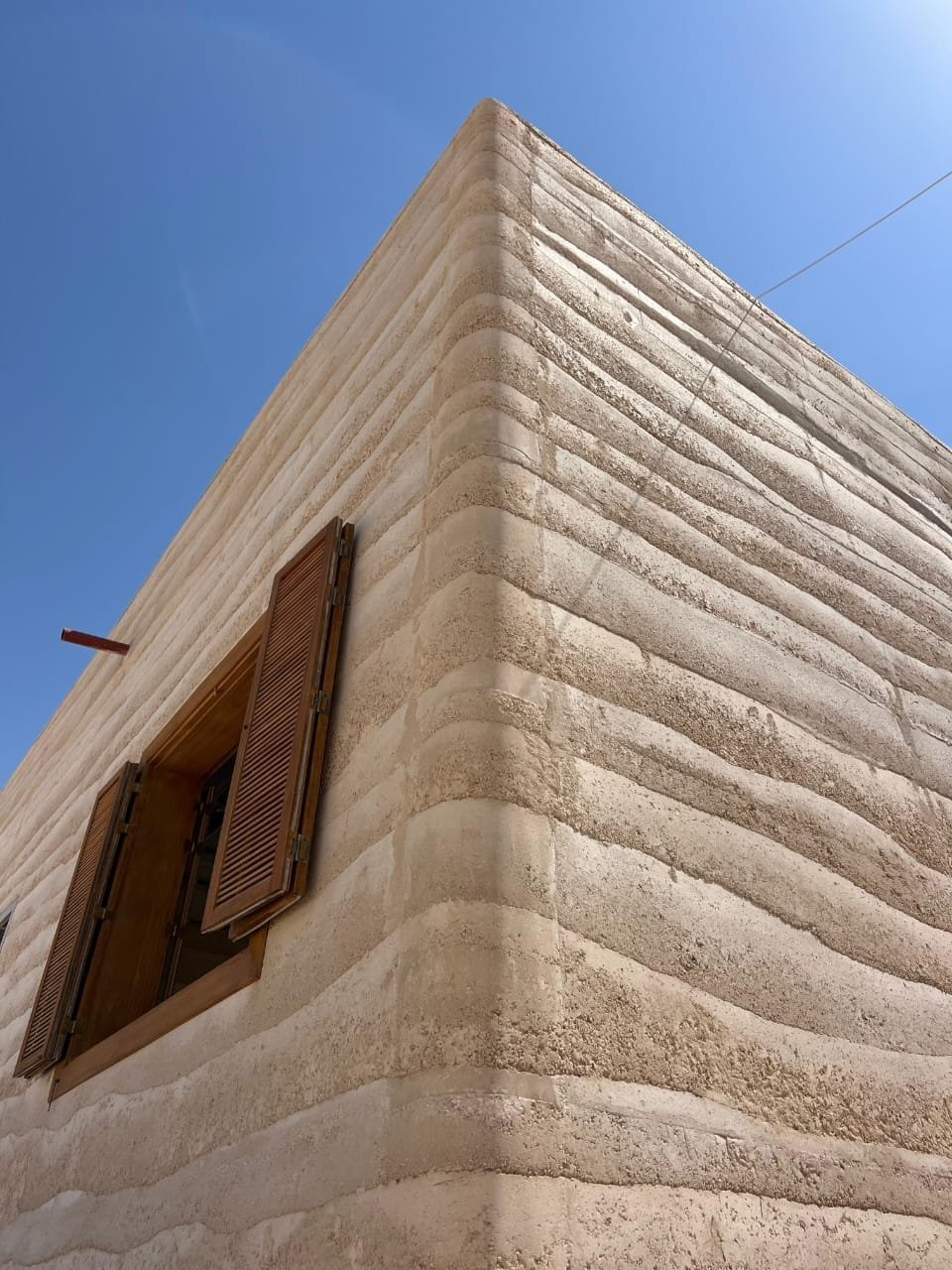
What earth walls do over decades is change at the surface. Fine particles wear from the face, sharp corners soften, and the tamped strata become slightly more pronounced. On a thick monolithic wall this weathering is a surface story — the mass behind it keeps doing exactly what it was designed to do, which is why earth buildings survive for generations across hot, arid regions.
How the Gulf climate works on an earth wall
In most respects the Gulf climate is kind to earth construction. Heat and ultraviolet light do very little to a mineral wall: there is no paint film to chalk, no resin to yellow, and the colour comes from the earth and aggregates in the mix rather than from a coating. The wall's mass also takes the daily temperature swing in its stride.
The pressures to plan for are water and salt. Rain is rare here but arrives hard, so run-off concentrates at wall heads and bases. Near the coast, salt-laden humidity and wind-borne sand work slowly on exposed faces. The guest buildings, mosque and boundary walls at Al Kaaban Resort in Qatar were all rammed in lifts on site and stand in precisely this climate.
Good detailing does most of the maintenance
The old rule for earth walls — a good hat and good boots — still decides how they age. Copings and overhangs stop run-off streaming down the face, and a robust plinth lifts the earth clear of splash and ponding. Irrigation deserves particular attention: in Gulf landscapes, a misdirected sprinkler will do more damage to a wall base than the weather ever will.
There are honest limits. Rammed earth does not belong where water stands or splashes constantly, exposed corners can chip under impact from trolleys or vehicles, and fixings should be planned rather than improvised. Get the detailing right, though, and the format performs at scale: the UAE Pavilion at Expo 2023 Doha was a complete pavilion in in-situ rammed earth, built by our own crews and awarded Gold for Best Self-Built Pavilion.
A realistic rammed earth maintenance schedule
For owners and FM teams, rammed earth maintenance is light but should be deliberate. Plan an annual walk-over: confirm copings and drainage paths are clear, check that irrigation is not wetting the wall base, and note any chipped corners or patches of accelerated wear. Ten minutes per wall, once a year, catches almost everything early.
Some light dusting from the face in a wall's first months is normal and settles down. Avoid film-forming sealers, which can trap moisture inside the wall; protection should come from detailing and the mix itself. Where damage occurs, repairs use a matched mix tamped into the prepared area — a fresh patch reads slightly different at first, then tones in.
For budgeting alongside upkeep, our note on rammed earth cost in the UAE sets out what actually drives price on real projects.
When the plaster finish is the right answer indoors
Not every brief needs a full structural wall. For interiors — fit-outs, upper floors, refurbishments where formwork and ramming are impractical — Rammed Earth Finish by Clayworks delivers the strata look as a 7-10 mm clay plaster on interior walls. We are Clayworks' sole authorised distributor and approved applicator across the Middle East, and the artisans who install it are on our own payroll.
Indoors the material brings quieter benefits too: clay walls help hold a room between 40 and 60% relative humidity, with nothing to off-gas. If you are weighing the two routes, our comparison of structural rammed earth versus the plaster finish walks through when each one makes sense.
Plan for patina, not perfection
A well-detailed rammed earth wall in the Gulf should be judged the way stone is judged: expect slow, even surface change that adds character rather than signalling decline. The failures worth worrying about are almost always detailing failures — water where it should not be — and they are preventable at design stage rather than expensive to manage afterwards.
If you are specifying earth walls or the plaster finish for a project in the UAE, send us your finishes schedule and we will come back with honest guidance on exposure, detailing and upkeep — or message us on WhatsApp at +971 50 136 0506.