
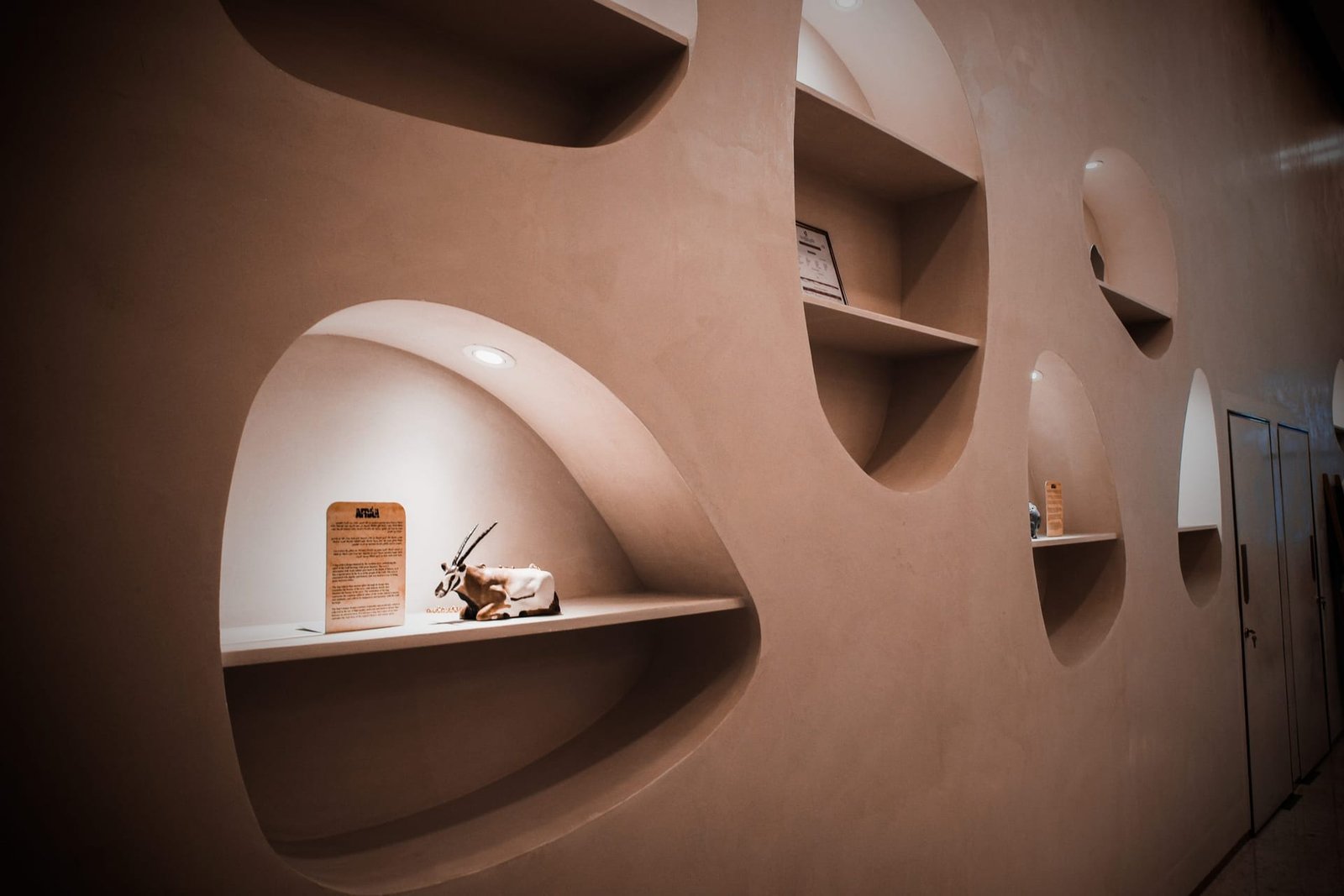
Lime plaster in Dubai is a mineral finish applied at 1 to 3 mm over a primed, true substrate. Microtadelakt, the polished lime system we install, is trowelled in graded coats, burnished, and sealed where the room takes water. It is vapour-open, mineral through its section, and repairable by hand. It is not a tanking layer, and although the material can be laid horizontally, we specify microcement for Dubai floors, because a floor is judged on wear and on how a local repair reads years later.
What a mineral lime finish is at one to three millimetres
Lime plaster in Dubai usually means a thin polished mineral system rather than the thick traditional render the name suggests. The Microtadelakt we install is a hydraulic lime plaster carrying marble dust, supplied as a single-component powder in four grain sizes — Base, Medium, Regular and Fine — and declared to UNE-EN 13813. The build-up is two coats of Base to establish the plane, then finish coats in whichever grain the approved panel calls for, at a total applied thickness of one to three millimetres. It is not a coating in the paint sense: the material is mineral through its section, and the sheen comes from compressing the surface with a trowel rather than from a film laid over the top of it.
Because the whole system is thinner than a fingernail, everything underneath it matters more than it would beneath a render. It goes over Primer 100, a water-based adhesion promoter used undiluted at six to eight square metres per litre, with the first finish coat following not less than thirty minutes and not more than eight hours after priming. Coats are separated by around four hours and a light sand at 40 or 80 grit, and pot life is roughly three hours at 20 °C. Those figures are what turn a decorative idea into a sequence a Dubai site manager can actually programme. The system sits on our lime plaster page in full.
One more thing follows from the thinness: the same powder produces several surfaces. Worked wet-on-wet it takes a high sheen; worked wet-on-dry it stays low and matt; the grain chosen for the last coat changes how much movement reads across the plane. That is why a product name is never a specification. Sheen, colour movement and the way the plaster turns an arris are settled first on a sample panel and then on a full-size trial area applied to your own wall, in the light that room actually gets. Everything afterwards is measured against the panel you signed, not against a photograph or a rendering.
Why lime suits a hot, conditioned Dubai interior
Dubai interiors run under air conditioning for most of the year, and the moisture does not stay still. Months of dry, over-cooled air are followed by a coastal summer in which the outdoor dew point sits high and every opened door pushes humidity into the building. A mineral lime finish stays vapour-open: the Microtadelakt system falls in Class 1 for water vapour transmission to UNE EN ISO 7783-2:2012, its Sd value under five metres. In a climate where the conditioned face of the wall is the cold one and vapour pressure drives inwards, a surface that does not seal the build-up shut is worth having on the schedule.
Two other numbers matter to a Dubai specifier. The system is classified A1 for reaction to fire under UNE EN 13501-1:2019, which is the classification consultants ask for in hotel corridors, lobbies and escape routes, and it settles an argument a decorative wall finish otherwise has to win at submittal. Thermal conductivity is 0.46 W/mK. That is useful context inside a build-up calculation and nothing more — three millimetres of plaster is not insulation, and it should never be put in front of a consultant as though it were.
Lime is also strongly alkaline, reading pH 12 a day after application, which is why our applicators work in gloves and eye protection. An alkaline mineral surface with nothing organic in it offers mould very little to feed on, and it resists growth on that basis. It does not deal with the cause. Mould in a Dubai bathroom comes from condensation, from ventilation that was value-engineered, and from water finding a path behind something. No wall finish repairs a design that produces it, and any supplier saying otherwise is selling the wrong answer to the right question.
Polished lime plaster and true tadelakt are not the same thing
Tadelakt is a technique before it is a product. Lime is laid in thin coats, compacted with a smooth stone while it is still green, then treated with olive-oil soap so the fatty acids react with free lime at the surface. It varies across a wall, it cannot be rolled or sprayed, and the window in which the plaster is still soft enough to compress but firm enough to hold governs the whole working day. We install it, and the chemistry is set out properly in what is tadelakt rather than repeated here.
Microtadelakt reaches a comparable surface by a different route: graded coats, a burnishing pass, then a sealer chosen for the room it is in. It repeats more predictably across large areas and it prices and programmes more reliably, which is why a good number of Dubai fit-outs asking for tadelakt are, when the build-up is written down, specifying this instead. Neither is the better material. They answer different briefs, and we set them beside microcement in polished plaster vs tadelakt vs microcement.
What both do that few finishes manage is turn a corner without a joint. The curved display walls at Afraa Boutique in Lusail and the arched halls of the Calligraphy Museum in Madinah sit outside the UAE and are offered here as technique references, not as Dubai work. They are the useful ones to look at when a Dubai scheme has coves, soffits or arches that a jointed material would have to fake, and when a client wants to see what a hand-worked mineral surface does across a whole room rather than on a sample board.
Substrate, movement, and what a three-millimetre finish inherits
At one to three millimetres the finish inherits its background. The manufacturer's sheet asks for substrates that are clean, free of grease, consolidated and true in planimetry, and that last requirement is the one that catches Dubai projects out. A blockwork-and-render wall perfectly acceptable under paint is not acceptable under a polished lime plane, where a shallow hollow catches raking light along its whole length. Walls out of plane are brought back into tolerance with Microtadelakt Thick Base at 5 to 15 mm, applied over the primer before any finish coat begins, and that levelling work belongs in the price rather than in the argument.
Where that build passes 10 mm, or where it crosses from blockwork to concrete to a plasterboard return, an alkali-resistant fibreglass mesh is bedded continuously into the first wet coat and lapped 100 mm at joints and around openings. It is an unglamorous line in a method statement and it is the one that decides whether a crack traces the block-to-column junction two summers later. Where the background changes material we would want the mesh whether or not the levelling reaches 10 mm, because the crack follows the change in stiffness rather than the thickness.
Then the honest limit. A mineral finish three millimetres thick does not bridge a moving joint, does not hold a cracked substrate together and does not conceal a structural problem — it reports one. Movement joints in the background have to be carried through the finish rather than plastered across, and their positions belong on the drawings before the first coat of primer, because a joint introduced afterwards is a cut line through a surface whose entire appeal is that it has no lines in it.
The sealed build-up for a Dubai wet room
In a bathroom or a hammam the lime plaster is half the specification and the sealer is the other half, and the sealer comes with a gate. Sealing follows hardening inside a window of roughly one to two days, and only when a meter reads under 5 per cent moisture at the surface. The choice is between Aquamax, the water-based route, and Maxipur 100%, a two-component aliphatic acrylic polyurethane in matt, satin or gloss at eight to nine square metres per litre with a recoat window running from four hours to three days. Miss the top of that window and the surface has to be abraded before the next coat goes on.
The test data is strong and should still be read carefully. The system is Class II for permeability to liquid water to UNE EN ISO 1062-3:2008, and under UNE EN 14891:2017 it showed no penetration under direct pressure at 5 bar over three days. Some published figures are measured without the sealer in place, and the manufacturer marks which ones. None of it makes the finish a tanking layer. Waterproofing, falls and drainage sit behind and below the plaster exactly as they would behind tile, which is the whole argument in is tadelakt waterproof.
A wet room also decides how the work is broken up. A trowelled mineral surface has no joints in it, so the bay is the room: shower walls, the niche, the bench, the reveal and the return are worked in one continuous session while the material is still open, and a crew that stops in the wrong place leaves a line no amount of polishing removes. Dubai heat shortens that window, which is why we programme wet rooms as whole rooms rather than as square metres. Where the plaster meets a tray, a glass screen or a threshold, the stop is detailed on a drawing, because a hand-formed edge cannot be improvised twice to the same profile.
Floors, and why Dubai floors go to microcement instead
Lime is wall, soffit and arch work in our schedules. It suits showers, hammams, vanity surrounds, feature walls, lobbies and stairwells, and it follows a curve that a tiled solution can only approximate. The data sheet does carry horizontal figures — a slip-resistance class of USRV 41 and compressive strength above 40 N/mm² — so the honest answer to whether the material can be laid on a floor is that it can. We still send Dubai floors to microcement, and the reason is not strength. It is what happens to a hand-worked surface after five years of chair legs, sand carried in underfoot, and a leak that had to be chased through the slab.
Repairability is the whole argument, and it cuts both ways. A lime wall is repaired by hand: the damaged area is cut back, re-plastered, re-burnished and resealed, and on a vertical surface read in one plane that patch settles into the wall within weeks. A floor is not read that way. It wears unevenly at doorways and under furniture, so a patch laid into a five-year-old floor meets a surface that has already changed, and the mend announces itself in exactly the low sun a floor always gets. In year six that difference is the entire conversation, and it is better had at concept stage.
The only boundary lime itself owns is water, and it belongs on the schedule early. The wall that gets wet is lime's, specified as the sealed build-up above; the dry wall in the bedroom next door is usually clay plaster, which stays on interior walls and ceilings. Which family belongs in which room, across a whole villa and in one place, is set out in choosing natural finishes room by room. What no schedule can do afterwards is move that boundary: a dry-side finish cannot be sealed into a wet-side one once the wall is up, and finding out at snagging costs the wall.
Curing, sealing, and what a Dubai programme has to allow
Lime sets in hours and carbonates for months, and both facts belong on the programme. Coats sit about four hours apart with a sand between them, three hours for wet-on-dry work, so a lime wall is never one bar on a Gantt chart. Nothing about carbonation can genuinely be accelerated either: heat and fans dry a lime surface, which is not the same as curing it, and drying it too fast is a reliable way to weaken the finish. Air conditioning blowing straight onto fresh work is the condition to watch on a Dubai site, along with sun through an unglazed opening.
The constraint that actually moves handover dates here is the sealer's own window. Maxipur is applied between 12 and 25 °C at relative humidity below 80 per cent, and never onto a plaster still reading above 5 per cent moisture. In a Dubai August, in a shell that is not yet conditioned, not one of those three conditions is automatic. The realistic sequence is to close the building, get temporary cooling and dehumidification running, take a meter reading, and then seal — rather than sealing to the diary and finding out in month four which of the three was missing.
So lime is booked late and given a clear run: after the wet trades, after first fix, once the envelope is closed and the room can be shut to following trades. A fresh lime wall used as a route for scaffold, ladders and cable pulls is the expensive version of this conversation, and it is expensive precisely because the finish is repairable by hand. Someone will be repairing it by hand, at the end of a programme with no float left in it, in the same room the client is waiting to be shown.
Maintenance, documents, and how to get a Dubai wall specified
Maintenance depends on which system is on the wall. True tadelakt is renewed by re-soaping and re-polishing and can be brought back indefinitely; a sealed Microtadelakt is cleaned with a mild, pH-neutral product and is patched and resealed locally where it is damaged. What damages either is acid. Lime is calcium carbonate, so vinegar, descalers and limescale removers etch the surface — a live risk in Dubai, where hard water leaves scale on glass and taps and the instinct is to reach for exactly the wrong bottle. Say so to the housekeeping team once, in writing, at handover.
On paperwork we would rather be exact than flattering. The Microtadelakt system holds emission and content test reports from Applus Laboratories, an A+ rating for indoor-air emissions under UNE EN 16516:2018, and the fire classification quoted earlier. Our credentials page lists every document we hold, who issued it and when it lapses, while what each kind of document is evidence of is worked through in Estidama, Pearl and your finishes. Dubai's own green building system, Al Sa'fat, is where a Dubai submittal starts, and since this material is manufactured in Spain it adds nothing to the regional-materials share — the clause is in Al Sa'fat and your finishes schedule.
Lime is the finish where the material and the hands are one decision, so we price them as one: we supply the plaster and apply it ourselves, with roughly 200 applicators kept on our own sponsorship instead of hired package by package. Before any of that, a sample settles the colour and a trial area on your wall settles the sheen, because sheen is the property that moves when the technique moves. The enquiry page is where to send the room list, the wet-room details and the waterproofing specification; we come back with build-ups and a sealing date you can actually hold. WhatsApp reaches us on +971 50 136 0506.