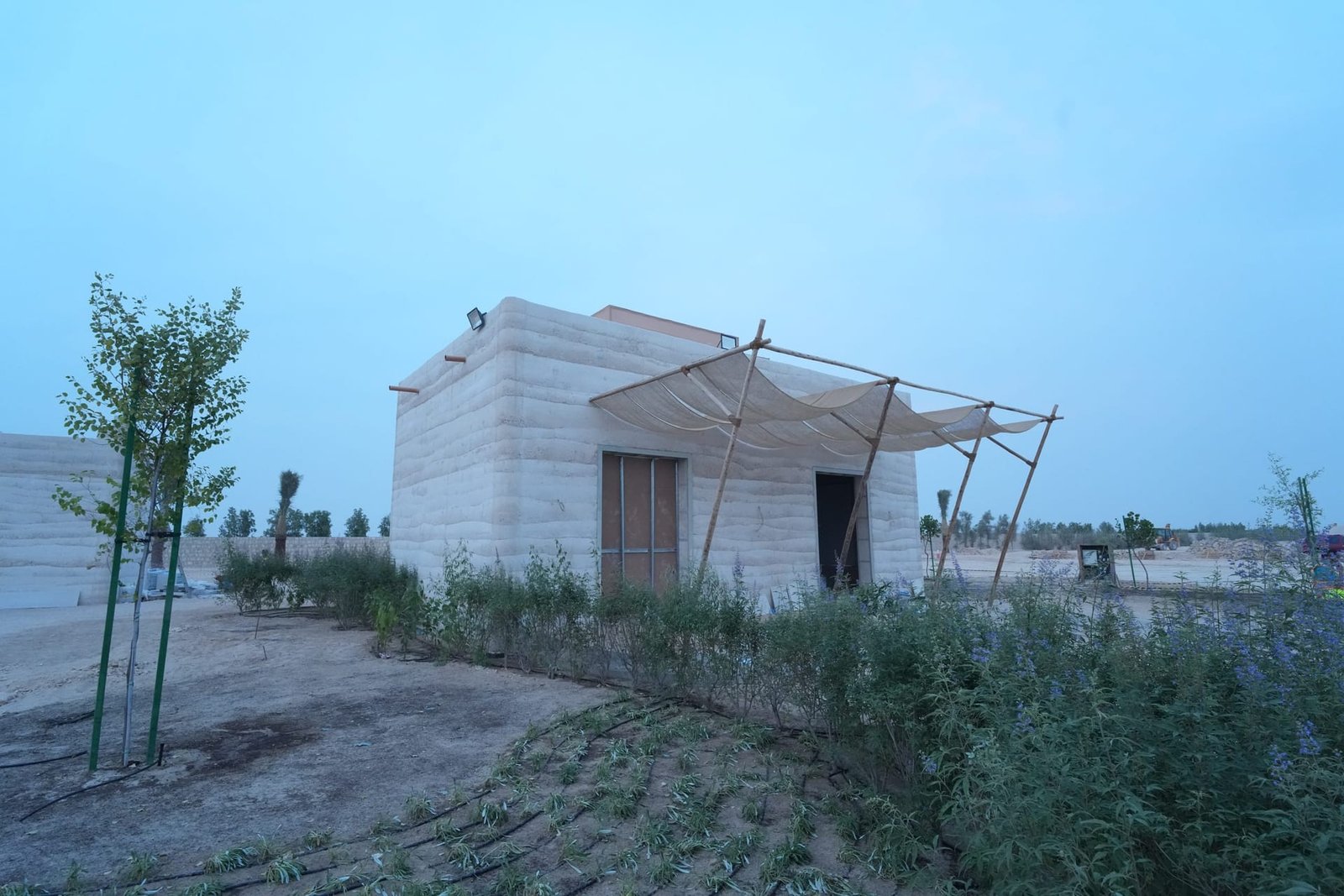
Rammed earth is a wall built by compacting damp subsoil in layers between temporary formwork until it becomes solid. Each compacted lift stays visible as a horizontal stratum. It is structural, mineral and load-bearing, used today for walls, facades and pavilions, including in-situ rammed earth across the UAE and wider Gulf.
What is rammed earth?
Rammed earth is a wall built out of earth rather than out of blocks or a wet pour. A graded mineral mix — gravel, sand, silt and a modest fraction of clay — is dampened, placed into formwork in shallow lifts and compacted until it is dense and solid. The clay acts as the binder, locking the coarser particles into a tight mineral matrix.
When the formwork is struck, the wall is finished. There is no render, no paint and no cladding over it. What you see is the compacted material itself, which is why the method appeals to architects who want a surface with genuine depth rather than a coating that imitates one.
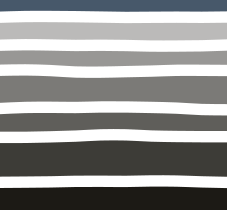
Because every lift is compacted separately, the finished wall carries a horizontal line at each layer. Those bands — the strata — are a record of how the wall was made, not a pattern applied afterwards. No two walls read exactly the same, and no two panels within a wall do either.
How is a rammed earth wall built on site?
The formwork comes first. It has to be engineered, set plumb and heavily braced, because compaction generates considerable outward pressure against the faces. Formwork design largely determines the panel sizes, the joint positions and the programme.
The mix is then batched to a consistent moisture content. Too dry and the material will not bind; too wet and it will not compact, it simply squeezes. Field checks on every batch are the difference between a wall that is uniform and one that is patchy.
Material is spread into the form in a shallow lift and compacted with pneumatic rammers, working the edges first and then the body of the lift. The sound of the rammer changes as the layer reaches density. Then the next lift goes in, and the process repeats up the height of the panel.
We build in-situ rammed earth with our own crews. The artisans who compact the wall are on our payroll rather than subcontracted, because consistency of compaction is a hands-and-judgement matter that does not travel well between teams.
What is rammed earth made of, and how strong is it?
The mix is entirely mineral: aggregate, sand, silt and clay, with water. There is no organic content. Colour comes from the earth itself and from any mineral oxide introduced, which means the palette is fixed at sample stage on the actual mix that will be used, not chosen from a chart.
Rammed earth can be built unstabilised, relying on the clay alone, or stabilised with a small proportion of cement to raise early water resistance and surface hardness. The choice is a project decision driven by exposure, detailing and the look you want.
Our acceptance testing is to 8 MPa, referencing New Zealand's earth building standards (NZS), which are widely used as written guidance for the material. Testing on the project mix matters more than any general figure, because rammed earth performance is a function of the specific soil and the compaction achieved.
Why is rammed earth used in the UAE and the Gulf?
The first reason is the surface. A rammed earth wall is mineral, matt and deep, and it changes through the day as the sun moves across the strata. Nothing sprayed or rolled behaves that way.
The second is mass. A thick earth wall is slow to respond to temperature, damping the daily swing rather than reacting to it. Mass is not the same as insulation, and a build-up still has to be designed as a whole, but in a hot climate the behaviour of a heavy wall is worth having. We look at this in more detail in our guide to rammed earth in hot climates.
The honest limits are worth stating too. Rammed earth is thick, so it takes floor area. It is formwork-driven, so it sets its own programme. And it is not something to introduce late in a project as a value-engineering swap; it needs to be in the design from the outset.
Where is rammed earth used today?
The method is being used at building scale in the region. The UAE Pavilion at Expo 2023 Doha was a complete in-situ rammed earth pavilion, built by our own crews, and took the Gold Award for Best Self-Built Pavilion.
At Al Kaaban Resort in Qatar, rammed earth was used across the guest buildings, the mosque and its minaret, and the boundary walls — a range that covers occupied interiors, a landmark form and long stretches of exposed external wall.
In the UAE, the applications we are asked about most often are entrance and boundary walls, villa feature walls, hospitality and cultural buildings, and landscape structures where a heavy mineral wall does more work than a rendered blockwork one.
Rammed earth wall or rammed earth finish?
These two are constantly confused, and they are not the same thing. A rammed earth wall is a structural element compacted on site between formwork. A rammed earth finish is a plaster applied to a wall that already exists.
The finish in question is a Clayworks clay plaster, applied at 7 to 10 mm, which produces the strata look on interior walls where the thickness, the structure or the programme for a true rammed earth wall is not available. It is an interior finish, and it is applied over prepared substrates. We are Clayworks' sole authorised distributor and approved applicator across the Middle East.
If you are weighing one against the other, our comparison of rammed earth against rammed earth plaster sets out where each is the right answer. It is also worth reading how the material compares with the default option in rammed earth vs concrete.
Talk to us about rammed earth in the UAE
Earth Layers Building Contracting LLC supplies and installs. We are the exclusive Middle East distributor for the materials we install, and the crews who build the walls are our own. That matters with rammed earth more than with almost any other finish, because the wall is made on site and cannot be corrected afterwards with a coating.
Samples are made on the project mix so you are approving the actual colour and grain, not an approximation. A site mock-up lets anyone see and touch the material at panel scale before a wall is committed - ask for one.
If you have a project in Dubai, Abu Dhabi or anywhere in the UAE, send the drawings and the exposure conditions through our enquiry page or message us on WhatsApp at +971 50 136 0506. We will tell you plainly whether rammed earth is the right call for the wall in question.