Lime plaster and Microtadelakt contribute evidence to an Abu Dhabi Estidama Pearl submittal without ever being certified by it. The Cemher Microtadelakt system we install is a mineral, lime-based finish trowelled at 1 to 3 mm: A+ for emissions into indoor air under UNE EN 16516:2018, Class A1 for reaction to fire, and Class 1 for vapour transmission. It is a wall, soffit and arch finish, sealed where the room takes water, and it is not a tanking layer.
In Abu Dhabi a wall finish is specified twice
Abu Dhabi settles what a building has to achieve before anyone picks a colour, and how the emirate's Pearl regime works, which categories a finish touches, and why a product contributes to a rating without ever holding one is set out in Estidama Pearl and your finishes schedule. What the regime means for lime is narrower and more practical than the scorecard suggests. A schedule line reading polished plaster, off-white is not a specification. It names an appearance and leaves a consultant with nothing to review, because none of the declared performance of a lime system belongs to a product name. It belongs to a build-up.
So write the build-up out. The clause should name the primer and its coverage, the levelling coat where the wall needs one, the grain of the finish coats, the sheen the panel was approved at, the sealer if the room takes water, and the substrate criteria the applicator will hold the main contractor to. Every figure a submittal later leans on, whether emissions, reaction to fire or vapour transmission, was measured on a defined system, and several published values are declared with no sealer in place. A clause naming the finish but not the sealer is a clause that cannot be evidenced. That correction costs five minutes at concept stage and a comment sheet at month nine.
The second specification is the physical one, and the two have to agree. What was tested has to be what is written down; what is written down has to be what the approved panel shows; and the panel has to be what the finished wall is checked against. Where those three drift apart, the drift arrives as a variation order or a returned submittal, and neither was necessary. On a Pearl-rated job the cost of that disagreement runs higher than usual, because the finishes schedule is not only a design document. It is evidence, and evidence that contradicts itself is worse than evidence that is merely thin.
The test classes behind Microtadelakt, and what each one covers
The system we install is Cemher Microtadelakt, a one-component hydraulic lime plaster with marble dust, trowelled in fine coats over a prepared base and worked wet-on-wet or wet-on-dry so that tadelakt, marmarino and polished plaster all come out of one material. Its declared record is European and testable. Emissions into indoor air are classified A+ under UNE EN 16516:2018, with chamber testing to UNI EN ISO 16000-6:2019. Reaction to fire is Class A1, and Class A1FL underfoot, under UNE EN 13501-1:2019. Vapour transmission sits at Class 1 to UNE EN ISO 7783-2:2012, the Sd value under 5 m. The four-grain range is declared to UNE-EN 13813.
A test class is narrower than it first looks, and saying so is what makes a submittal survive review. A1 describes how the material behaves in fire; it says nothing about durability or how the surface cleans. A+ describes what came off a tested product in a laboratory chamber under a defined protocol, not the air of a finished room, which also answers to furniture, adhesives, sealers and how well the space is ventilated. Class 1 for vapour transmission describes resistance to water vapour, not resistance to liquid water. Each line is strong evidence for the one question it addresses and weak evidence for anything else, and a consultant who has reviewed a few packages knows which is which.
Certificates come in kinds, from life-cycle declarations to health disclosures to emission test reports, and no one of them substitutes for the others, which is why how to read each one, including a lapsed one, is worked through in the Estidama documents guide. For lime the practical ask is short. Get the report that names the build-up rather than the range. Get the fire class of the system specified for that area rather than the best figure in the family. Ask which values were measured with a sealer on the panel and which were not. The register of what we hold, with issuing bodies and dates, is on the credentials page, and the documents sit in the specification library.
Vapour-open where it should be, sealed where the water lands
Lime hardens by carbonation, drawing carbon dioxide back out of the air over months rather than hours. Left unsealed there is no plastic film across the face of the wall, which is why the vapour class sits where it does. In an Abu Dhabi interior running mechanical cooling for most of the year that matters at the level of the whole build-up rather than the surface alone: a vapour-open finish lets a wall dry outwards instead of trapping moisture behind a coating, and it goes on doing that for as long as nobody paints over it. Rolling a conventional emulsion onto a lime wall is the commonest way that property gets thrown away in year three.
Wet rooms are a different specification, and the trade-off belongs in writing rather than in a discovery on site. The wet-room build-up is sealed, and the sealer has a gate in front of it: it cannot go on until 24 to 48 hours after the plaster has hardened, and not then unless a meter reads the surface under 5 per cent moisture. A sealed lime face takes direct water and cleaning better than a bare one. It is also less vapour-open than the same plaster left alone, and Cemher marks which of its published figures were obtained without sealer. Specify the sealed system where water actually lands, and leave the dry rooms next door unsealed instead of sealing a villa by default.
The honest boundary is worth stating plainly. A vapour-open mineral surface is a useful property in a humid coastal city; it is not ventilation, it is not an extract fan, and it is not a correctly detailed waterproofing layer. Where a room has a moisture source nobody has dealt with, the lime finish will not deal with it either. It will simply be the surface on which the problem becomes visible, and it will then be blamed for reporting what it did not cause. Lime and Microtadelakt are wall, soffit and arch finishes on our schedules; how the wider palette divides room by room is a separate question, set out across the materials range.
Arches, soffits and why a seamless coat suits curved work
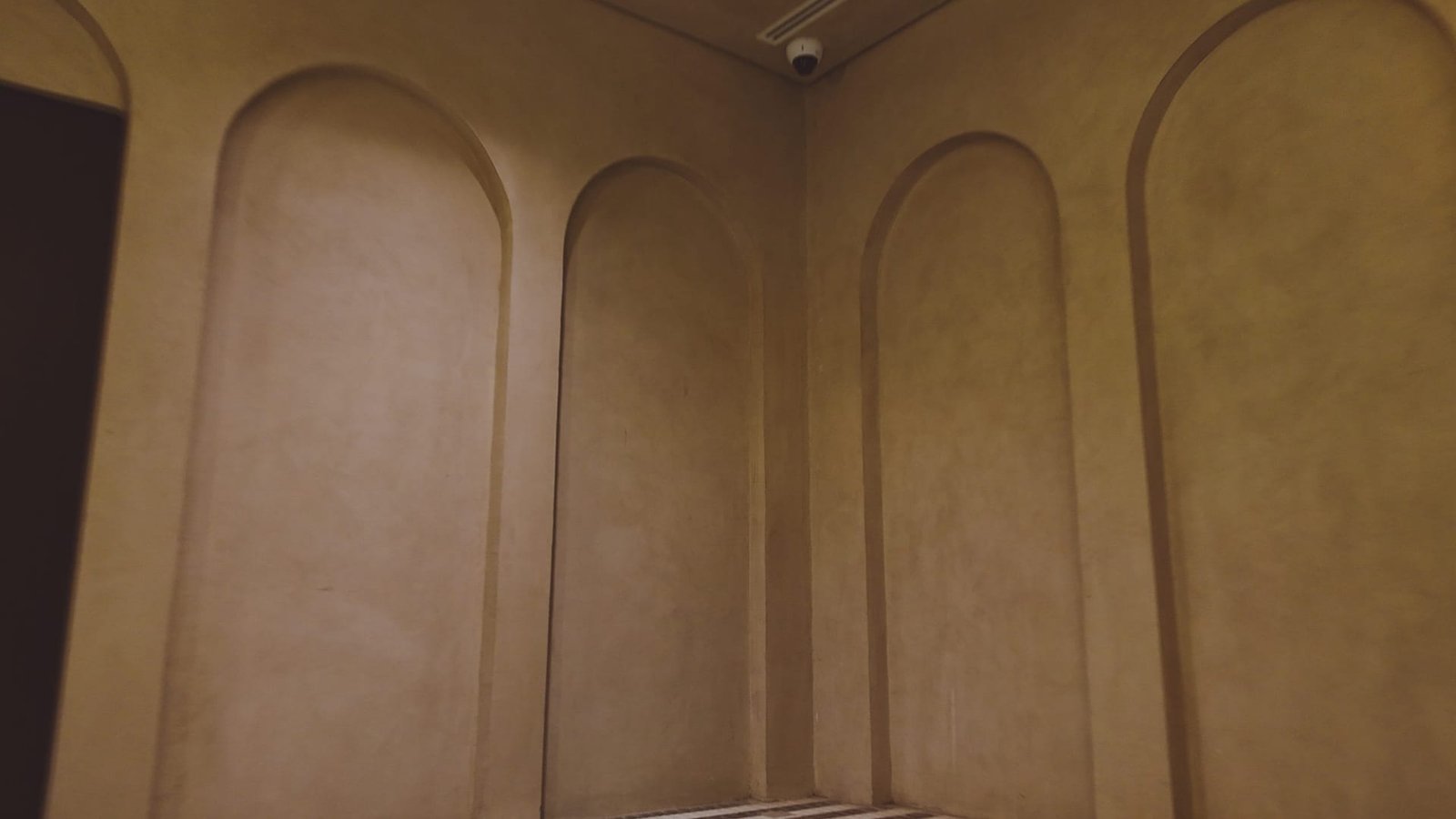
A mineral finish at 1 to 3 mm is trowelled onto the geometry that was built, so what the eye reads is the shape of the substrate rather than the shape of a panel system. There are no boards to set out, no beads marching around an intrados, no grout lines, and no joint to resolve where a curve meets a flat. Arch soffits, groin junctions, vaults, curved reveals and niches simply keep going. On hospitality and cultural work in Abu Dhabi, where an arched opening is often the whole architectural idea rather than a decorative gesture, that continuity is why the finish gets chosen, and it is why a jointed alternative always reads as a compromise.
A thin coat does not correct geometry, and no amount of trowelling will make an out-of-true arch look true. That is what the high-build member of the system is for: Microtadelakt Thick Base runs 5 to 15 mm and brings a soffit or a curved reveal into tolerance before any finish coat goes on, with continuous alkali-resistant fibreglass mesh set into the first coat wherever the build passes 10 mm and wherever the background changes material. The junction between a blockwork arch and a plasterboard soffit is exactly such a place. It is also the first line a value engineer reaches for, and the crack that arrives two summers later traces it precisely, because a two-millimetre skin cannot hold two different backgrounds together on its own.
Soffits are the least forgiving thing in a room to light. Grazing light from below picks out every trowel stop, so the area a crew can close before the edge sets governs how a ceiling is divided, not the drawing grid. Pot life is about three hours at 20 °C and shorter on a hot Abu Dhabi site, which is a genuine constraint on a large arched hall rather than a footnote in a data sheet. Where the same space also wants a seamless floor, that belongs to a different family and a different sealer, so send it to microcement rather than carrying lime down onto the slab, since a floor answers to abrasion and to how a patch repair looks after several summers of use.
Holding one crew and one approved panel across a large package
At scale the variable is not the powder, it is the hands. Sheen in this material is a product of technique: trowelled wet-on-wet the surface comes up glossy, trowelled wet-on-dry it settles flat and matt, and the difference reads from the far end of a corridor. Two crews using the same batch will produce two surfaces. That is why the trowel hands on our packages are on our own payroll and sponsorship, roughly 200 applicators rather than a team hired in per project, and why we resist splitting a single large area between crews even when the programme argues for it. Continuity of labour is not a staffing preference here. It is the mechanism by which a long corridor reads as one wall.
The area is then broken down against the wet edge rather than the drawing grid. A bay is as large as the crew can close while the leading edge is still live, and the break lines go where the architecture already stops: an arch springing, an internal corner, a change of plane, the reveal of an opening. They never go across the middle of a lit plane, where a stop sits in the open and cannot be explained away. Coat intervals of roughly four hours and a pot life of about three hours fix how much can honestly be closed in a shift, so bay sizes are worked backwards from those two numbers at method-statement stage rather than discovered in the third week.
One panel then governs the package. It is applied on the project, on the real substrate, under the light the finish will live in, kept on site until handover, and tied to the colour and batch record, so that a bay finished in the final week is checked against the same reference as the first bay. Our published Microtadelakt references sit outside the UAE and should be read as evidence of technique rather than local work: the Calligraphy Museum in Madinah carries the material through arched halls at cultural scale, and Afraa Boutique in Lusail is a retail interior where it was chosen for how it reads rather than for water. We have delivered lime work inside the emirate, and none of those projects are published under a building or client name; where we work in Abu Dhabi sets out the coverage.
The coastal question: salt, humidity and exteriors
Abu Dhabi is a coastal city on low ground, with salt-laden air off the Gulf and coastal soils carrying chlorides and sulfates. Salts travel in water and crystallise wherever that water leaves the wall. If the surface is a film that resists vapour, crystallisation happens behind it and the film lifts away in plates, taking the finish with it. A vapour-open mineral plaster lets the drying happen at the face instead, where efflorescence appears as a powder that can be brushed back rather than as a coating failure that has to be stripped and made good across a whole elevation.
That is a difference in behaviour, not a cure. Where salts are actively arriving from the ground or through a failed detail, the specification question is the source, whether that is the damp-proof course, the tanking or a junction that leaks, and no plaster in any family answers it. A lime finish applied over an untreated salt path will show the same efflorescence again, and re-plastering is not a repair. On exteriors, add sun, wind and shortened working windows to the same list, which is why exterior lime work is programmed around the hour of the day rather than around the drawing.
On water itself, be precise about what the data actually says. The Cemher record includes UNE EN 14891:2017 testing at 5 bar of direct pressure held for three days, with no penetration recorded, and liquid water permeability in Class II. Those are laboratory results on one defined build-up, not a licence to describe a finished wall as sealed against water. Tadelakt and Microtadelakt are finishes; the waterproofing is detailed behind them in the ordinary way, and the whole distinction is worked through in is tadelakt waterproof.
Programme: the intervals that will not compress
The sequence is fixed and it begins well before anyone is on site. A sample is agreed first; then a panel is applied on the project itself, on the substrate the finish will actually sit on, under the light it will actually be seen in. With lime that is not a courtesy step. Sheen is the property that moves most with technique, and no photograph carries it, so a wall approved from a screen has been judged on a camera's exposure rather than on a trowel's pressure. A sample board is the honest way to choose a direction, and we bring one to your office or to site. For an Abu Dhabi job the panel that governs is the one on your own wall.
Then the intervals, which a compressed handover date cannot argue with. Coats go on at roughly four-hour spacings with a light sanding between at 40 or 80 grit. Pot life is about three hours at 20 °C. The material is not applied below 10 °C, which is rarely this emirate's problem; heat and air movement closing the wet window early is. The sealer waits 24 to 48 hours after hardening, and then only if a meter reads the plaster under 5 per cent moisture. That meter reading is the figure that most often collides with a programme, and on an unconditioned shell in August it is the reason temporary cooling and dehumidification come before the sealing coat rather than after it.
Book lime late and give it a clear run: tanking complete, MEP first fix closed out, substrates true and dry, the room shut to following trades. Handing a finished lime surface over as a working corridor guarantees damage, and the making good is hand work booked into whatever float is left. Supply and application sit with one company on our projects, so the mix, the panel, the sealer and the wall are never argued across two contracts at handover. Send the finishes schedule, the wet-room details and the dates you are working to through the enquiry page, and we will come back with build-ups per area, the documents that support them, and a mock-up programme. WhatsApp: +971 50 136 0506.