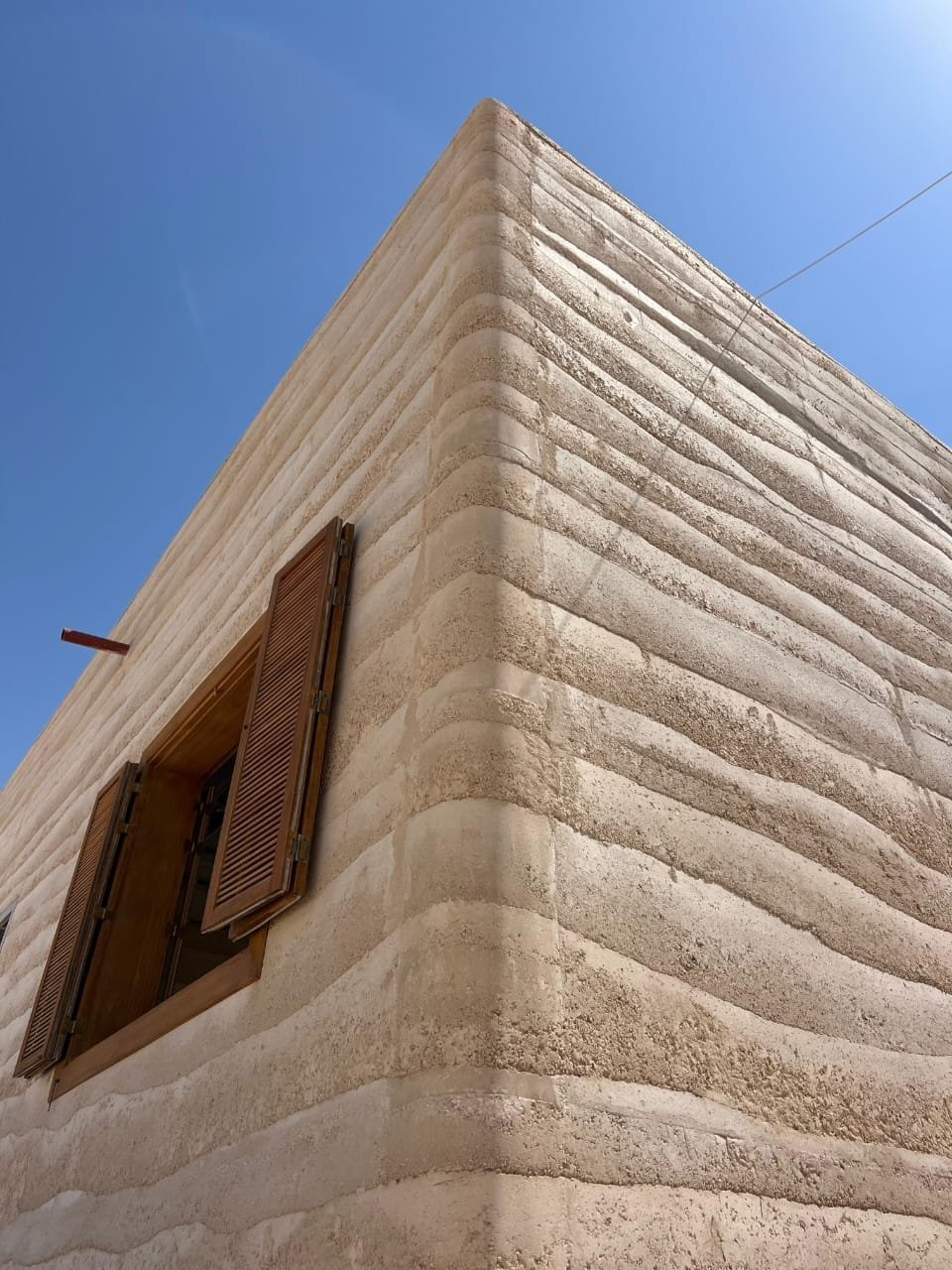
Yes. Rammed earth suits hot, dry climates: it is compacted damp rather than poured wet, so it gains strength as it dries, and heat speeds that up. The Gulf challenges are protecting fresh lifts from drying too fast, dust control, and sequencing formwork around site heat.
Does rammed earth work in a hot climate?
Yes, and the Gulf is closer to the material's natural home than a damp temperate climate is. Rammed earth is placed damp and compacted, not poured wet, and it gains strength as that moisture leaves. Warm, dry air helps that happen.
The long history of earth building across Arabia, North Africa and the Levant is not a coincidence. What changes on a modern Gulf project is the pace: heat that removes water in hours rather than days has to be managed rather than simply enjoyed.
So the honest answer is that the climate is an advantage on the drying side and a discipline on the detailing side. The rest of this article covers what that means for the mix, the curing, the site and the programme.
What the sun and dry air do to a fresh rammed earth wall
Earth is compacted at an optimum moisture content: damp enough to compact properly, dry enough not to slump. As the wall dries, the particles draw together and the wall stiffens and gains strength. That process is gradual, and it wants to be even.
Direct summer sun on a freshly struck face dries the outer few millimetres far faster than the body of the wall. The result can be a surface that dusts or crazes while the core is still losing water, with shrinkage that is not uniform through the thickness.
The controls are simple and unglamorous. Shade the working face. Strike formwork to a plan rather than as early as possible. Keep exposed faces covered through the hottest part of the day, and programme the heavy compaction for the cooler hours.
None of this is exotic. It is the instinct any experienced concrete or plaster crew already has in the Gulf, applied to a material that is more sensitive to it and more forgiving afterwards.
Dust, wind and the joint between lifts
The weak point in any rammed earth wall is the interface between one lift and the next. That bond is made by compaction, so anything sitting between the two layers weakens it, and in a desert environment that something is dust.
Formwork left open overnight collects a fine film. Wind-blown sand lands on a compacted lift face while the crew is loading the next batch. On our sites the lift face is cleaned before the next layer goes in, and open formwork is covered whenever it is not being filled.
Wind matters for colour as well as strength. Airborne sand settling into a green face can leave streaks that were never in the mix design, which is why screening around the working area is part of the site setup rather than an afterthought.
Does rammed earth need water curing like concrete?
Not in the same way. Concrete is hydraulic: it needs water present for cement hydration to continue, which is why slabs are ponded and covered. Unstabilised rammed earth is not setting chemically, it is drying, and adding water works against it.
Where a mix is cement-stabilised, some hydration is happening and holding moisture over the first days matters more. That is one of several reasons the stabilised decision is a project decision rather than a default, as set out in stabilised versus unstabilised rammed earth.
Either way the practical instruction on a Gulf site is the same. Protect from rapid drying, do not soak. Shade and cover beat hosing every time.
How does heat affect the programme?
Rammed earth is built on a cycle: erect formwork, place and compact lifts, strike, move on. Heat pushes on both ends of that cycle. Drying is quicker, which can shorten the wait before striking, but the usable working window in the day is shorter and crews have to be rotated.
We plan the heavy compaction for the cooler parts of the day and keep material covered so it reaches the formwork at the moisture content it was mixed at. Earth left open on a hot slab is not the same material an hour later.
Formwork logistics matter more than most programmes assume. Tall walls, corners, openings and stepped parapets all slow the cycle down, and a realistic rammed earth programme is set by formwork moves rather than by the earth itself.
For UAE-specific sequencing and what to expect on a Dubai site, see rammed earth in Dubai.
The payoff: thermal mass in a hot climate
The reason to accept the discipline is what the wall does afterwards. A thick earth wall stores heat and releases it slowly, so the peak of the afternoon arrives inside the building later and flattened rather than in step with the outside air.
In a climate with a large daily swing that delay converts into comfort and into load taken off the cooling system. It is a property of mass and thickness rather than of insulation, and the two do different jobs, as explained in rammed earth thermal performance.
It is also why an earth wall tends to feel cool to the hand in a Gulf summer. The surface temperature lags the air around it.
Testing, mixes and proving it on site
Earth is a local material, so every project starts with the earth available to it. Mix trials establish grading and moisture, sample panels establish colour and strata, and both are approved before production walls begin.
Our acceptance testing is to 8 MPa, referencing New Zealand's earth building standards, which are written specifically for earth construction. Testing on samples from the same mixes gives the design team a figure to hold us to rather than a description.
Long-term behaviour of finished walls in Gulf conditions is covered separately in maintaining rammed earth in the Gulf.
Building rammed earth in the UAE and the wider Gulf
We have done this at scale in the region. Our own crews built the complete in-situ rammed earth UAE Pavilion at Expo 2023 Doha, which took the Gold Award for Best Self-Built Pavilion, and at Al Kaaban Resort in Qatar we delivered guest buildings, a mosque and minaret, and boundary walls.
Earth Layers supplies and installs. The artisans who compact the walls are on our own payroll rather than subcontracted, which is why the detailing discipline described above happens on site rather than only in a method statement.
If you are weighing rammed earth for a project in the UAE, Saudi Arabia or Qatar, send us the drawings and the programme and we will tell you plainly what the climate gives you and what it costs you in sequencing. Start at enquire, or message the UAE office on WhatsApp at +971 50 136 0506. Wellness, in Every Surface.