
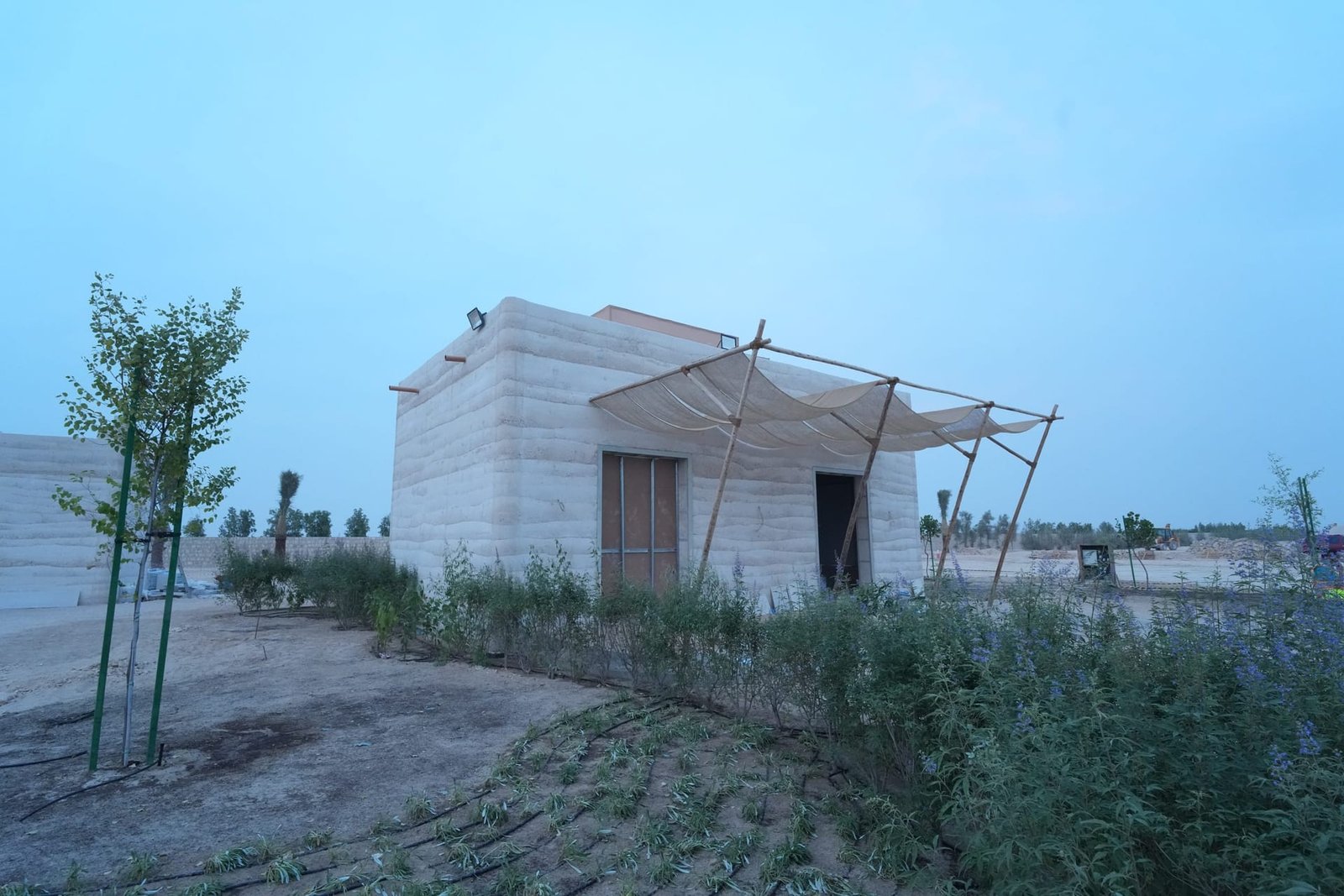
Rammed earth has high thermal mass, not high insulation value. A thick earth wall stores heat and releases it hours later, flattening peaks and shifting cooling loads out of the afternoon. Where a U-value must be met in the UAE, insulated double-skin rammed earth places insulation between two rammed leaves.
What does thermal mass do in a rammed earth wall?
Thermal mass is the capacity of a material to absorb, store and release heat. Rammed earth has a great deal of it: the walls are dense, thick and built solid, so a large quantity of material sits between the outside air and the room.
Heat arriving at the outer face does not pass straight through. It is absorbed into the wall and moves inward slowly, so the interior surface warms long after the exterior surface has peaked. The wall behaves like a flywheel, resisting sudden change in either direction.
The practical result indoors is stability. Interior surface temperatures move within a narrower band than the air outside, radiant conditions are more even, and the room feels calmer than a lightweight enclosure of the same U-value. Rammed earth delivers that without any applied layer, because the mass is the wall.
Is thermal mass the same as insulation?
No, and conflating the two is a common error in specifying earth walls. Insulation resists the flow of heat. Mass delays and dampens it. A material can be strong at one and ordinary at the other, and rammed earth is exactly that case.
In steady-state terms, which is what a U-value calculation assumes, a solid earth wall is a moderate performer. Its thermal conductivity sits closer to concrete than to a mineral wool board, so on paper a single-skin earth wall does not compete with an insulated cavity build-up.
Real walls, however, do not sit in steady state. Outdoor temperature and solar gain swing on a daily cycle, and mass works on exactly that cycle. That is why measured behaviour and calculated U-value can tell noticeably different stories about the same wall, and why it is honest to describe rammed earth as a mass strategy rather than an insulation strategy.
Time lag and decrement factor explained
Two terms describe what mass actually does. Time lag is the delay between peak heat at the outside face and peak heat at the inside face. Decrement factor describes how much the swing is flattened on its way through.
In a wall of typical rammed earth thickness the lag is measured in hours, and it lengthens as the wall gets thicker. The peak that strikes a west elevation in the afternoon reaches the room in the evening, reduced in amplitude. Wall thickness is therefore a thermal decision as well as a structural one.
That shift matters in a building whose cooling plant is sized on peak load, and it matters for comfort in a building that is not mechanically cooled all day. It matters less in a space held at a fixed setpoint around the clock, where the wall is simply one element in a continuous heat flow.
Does rammed earth reduce cooling loads in the UAE?
It reduces peak cooling load and it shifts when that load arrives. Whether it reduces total annual cooling energy depends on the building and how it is operated, and it is fairer to say that than to promise a number.
Mass pays back where there is a daily temperature swing to work with, and where the building can be flushed with cooler night air. Gulf shoulder seasons offer both. High summer offers much less: night temperatures stay elevated, and coastal humidity in Dubai and Abu Dhabi limits how useful a night purge can be.
Even in high summer, mass still does two useful things. It holds the internal surface temperature of the wall well below the external surface temperature, which reduces radiant discomfort near the facade, and it moves the peak away from the hottest part of the afternoon. Those are genuine benefits, but they are comfort and peak-load benefits rather than a substitute for insulation. Rammed earth in a hot climate follows how the walls behave through the year.
Insulated (double-skin) rammed earth and U-values
Where a project has a U-value target to meet, single-skin rammed earth is often not the way to meet it. The established answer is insulated rammed earth: two rammed leaves built either side of a continuous insulation layer, compacted in the same operation, tied together and read as one wall.
The build-up shows rammed earth on both faces, keeps mass on the internal side where it counts for comfort, and puts thermal resistance where a calculation can see it. The wall is thicker overall, and the formwork and ties are more involved, which shows up in programme.
The choice is a project decision rather than a doctrine. Boundary walls, landscape walls, screens, feature elements and unconditioned buildings are usually built solid. Conditioned envelopes with a performance target are where the double-skin build-up earns its complexity.
This is a conversation worth having before the wall zone is fixed on the drawings, because an insulated build-up needs its thickness allocated early rather than found later.
Does an interior rammed earth finish give the same thermal benefit?
No. Clayworks Rammed Earth Finish is a 7-10 mm clay plaster that gives the strata reading on an interior wall. At that thickness it contributes essentially nothing to thermal mass, and it is not offered as doing so.
What it does contribute is surface and moisture behaviour: the appearance of an earth wall on a substrate that could never carry one, and clay's hygroscopic action, which helps hold a room between 40 and 60% relative humidity with nothing to off-gas. In an air-conditioned interior that is a comfort benefit worth having, but it belongs to moisture rather than to heat. The difference between the wall and the finish is worth setting out clearly in any specification.
Designing with rammed earth thermal mass on a UAE project
Mass rewards the decisions made around it. Shade the wall and it starts each day cooler. Orient the heaviest walls towards the harshest exposure. Leave the internal face exposed rather than lining it, because a covered mass wall is doing half its job. Control the glazing and shading that would otherwise throw gain into the room the wall is trying to steady.
We supply and install, with our own artisans on payroll rather than subcontracted crews. The complete in-situ rammed earth UAE Pavilion at Expo 2023 Doha was built by those crews, and we work the same way on villa, hospitality and cultural projects across the UAE.
If you have a wall zone, an exposure and a performance target, send them through and we will tell you whether solid or insulated rammed earth is the sensible answer. Start an enquiry or message us on WhatsApp +971 50 136 0506.