A rammed earth feature wall can be built two ways: a solid in-situ wall compacted in lifts on site, or Rammed Earth Finish, a 7-10 mm Clayworks clay plaster that reproduces the strata on an existing wall. Solid suits ground floors and new build; plaster suits fit-outs.
What is a rammed earth feature wall?
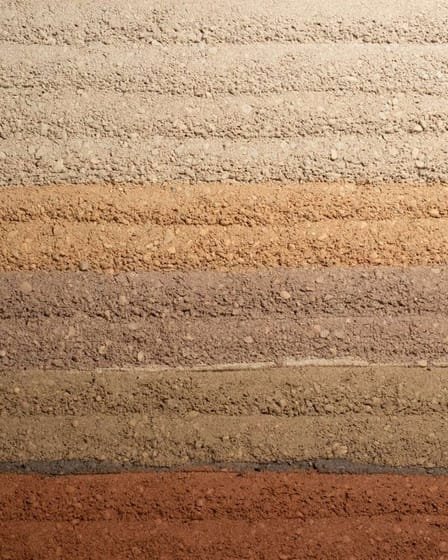
A rammed earth feature wall is a wall whose surface is the earth itself. Damp earth is compacted in horizontal lifts, and each lift leaves a line, so the finished face reads as strata. Nothing is painted or applied on top; the colour, the grain and the shadow are the material.
There are two honest ways to get that look inside a building. The first is a solid in-situ wall, compacted between formwork on site exactly as we build rammed earth externally. The second is Rammed Earth Finish, a clay plaster applied 7-10 mm thick that builds the same banding onto a wall that already exists.
Both are earth, and up close both behave like earth. They differ in weight, thickness, programme and what the wall can do structurally, and that difference is what decides which one belongs in your project.
Solid rammed earth or Rammed Earth Finish plaster?
A solid interior rammed earth wall is a piece of construction. It is set out on the drawings, it needs support beneath it, formwork is erected around its full height, and the wall is built where it stands. Once the formwork is struck, the wall is finished; there is no second trade.
Rammed Earth Finish is a finishing trade. At 7-10 mm it adds almost nothing to wall thickness and next to nothing to the loading, and it can go onto plasterboard, blockwork or render, including curves and returns that no formwork would reach economically.
The trade-off is straightforward. A solid wall gives you real depth at reveals and openings, thermal mass, and edges that are unmistakably earth. The plaster gives you the strata reading and the tactile surface, but the wall behind it is still an ordinary wall. We set the two side by side in rammed earth versus rammed earth plaster.
Where does a solid interior rammed earth wall belong?
Solid interior walls make most sense at ground level, on a slab or foundation that can carry them, and while the design is still on paper. Lobbies, double-height entrance halls, stair cores, prayer spaces and villa living rooms are the usual candidates.
You also need room to work. Formwork has to be erected, filled and struck, which means access, height clearance and a sequence agreed with the main contractor before the building closes in. Retro-fitting a solid earth wall into a finished interior is rarely worth the disruption.
Where the wall is doing more than looking good, the mass earns its place. An internal earth wall absorbs and releases heat slowly, which steadies a room that swings between shaded and sunlit; the mechanism is set out in our note on rammed earth thermal performance.
At Al Kaaban Resort in Qatar our own crews built guest buildings, a mosque and minaret, and boundary walls in in-situ rammed earth, so interior and exterior faces belong to the same wall rather than to two separate specifications.
Where Rammed Earth Finish plaster belongs
Most interior work in Dubai and Abu Dhabi is fit-out, and Rammed Earth Finish exists for exactly that situation. An apartment feature wall, a headboard wall, a reception backdrop, a restaurant banquette wall, a column or a curved bulkhead: all substrates that already exist and cannot be replaced with a metre of compacted earth.
Because it is a clay plaster, it follows clay plaster rules. Interior walls and ceilings only. Never floors, and never direct-water zones such as shower enclosures or the splash area around a basin, which belong to lime and tadelakt.
It is also the sensible route above ground floor level, in occupied buildings, and anywhere the programme cannot absorb formwork. The finish arrives late in the fit-out, like any other plaster, and the strata are built up by hand.
How do you light a rammed earth feature wall?
Light it from a shallow angle. Strata are horizontal ridges and recesses a few millimetres deep, and they only exist visually when something casts a shadow across them. Flat frontal light from the middle of the room will erase the texture you paid for.
In practice that means grazing: linear fittings or spots set close to the wall face, washing down from a slot or cove at the head, or up from a floor recess. The nearer the source is to the wall, the harder the shadow and the more pronounced the banding.
Keep the colour temperature warm and consistent. Earth colours sit in the ochre, sand and terracotta range and cool white light drains them, while mixing sources of different colour temperature on one wall shows up badly on a surface with this much relief.
Daylight does the same job for free. An accent wall opposite a tall window changes hour by hour as the sun moves, which is why the material photographs so differently morning and evening.
How much strata do you get, and can you choose the colour?
Yes to both, within limits. In solid work, banding is a function of lift depth and the earth mixes chosen for each layer, so a wall can read as tight and quiet or as broad and geological. In Rammed Earth Finish the applicator builds the layers by hand, and the palette runs from cream through sand and ochre to terracotta.
What you cannot have is a repeat. Earth is a natural material applied by people, so two panels will be siblings rather than clones. That is the point of the finish, and it is also why sample panels matter more here than on a painted wall.
We make samples for approval before any wall is committed, and a mock-up of either the solid material or the plaster can be applied on your own site - ask for one. Rammed Earth Finish is part of the Clayworks range, and Earth Layers is Clayworks' sole authorised distributor and approved applicator across the Middle East.
What is an earth wall like to live with?
Clay is hygroscopic: it takes up moisture from the air when a room is humid and gives it back when the air dries. In a home running air conditioning for much of the year, a clay-plastered wall helps hold the room between roughly 40 and 60% relative humidity, which is a comfortable band to sit in.
There is nothing in it to off-gas. The colour is mineral pigment through the material rather than a film on top, so a knock exposes more of the same tone instead of a different one underneath.
Both solid rammed earth and Rammed Earth Finish are dry-dusted or soft-brushed rather than washed, and both can be locally repaired by the same trade that installed them. Maintaining rammed earth in the Gulf covers the routine in more detail.
Specifying a rammed earth accent wall in Dubai
Decide early which of the two you are actually asking for. If the wall is at ground level, in a project not yet built, and can be supported, a solid wall is on the table. If it is a fit-out, above ground, or on a curve, Rammed Earth Finish will get you there without fighting the programme.
Earth Layers supplies and installs both. The artisans who compact the walls and apply the plaster are on our own payroll rather than subcontracted, which is how the same crew that built a complete in-situ pavilion also finishes a single apartment wall.
Send us the elevation, the substrate and the lighting layout and we will tell you which route suits. Start on the enquire page, or message the UAE office on WhatsApp at +971 50 136 0506. Wellness, in Every Surface.