
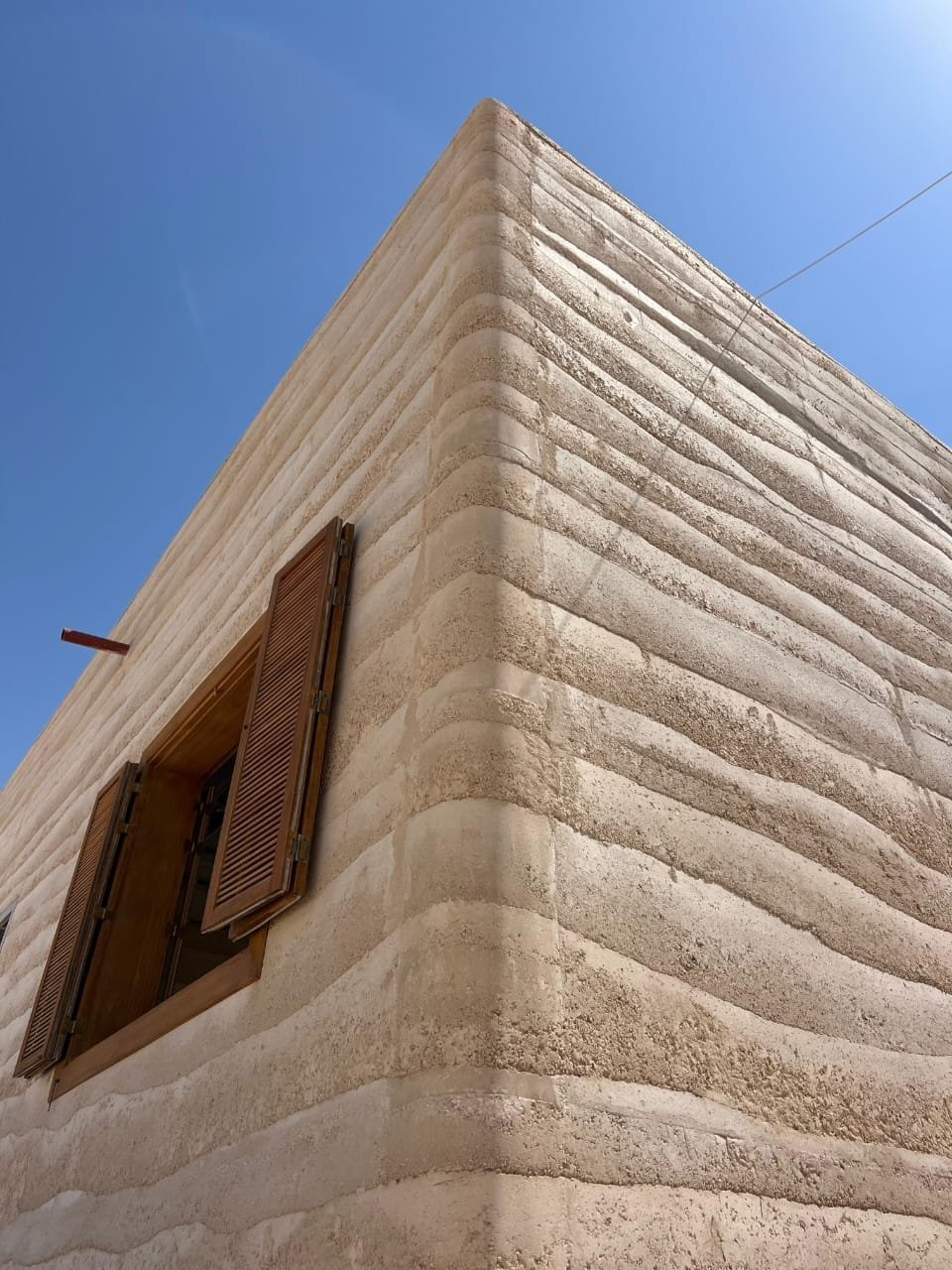
Rammed earth and concrete are both monolithic mineral walls formed against formwork, but the binder differs: concrete relies on cement, rammed earth mainly on the clay in its own soil. Rammed earth is thicker, needs no paint or render and shows tamped strata; concrete is faster, thinner and usually coated.
Rammed earth vs concrete: what is actually different?
Both materials are placed against formwork and end up as a monolithic mineral wall, which is why they get compared in the first place. The difference is what holds the wall together. Concrete is cast wet and gains strength through cement hydration. Rammed earth is placed damp and compacted, gaining strength from density and from clay binding the mineral skeleton.
That one difference propagates through everything else: how the wall looks, how thick it has to be, how fast it goes up, how it is repaired and what its environmental profile is. If you want the fundamentals of the method first, start with what rammed earth is.
The line is not absolute. Rammed earth can be stabilised with a small proportion of cement to raise early water resistance and surface hardness, which places stabilised mixes somewhere between the two. Unstabilised rammed earth relies on clay and compaction alone.
How do rammed earth and concrete compare on appearance?
A concrete face is a negative of its formwork. Board marks, tie holes, pour lines and joints are all the mould talking, and colour comes from the cement, the aggregate and any pigment. Fair-faced concrete is achievable but unforgiving: the formwork has to be near-perfect, and a defect is visible for the life of the wall.
A rammed earth face comes from the material and the act of compaction. You get horizontal strata, visible grain, and gentle colour drift between batches. The material is tolerant of variation because variation is the aesthetic — the wall is meant to look made, not moulded.
The practical consequence is what happens afterwards. Concrete is frequently sealed, coated or painted, whether for protection or to hide patch repairs, and that starts a maintenance cycle. A rammed earth wall is normally left exactly as it comes out of the formwork.
| Aspect | Rammed earth | Concrete |
|---|---|---|
| Binder | Clay in the soil, sometimes a little cement | Cement |
| Surface | Tamped strata, mineral, left as built | Board marks and tie holes, often coated |
| Colour | From the earth and mineral oxides | From cement, aggregate or pigment |
| Section | Thick; mass comes from thickness | Thinner for the same structural job |
| Finishing trades | None; the wall is the finish | Often render, paint or protective coating |
| Repair | Patched in matching earth, weathers in | Patches rarely match; usually painted over |
Mass, thickness and thermal behaviour
Both are heavy materials with useful thermal mass, but they arrive at it differently. Concrete reaches its structural job in a relatively thin section, so a concrete wall gives less mass per running metre unless it is deliberately thickened. Rammed earth has lower compressive strength, so it is built thick — and that thickness is precisely what delivers the mass.
In a hot climate a heavy wall shifts and damps the daily temperature swing rather than blocking heat outright. Mass is not insulation, and the build-up still has to be designed as a whole, with the wall assessed alongside glazing, orientation and shading. Our note on rammed earth thermal performance goes into how that behaves in practice.
The design implication is straightforward: rammed earth takes floor area. On a tight urban plot in Dubai that is a real cost, and it needs to be understood at concept stage rather than discovered at coordination.
Which is easier to build?
Concrete wins on supply chain, and it is not close. Ready-mix is available everywhere in the UAE, formwork systems are standard, the trades are familiar and the quality control regime is thoroughly understood by every consultant on the job.
Rammed earth demands more. Formwork has to resist compaction pressure rather than fluid pressure. The mix has to be batched to a consistent moisture content. The compaction itself is skilled work, done lift by lift, and the result depends directly on the crew. That is why the artisans who build our walls are on our own payroll rather than subcontracted.
Rammed earth does remove downstream trades, and that is often overlooked in programme comparisons. There is no render, no skim, no paint, no repaint cycle. The wall is complete when the formwork comes off.
At Al Kaaban Resort in Qatar the method was carried across guest buildings, the mosque and minaret, and long runs of boundary wall, which is about as broad a test of buildability as the material gets.
Environmental profile: where the real difference sits
The honest comparison is a comparison of binders. Cement is the carbon-intensive component of concrete, and the more of it a wall contains, the heavier its footprint. Unstabilised rammed earth binds with the clay already present in the soil, so the binder-related burden is substantially lower. Stabilised mixes sit between the two, in proportion to the cement they carry.
There is a second, quieter difference. A rammed earth wall carries no coatings, primers or paints, so there is nothing applied to the surface to off-gas or to be renewed on a cycle. At end of life, unstabilised earth is inert mineral material.
Natural finishes of this kind contribute to WELL, LEED and Mostadam scorecards. They are not certified in themselves, and any credit belongs to the assessed building rather than to a product.
How each material ages and repairs
Concrete ages by carbonating, staining and — where reinforcement corrodes, which is a live concern near the Gulf coast — spalling. Patch repairs almost never colour-match, which is one reason so much concrete ends up painted. Once painted, it stays painted.
Rammed earth ages by weathering rather than failing. Exposed faces lose a little fine material over time, the strata become more legible, and the wall gains patina. Repairs made in matching earth blend into the surface as they weather, instead of announcing themselves.
Lifespan in both cases is decided by detailing far more than by the material. For rammed earth specifically, that means water at the top and the base of the wall, which we cover in how long rammed earth walls last.
So which should you specify?
On most projects it is not either/or. Concrete does the slabs, cores and frame; rammed earth does the walls that are seen and touched. A very common arrangement in the UAE is a concrete structure behind, with rammed earth boundary walls, entrance walls and facade elements in front of it.
Specify rammed earth where you want the material to be the finish, where you can give the wall its thickness, and where the programme can accommodate formwork-driven construction. Specify concrete where speed, span, thin section or heavy structural demand govern the design.
We supply and install in-situ rammed earth with our own crews, with acceptance testing to 8 MPa referencing New Zealand's earth building standards. Send us the elevations and the exposure conditions through our enquiry page, or message us on WhatsApp at +971 50 136 0506, and we will tell you honestly which of the two the wall should be.