
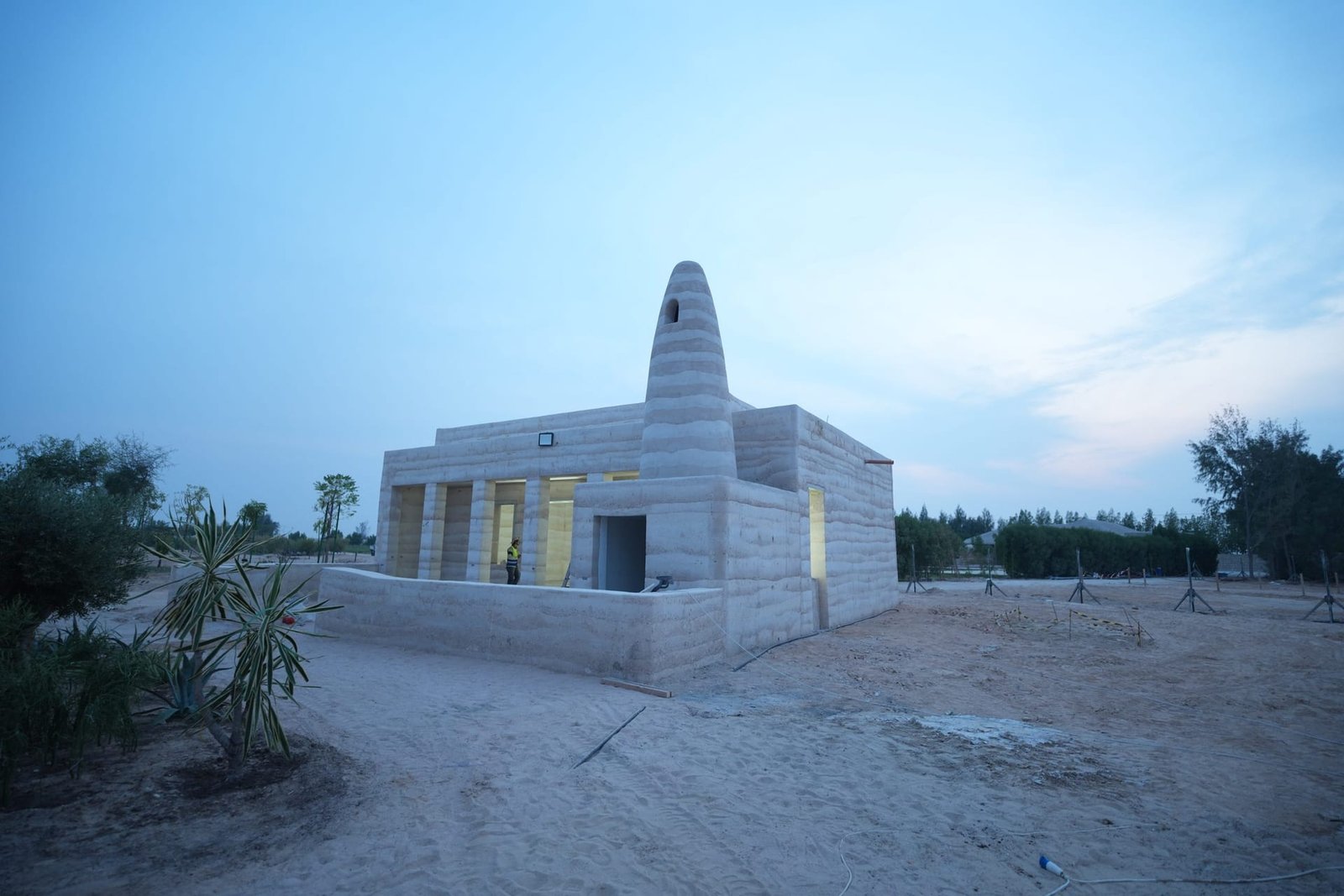
Rammed earth's advantages are thermal mass, acoustic mass, durability, low-toxicity materials and a finish that is the structure. Its disadvantages are low insulation value on its own, thick walls that consume floor area, a slow formwork-led programme, exposure detailing demands, and colour variation that must be accepted.
What are the main advantages of rammed earth?
The first advantage is that the structure is the finish. A rammed earth wall arrives complete: no plaster, no paint, no cladding, no decorating trade behind it and no repainting cycle in front of it. One element does the work that three or four normally do.
The second is mass. Dense walls store and release heat slowly, flattening internal temperature swings and shifting peak cooling load away from the afternoon, and the same mass gives useful acoustic separation between spaces. Rammed earth thermal performance covers what that does and does not achieve in a Gulf climate.
The third is material honesty. The mix is mineral: graded aggregates, fines and a stabiliser. There is nothing to off-gas from the wall itself, and natural finishes of this kind contribute to WELL, LEED and Mostadam scorecards where a project is pursuing them.
The fourth is that it ages well. Earth walls weather rather than fail. Surfaces soften, colour deepens slightly, and the result reads as patina. A painted wall in the same position looks tired long before an earth wall does.
What are the disadvantages of rammed earth?
It is not an insulator. Mass and insulation are different properties, and a solid earth wall is a moderate performer in steady-state terms. Where a U-value has to be met, an insulated double-skin build-up is needed, which adds thickness and complexity.
It is thick. Structural rammed earth takes a substantial wall zone, and on a tight urban plot that floor area is not free. The cost of the material is sometimes paid in square metres rather than in the tender.
It is formwork-led and therefore slower than blockwork. Programme is set by how quickly panels can be formed, filled, compacted and struck, and by the sequence in which formwork can move around the building. It is not a trade that can be accelerated indefinitely by adding labour.
It varies. Colour and texture shift between batches and between panels, because the material is mineral and mixed on site. Sample panels set the expectation, and a client who wants uniformity in the way a painted wall is uniform will not be satisfied.
It is unforgiving of poor detailing. Without a cap, a plinth and drainage that moves water away from the base, an earth wall will show you the mistake, as set out in is rammed earth waterproof.
| Factor | Advantage | Trade-off |
|---|---|---|
| Thermal | High mass, shifts peak cooling load | Low insulation value on its own |
| Finish | Structure is the finish, no paint | Colour and texture vary between panels |
| Space | Solid, dense, durable wall | Thick walls consume internal floor area |
| Programme | One trade builds and finishes | Formwork-led, slower than blockwork |
| Repairs | Local hand patching is possible | Patches rarely disappear completely |
| Water | Sheds rain when capped and drained | Not for showers or direct-water zones |
Is rammed earth expensive?
It is not a budget wall, and pretending otherwise helps nobody. The cost sits in formwork, skilled labour and time on site rather than in exotic materials, so the fair comparison is against a finished wall, meaning structure plus render plus paint plus their maintenance, not against bare blockwork.
The comparison also depends on how much of the building uses it. A single feature wall carries the whole formwork setup across a small area, while a full facade spreads the same setup much further. What rammed earth costs in the UAE sets out what drives the figure without pretending there is a single rate.
When is rammed earth the wrong choice?
Direct-water zones. Shower enclosures, the area around a basin and anything permanently wet belong to lime plaster and tadelakt, which are built for those conditions.
Projects with no tolerance for variation. If the specification demands a uniform, repeatable, colour-matched surface across large areas, a site-mixed mineral wall is the wrong instrument.
Very tight programmes and very tight plots, where neither the weeks nor the wall thickness exist to be spent.
Retrofit into an existing structure that cannot carry the load. Rammed earth is heavy, and a wall that cannot be founded properly should not be built.
In several of those cases the answer is not to abandon the look, but to change the method.
Rammed earth or rammed earth finish plaster?
Clayworks Rammed Earth Finish is a clay plaster applied at 7-10 mm that produces the strata reading on an interior wall. It is a different product with a different job: a finish rather than a structure.
It goes onto existing substrates, adds negligible weight and thickness, and can be installed in a fitted-out interior where in-situ ramming would be impossible. It also brings clay's hygroscopic behaviour, helping hold a room between 40 and 60% relative humidity, with nothing to off-gas.
What it does not give you is mass, acoustic separation or an exterior wall, and like all clay plaster it is for walls and ceilings only, never floors and never direct-water zones. The full comparison is worth reading before either goes into a specification.
What rammed earth demands from the design team
Early involvement. Wall zones, foundations, cap details, plinths, service routes and openings all need to be settled before the formwork is designed, and retrofitting those decisions into a drawn scheme is expensive.
Sample panels. Mix, colour, lift height and any surface treatment should be agreed on a built panel rather than a photograph, and that panel then becomes the acceptance benchmark on site.
Realistic tolerances. Rammed earth is built to earth-building tolerances, not precast tolerances, and the specification should say so plainly rather than leave it to be argued at handover.
A defined structural basis. Our acceptance testing is to 8 MPa, referencing New Zealand's earth building standards (NZS), which gives engineers and approving parties a stated reference to work from.
Is rammed earth right for your project?
The material suits landscape and boundary walls, hospitality and cultural buildings, villas with a design language that carries it, and any project where a wall is meant to be seen and touched rather than painted. It suits wet zones, uniform-finish specifications and airless programmes far less.
We supply and install, with our own artisans on payroll rather than subcontracted crews. At Al Kaaban Resort in Qatar those crews built guest buildings, a mosque and minaret and boundary walls in in-situ rammed earth.
Send drawings, a mood board or a rough description and we will give you an honest read on whether the material fits the project, or whether an interior finish would serve it better. Start an enquiry or message us on WhatsApp +971 50 136 0506.